We often believe we’re arguing about politics.
Immigration. Religion. Taxes. Education. Free speech. Healthcare.
Sometimes we are.
More often, I think we’re having a much deeper conversation without realizing it.
We’re asking whether our value systems still overlap.
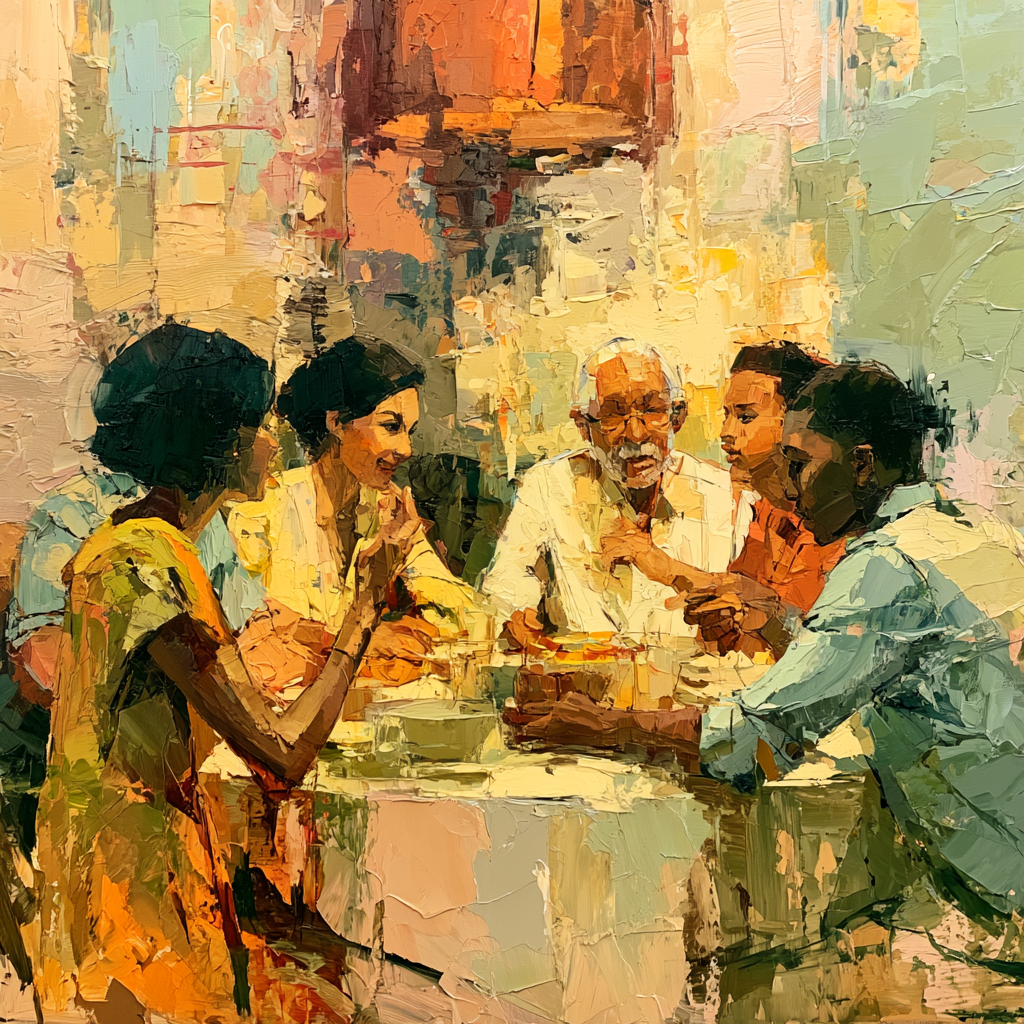
As a therapist, I notice this most often inside families. Parents and adult children stop speaking. Siblings become strangers. Old friends drift apart without ever naming why. Couples begin to wonder whether they were ever really compatible at all.
On the surface, they are debating a policy.
Underneath, they are asking something far more personal:
Can I still trust the operating system we built together?
Culture as an Operating System
I find it useful to think about culture as an operating system.
Every culture develops its own customs, traditions, rituals, expectations, rules, and values – the shared code that lets people cooperate. And those systems offer more than organization. They offer predictability. Meaning. Identity. They lower uncertainty and provide a kind of existential congruence, a felt sense that what we are doing together is coherent and worthwhile.
From an evolutionary standpoint, this makes sense.
Humans are social mammals. Like most social species, we survived by coordinating with one another, and shared expectations are what make coordination possible. Cooperation improved our odds. Culture was one of the tools that made cooperation dependable.
So wanting a coherent culture is not, in itself, pathological.
It is deeply, unavoidably human.
The paradox arrives when we forget why the operating system exists in the first place.
A healthy culture needs enough stability to preserve the values that make cooperation possible.
It also needs enough flexibility to bend when reality shifts beneath it.
Those two needs live in permanent tension.
Too little structure, and a culture begins to fragment.
Too much rigidity, and it turns obdurate – unable to answer the double bind that arrives the moment reality stops matching the rules.
The Paradox of Protection
Here is where it turns strange.
The very organizations we build to protect our cultures often become the thing that endangers them.
Political parties.
Religious institutions.
Social movements.
Ideological communities.
Most begin as instruments – ways of guarding something shared. We take an abstraction, a common way of seeing the world, and we materialize it into something we can name and defend.
And then, slowly, the name takes over.
The organization itself becomes the object of loyalty. The symbol replaces the purpose. Instead of asking, “Does this still reflect our values?” we begin asking, “Is this what my group believes?”
Once our identity fuses with the organization, curiosity starts to feel dangerous.
Changing our minds no longer feels like learning.
It feels like betrayal.
When Flexibility Becomes Dogma
There is a deeper irony still.
If you asked most healthy cultures to name their core values, many would include cognitive flexibility – the willingness to learn, to adapt, to revise our understanding when new evidence arrives, to stay compassionate when the context changes.
And yet the moment those values get dogmatized, they tend to lose the very flexibility they were meant to protect.
There is something almost self-defeating in it. It is difficult to be dogmatically open-minded. It is hard to stay genuinely flexible when your identity depends on never questioning the group. A culture that turns “stay curious” into a commandment has, without noticing, already stopped being curious.
Culture Is Not Race
This is where many of our conversations about culture become needlessly confused.
We tend to collapse race, nationality, religion, politics, and values into a single category.
They are not the same thing.
Culture and race are different variables. Shared values can exist across wildly different backgrounds. Two people who look nothing alike may run nearly identical operating systems. And two people who look almost the same may be running systems with very little in common – the distance, say, between a devout Mormon and a secular universalist, both of whom might check the same box on a form.
Our mammalian brains do not always register that distinction.
Like most social animals, we are exquisitely alert to the line between our group and another. Wolves do it. Chimpanzees do it. Much of it comes down to boundaries that, on closer inspection, are largely imagined – this troop, that troop; this side of the river, that side. The instinct is ancient, and it is real. It explains a great deal about our reactions. It justifies none of them.
You can watch that confusion at work in much of our present anxiety about immigration. Some of the fear is genuinely about values – a worry that a newcomer will rewrite the shared operating system. But some of it is only the older reflex, mistaking a different face for a different value system, or blaming a struggling economy on a struggling culture when the two may have little to do with each other.
Emotional maturity asks something harder of us. It asks us to separate appearance from values. Identity from character. Group membership from integrity. And, most difficult of all, to become curious before we become certain.
What We’re Really Asking
This is why family arguments about politics so rarely stay about politics.
Two people believe they are debating legislation. What they are actually testing is whether the person across the table still shares their deepest commitments.
Do you still value honesty?
Compassion?
Responsibility?
Justice?
Freedom?
Loyalty?
Safety?
Sometimes two people fight for opposite policies while protecting the very same value. Sometimes they endorse the same policy for entirely different reasons.
Without curiosity, those distinctions vanish.
What’s left is no longer a disagreement about values, which can be talked through, but a collision of identities, which mostly cannot. Identities are almost impossible to negotiate. Values are far more workable.
The Language of Values, Not Identity
Imagine a conversation that went more like this:
“I understand the outcome you’re hoping for. I actually share it. I’m not convinced this policy gets us there, but I respect the value you’re trying to protect.”
Or this:
“I support this policy because I think it creates more security. And at the same time, I feel some conflict, because I also value honesty and compassion and fairness, and those don’t disappear just because I happen to like the outcome.”
That kind of talk asks for something our current culture rarely rewards.
Nuance.
It asks us to sit in the discomfort of holding two truths at once – to admire the efficiency of an idea while questioning whether its means match our values, to notice that agreement and disagreement are almost never total.
This is close to what I mean by dialectical maturity.
Not the surrender of conviction.
Not a collapse into relativism.
Just a refusal to let certainty matter more than connection.
Because a family is its own culture. A marriage is its own culture. A friendship is a small and intricate culture of two. And much of therapy is simply the work of helping those cultures stay stable enough to feel safe and flexible enough to keep growing.
A Different Question
So the next time one of these conversations begins to heat, it may be worth reaching for a different question.
Not, “Which side are you on?”
But, “What are you trying to protect?”
The first question sorts people into camps.
The second returns them to each other. It moves the conversation off the policy and back onto the person, and it makes room for curiosity in the place where certainty had been standing.
Often that is all the person across from you was ever asking for. Not agreement. Just some sign that, whatever we decide about this particular policy, we still recognize each other – that we both still care about honesty, still flinch at cruelty, still want to be the kind of people we once agreed to be.
That recognition is hard to reach through a raised voice.
It is almost always waiting inside a real question.