
02
Topic guide
Start here
Love lives in the pattern between two people as much as inside either one. This guide follows attachment, mattering, communication, conflict, and repair, and how two people stay close without losing themselves.
Read these first
- What Are the Four Attachment Styles?What we have learned to expect when we need help, and how it changes.
- How to Make Your Partner Feel ImportantSecurity as the repeated experience of mattering.
- How to Become a Better CommunicatorPlay, logistics, connection, and meaning: what a conversation is for.
Questions this topic answers


Relationships are where we find out whether our needs have somewhere to go. Love, attachment, communication, and conflict all turn on what we have learned to expect from other people. That expectation is built, or worn down, a little every day, mostly by whether we keep experiencing that we matter.
I need help, and I am likely to get it. I need help, and I am uncertain whether it will come. I need help, and I do not trust it. Those three expectations sit under how we reach, how we listen, how we fight, and how we come back. They are expectations, and they change.
When something goes wrong, what have we learned to expect from other people?
What attachment is, beneath the four styles
At its heart, attachment is biological. Our nervous systems are built to regulate in the presence of other nervous systems, and a wolf does not hunt effectively alone. Repeated experience then teaches us what to expect when we need help, and those expectations become schemas the body acts on before we think anything.
Secure
I need help, and I am likely to get it.
The nervous system is available to be steadied by another person, without fusing with that person’s experience.
Anxious
I need help, and I am uncertain whether it will come.
Help can be taken in, and the fear that it will be inconsistent or leave rides along with it.
Avoidant
I need help, and I do not trust it.
An offer of help registers as more burden than relief. The avoidant person is still anxious. The anxiety has been organized differently.
Disorganized
No strategy holds.
The same person who could help also feels like a threat, and approach and avoidance fire at the same time.

Both anxious and avoidant attachment carry fear, and none of it lives at the poles. “I love you, I’m here” can land in an insecure system as fear, or as burden, as if accepting the help would be more work than handling it alone. In adults I almost never see disorganized attachment as a pure pattern. It is often an anxious or avoidant pattern interacting with another source of dysregulation, and the label works best as the beginning of an inquiry.
There may be four recognized attachment categories. There are three organized attachment strategies. The fourth names a breakdown in the organization.
A pattern, not an identity
A framework meant to help us recognize patterns can become another source of over-identification. We stop saying that we have an anxious response in this relationship and start saying that we are anxiously attached. The same person may feel secure in one relationship and anxious in another, pursuing in one moment and disappearing in the next. Neglect does not guarantee avoidance. One injurious relationship can reorganize a long secure history, the way one dog attack on the walk home changes a lifetime of comfort around dogs. Security can be injured, and insecurity can be revised.
What Are the Four Attachment Styles? follows each pattern through all four stages. The attachment self-reflection looks at our patterns relationship by relationship, calm and under stress, as a reflection and never a label. The questions about childhood to ask a partner open the place where each of us first learned what to expect.
Why loving someone our way does not always land
Most of us, without noticing, love our partners the way we ourselves want to be loved. The intention is good, and the result is often inaccurate. When I do the things that would make me feel loved, I am sending a message in my own language and assuming it arrives already translated. People feel secure when they consistently experience that they matter, and there are far more than five ways to experience it, each with its own loneliness when it goes missing.
| Pathway | When it is present | The loneliness when it is missing |
|---|---|---|
| Felt safety | When it is presentA presence that settles the nervous system | The loneliness when it is missingBraced or on edge even when nothing is wrong |
| Being seen as ourselves | When it is presentA distinct self recognized and left intact | The loneliness when it is missingManaged, engulfed, remade into who they need |
| Predictability and structure | When it is presentPlans made and kept | The loneliness when it is missingUncertainty, disorganization, broken trust |
| Participation in my world | When it is presentA partner entering our interests, family, and traditions | The loneliness when it is missingAlone in the things we love |
| Playfulness | When it is presentHumor, delight, silliness | The loneliness when it is missingA relationship gone airless and purely functional |
A meal near the time we said, or a plan communicated in advance, can look like a household preference. It is an attachment behavior, and it says that our partner matters enough to plan around. Even “physical” hides three hungers: sexual desire, affection, and felt safety. A person can be held endlessly and still feel undesired. Three different hungers. Three different messages.
The question worth repeating
What helps you feel important?
The growth is in walking toward a partner’s pathway when it is not our own. We can make the day about the hike, or we can make it about making our partner feel important. Those turn out to be entirely different days. What Makes Your Partner Feel Loved? maps the pathways, and Love, Acceptance, and Growth follows why loving well asks us to change. The pathways to importance worksheet helps each partner find their own and choose one act for the week.
Tend the pipes: maintenance before repair
The best way to take care of plumbing is to maintain the pipes, and when something better comes along, upgrade them. If our first answer is learning to fix a burst pipe, we have already assumed catastrophe. Some repair is necessary. A great deal of what drives couples into crisis is maintenance no one was doing.
Most repair is the cost of maintenance nobody did.
Maintenance happens when nothing is wrong. Our partner comes home excited about a project, and we ask a question, match some of their energy, and let it matter for a minute. These small moments are bids for connection. Good news met with a glance up from a phone teaches a partner to stop bringing it. Repair can be small too. “I think we’re both getting a little ahead of ourselves here. Can we be silly for a minute instead?”
A relationship also does many jobs at once. It is an attachment system, a practical partnership, a place to play, and a way of making meaning, and the jobs feed one another. A decline in play affects romance, romance affects bonding, and eventually a couple is arguing about communication when the original injury occurred somewhere else entirely.

What Is a Long-Term Relationship For? walks through each function. The relationship check-in is a self-reflection on which parts of ours are steady and which need attention now, and the premarital counseling questions ask what a relationship is for before the commitment is made.
Safety and desire
Safety and aliveness are both needs, and they can crowd each other out. For some of us, emotional vulnerability generates sexual connection. For others the sequence reverses, and physical closeness opens the way to emotional expression. Neither is wrong. When partners assume their own sequence is universal, rejection is perceived where difference lives. One partner needs more sex, the other needs more emotional intimacy, and both are often correct, because each feeds the other. The mismatched desire worksheet looks at the unwritten rules about sex each of us brings into a relationship, starting on our own side.
What is this conversation for?
Communication sits downstream of attachment, and most of the skill lives in recognizing what kind of conversation we are in. Much of what passes between two people serves one of four purposes, and each asks something different of the speaker and the listener.
Play
Talking because it is fun
The listener’s job is to recognize the game and join it. Fact-checking a story told for fun ends the play.
Logistics
Talking so something happens
It runs on clarity: a specific request, the missing information, and who does what by when.
Connection
Talking to stay connected
Underneath the subject: I want to know that I can bring my experience to you and stay connected.
Meaning
Talking to find what matters
Shared values and a shared future. A question about where we would go if we could go anywhere can carry a dream.

Couples talk past each other when each brings a different purpose to the same moment. The partner who wanted to vent about a coworker hears a plan and feels unheard. The partner who offered the plan was offering what, for them, is closeness. When a partner says we do not listen, the relational purpose is almost always the one they mean, and when we cannot tell which conversation we are in, we can ask. “Do you want me to listen, help you think it through, or help fix it?”
Being heard is relational, and the speaker carries half of it. A deli order made entirely of dislikes could go on until closing without producing a sandwich. Words like more, closer, and enough hold a private standard, so “I want to feel closer to you” can carry emotional truth and no shared definition of closeness. The complaint to request worksheet turns a complaint into a request a partner can meet. How to Become a Better Communicator covers all four purposes, and Why Don’t People Listen to Me? stays with the speaker.
When one of us chases and the other disappears
The anxious reach often arrives disguised. Imagine a couple at a bar, and one partner notices an attractive man talking with the other.
A secure reach
Direct
I saw you twirling your hair while you talked with him, and I am feeling insecure. Could I have some reassurance?
An anxious reach
Protest
Why don’t you go home with him? If that’s what you want, I guess I’ll go home.
The second statement sounds rejecting, and it is usually an intensified reach. It asks the other person to recognize the need beneath the attack while regulating their own response to being attacked. Often they defend or withdraw, and their reaction becomes new evidence that they were never going to be there. The pattern produces the outcome it feared. Withdrawal looks calmer. We say everything is fine, or disappear into a phone. The anxiety has not been resolved. It has been made private.
The loop between two people
In couples therapy, a cycle is the circle two people create when each person’s response becomes the other person’s next stimulus. A complaint about dishes arrives as a universal, the universal lands as an attack, the counterattack lands as not being heard, and the volume rises until one person floods and shuts down. Couples therapists call this pursue and withdraw. The harder one partner reaches, the further the other retreats.
Each person’s protection becomes the other person’s threat.
Seen from inside, the cycle has one author, and it is always the other person. With a little distance, it has two. Every turn contains a fork. The one reaching can reach underneath the protest, and the one flooding can name it and offer a return.
Two forks
When you shut down, I get so afraid that I am going to lose you. I am flooded, I want to hear this, and I need twenty minutes.
A pause with a return protects the nervous system and the connection together. A pause without one lands as leaving. An anxious partner and an avoidant partner are not doomed. Repeated repair adds new entries beside the old ones, and the negative cycle becomes one possibility among several. Cycles also run on pleasure. A memory of a beach answered with burden can drift into an argument about the dog, and the same memory answered with resonance accumulates connection.
What Is Cycle Work in Couples Therapy? traces one argument turn by turn, and the bids for connection worksheet maps a cycle that starts with pleasure. Anxiety, Codependence, and What It Actually Means to Try follows a couple for whom trying harder, each in their own direction, kept the distance intact.
Close without disappearing
Security requires two separate people. We know who we are, and we know that our partner is someone else. Family systems thinking places relationships on a continuum from disengagement to enmeshment, and secure connection lives in the moving balance between them.
Disengaged
Too separate to help
We are no longer available to each other.
Secure
Connected and separate
We can attune without fusing.
Enmeshed
Too fused to help
One dysregulated nervous system produces a second one.

Responsibility sits on the same continuum. In a committed partnership we carry some responsibility for our partner’s emotional well-being. Not all of it, and not in a way that erases their agency. But some. Codependence is the fused end in practice, an unspoken agreement to impede each other’s growth because change is uncomfortable. It’s Not My Job To Make You Happy and Codependence and the Quiet Agreement Not to Grow take up each side.
Healthy trust feels like this: I can feel you completely, and still know that I am here.
When closeness itself feels dangerous
We flinch from what we long for. When closeness is available, many of us experience contraction, panic, or a conflict that seems to arise out of nowhere. If love was once inconsistent, then reliability feels suspicious. When the person who hurt us was also supposed to keep us safe, safe attachment itself can become part of the trigger.
Highly analytical couples can miss each other another way. The relationship organizes around understanding the connection instead of experiencing it, and two partners become two investigators working the same case. Connection does not deepen through explanation. It deepens through shared emotional presence.
What it can sound like
When you’re kind to me, part of me gets scared. I want to trust it, but I’m still learning how.
A disclosure like that lets a partner meet us inside the old story without reinforcing it, and over time the body starts to associate intimacy with safety. When Intimacy Feels Unsafe and Intellectualization in Relationships follow both.
Fighting without losing each other
Couples rarely end because they fought too much. Conflict is the signal flare, and the fracture is usually structural. If the system beneath the conflict remains unchanged, more skillful arguments replace less skillful ones.
Listening breaks down the same way. Most of us already know how to listen, and in the moments that matter we lose access to it, because something in us has been activated. This is not a knowledge problem. It is a shift in state. When a partner says we are not listening, they often mean something more specific. I can feel that your attention has shifted away from me and toward yourself.

Each way of leaving is an attempt to stabilize ourselves. The return starts with noticing the shift, often in the body first, and staying. Validation and agreement are different acts. “Your feeling makes sense to me, and I remember what happened differently.” Both can be real.
Character and behavior
“You are messy and unhelpful” speaks to character, and a statement about character works as shame. “I would like you to clean the dishes you leave in the sink” speaks to a behavior and invites guilt, which is functional, because a behavior can change.
Many fights are two people describing different parts of one system. The analytical why helps us understand how a pattern works. The curious why allows us to remain with the person living inside it. How to Listen Empathically follows the six ways attention leaves, Why Do People Get Divorced? looks underneath the fighting, and Why Can’t I Change Even When I Understand My Patterns? stays with a couple caught inside an accurate analysis.
Repair or leave?
This question is held better as a tension than as a checklist. A calm house can mean peace, and it can mean that someone has stopped reaching. Some relationships carry growth that has stalled and is still possible: maintenance nobody did, a loop both people can see, a partner whose development has paused while the other over-functions around it.
Real love holds acceptance, growth, relationship needs, and compatibility at once. Accepting what is congruent in a partner lets them rest. Where they are stuck or defended, standing beside them and calling them forward can be the more loving act. Staying can also become enabling. When one partner’s fear has organized the whole relationship, the other may need to say something like this.
Staying without enabling
I’m not going to leave you. I’m not going to abandon you. I want you to come with me. But I cannot any longer enable this viewpoint that if you stop treading water you’re going to die.
Some situations sit outside what communication can reach. Listening is not an obligation to stay present for intimidation, degradation, or coercion, and cycle work assumes both people are willing to be influenced by each other. We cannot regulate someone into tolerating what remains unsafe.
Every option here carries a fear. We can stay out of fear of being alone, and we can leave out of fear of being known. Neither is the same as choosing which fear we are willing to live with for the sake of who we are. When an ending does come, especially with children involved, empathy and structure have to coexist. Treading Water, Fear of Abandonment vs. Integrity, and Double Binds in Co-Parenting After Divorce each hold a part of it.
What helps
Security grows through repeated experience more than through insight, so most of what helps is ordinary.
Ask
What helps you feel important?
Ask it early, and keep asking, because people change and so do their pathways.
Reach
Make the need direct
I love you, and I am making up a story about losing you. Can I have a hug?
Repair
Contact while the fear remains
Repair restores contact while the uncertainty remains. Reassurance tries to remove the uncertainty as the condition of contact.
Pause
A time to come back
I want to understand this, and I can’t do it well right now. Can we come back to it at eight?
Differentiation, deconstruction, and dialectic give understanding somewhere to go. Differentiation lets us know the pattern without becoming the pattern. Deconstruction traces the protection upstream to the need. I want you, and I do not want to lose you. Dialectic lets both sides remain true. I am fearful, and I am safe.
We do not reason our way into secure attachment. We develop it through repeated experiences in which the need becomes direct enough to be received.
Couples therapy can be one of the relationships where a different expectation develops. We start with a conversation that sits around a three or a four out of ten, slow every turn down, and practice repair while it is being felt. Insight and experience arrive together.
Coherence and its two failures
In the Fractal Field of Mental Health, relationships live mostly in the relational dimension, and each dimension can be balanced, overexpressed, or deficient.
Balanced
I can need you and remain myself
We connect deeply without losing individuality. Boundaries are flexible and clear, allowing empathy without enmeshment and love without possession.
Overexpressed
Merging
We merge so entirely that we lose a sense of self, over-accommodating or becoming responsible for the whole relationship. Trust becomes reckless.
Deficient
Guarding
We guard so tightly that we cannot be touched. Connection feels distant or inconsistent, and trust is withheld.
Too much fear of loss leads to fusion; too much fear of closeness leads to withdrawal. The anxious and avoidant strategies sit here as tendencies, and the same person can lean either way depending on the relationship and the moment.
There is a dialectical version of the same imbalance. Some of us understand a partner’s side so completely that we never advocate for our own need. What we call patience becomes an agreement: I will not insist on being reached. The sensitivity that makes us valuable becomes the reason we hesitate to advocate for that value. The deficient form is the either-or fight over who is right, where subjectivity hardens into certainty.
How this connects
Anxiety
Anxiety, Stress, Triggers & Trauma
Attachment shapes the spike, the story, the behavior, and the return.
Parenting
Our first expectations come from caregivers, and they are probabilities, not predictions.
Self-worth
Self-Awareness, Self-Worth & Integrity
Differentiation includes advocating for our own need inside the relationship.
Culture
Culture, Politics & Shared Problems
A marriage is its own small culture, and belonging is an attachment need at every scale.
Fear still arrives in a secure relationship. What changes is that it no longer has to disguise itself as accusation, indifference, certainty, or distance in order to stay connected. Every ordinary exchange, a riff, a plan for Thursday, a bid received or missed, is also being written into what two people expect the next time one of them reaches. We still need one another, and the need either has somewhere to go or does not.
Worksheets, self-reflections, and diagrams
Worksheets for this topic
Pathways to Importance WorksheetWhat Makes Your Partner Feel Loved
Find the pathways that help each partner feel important, then choose one act for the week.
Bids for Connection WorksheetMapping a Cycle That Starts With Pleasure
Map a cycle that starts with pleasure, and keep the bid alive.
How to Ask Your Partner for What You WantComplaint to Request Worksheet
Turn a complaint into a request our partner can actually meet.
Questions About Your Childhood to Ask Your Partner
Twenty-five questions about childhood to ask a partner, one sitting at a time.
Premarital Counseling Questions Worksheet
What the relationship is for, how we weight our values, and the practical questions before commitment.
Mismatched Desire WorksheetUnwritten Rules About Sex
The unwritten rules about sex we bring into a relationship, examined on our own side first.
Attachment Style Self-ReflectionPatterns by Relationship and Under Stress
Patterns by relationship, calm and under stress. A reflection, not a label.
Relationship Check-InWhich Parts of Our Relationship Need Attention?
Which parts of our relationship are steady, and which need attention now.
Attachment Through the Four Stages
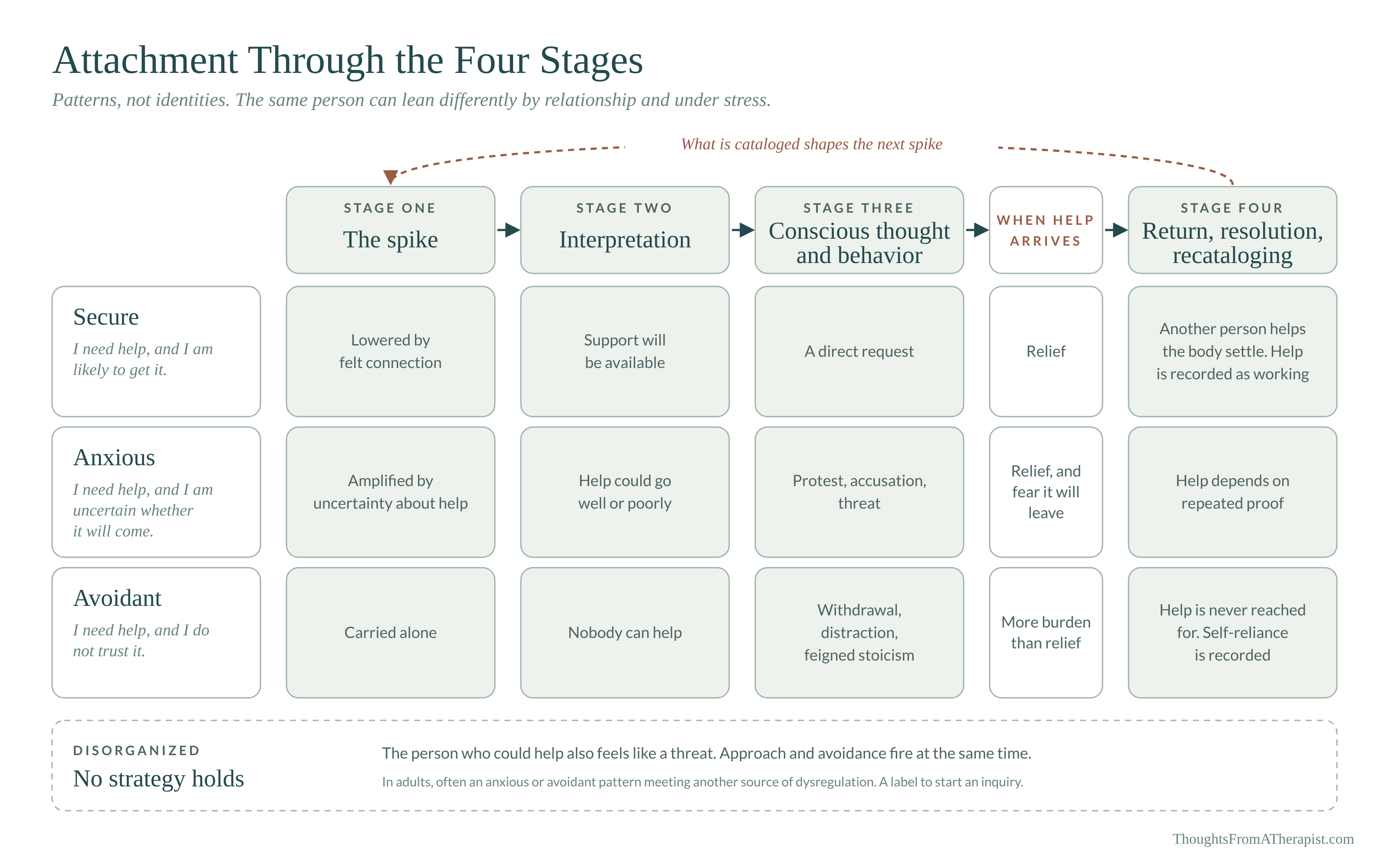
Secure, anxious, avoidant, and disorganized patterns moving through the four stages.
The Four Purposes of Communication
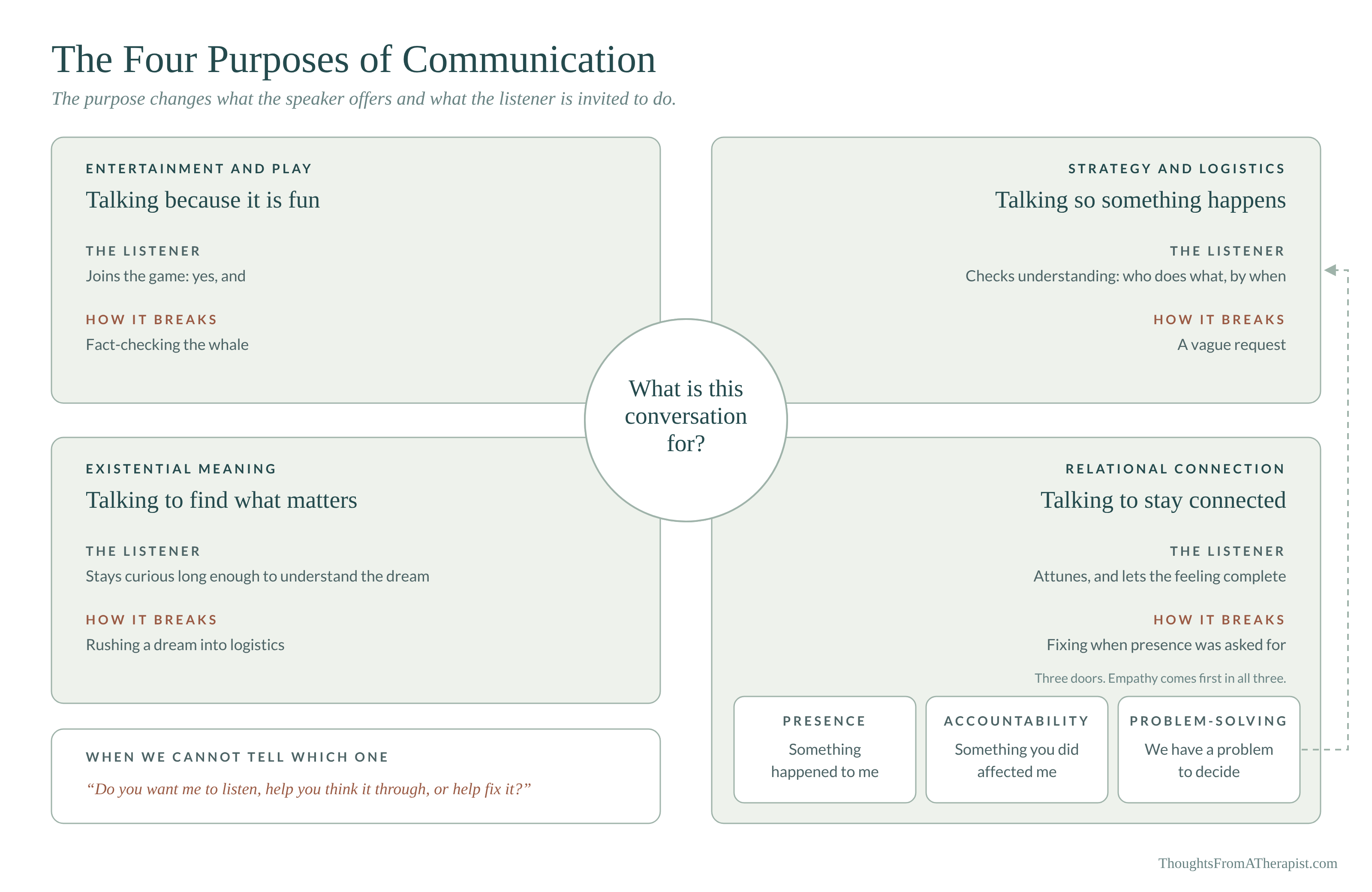
Play, logistics, connection, and meaning: what is this conversation for?
Defensive ListeningSix Ways Attention Leaves
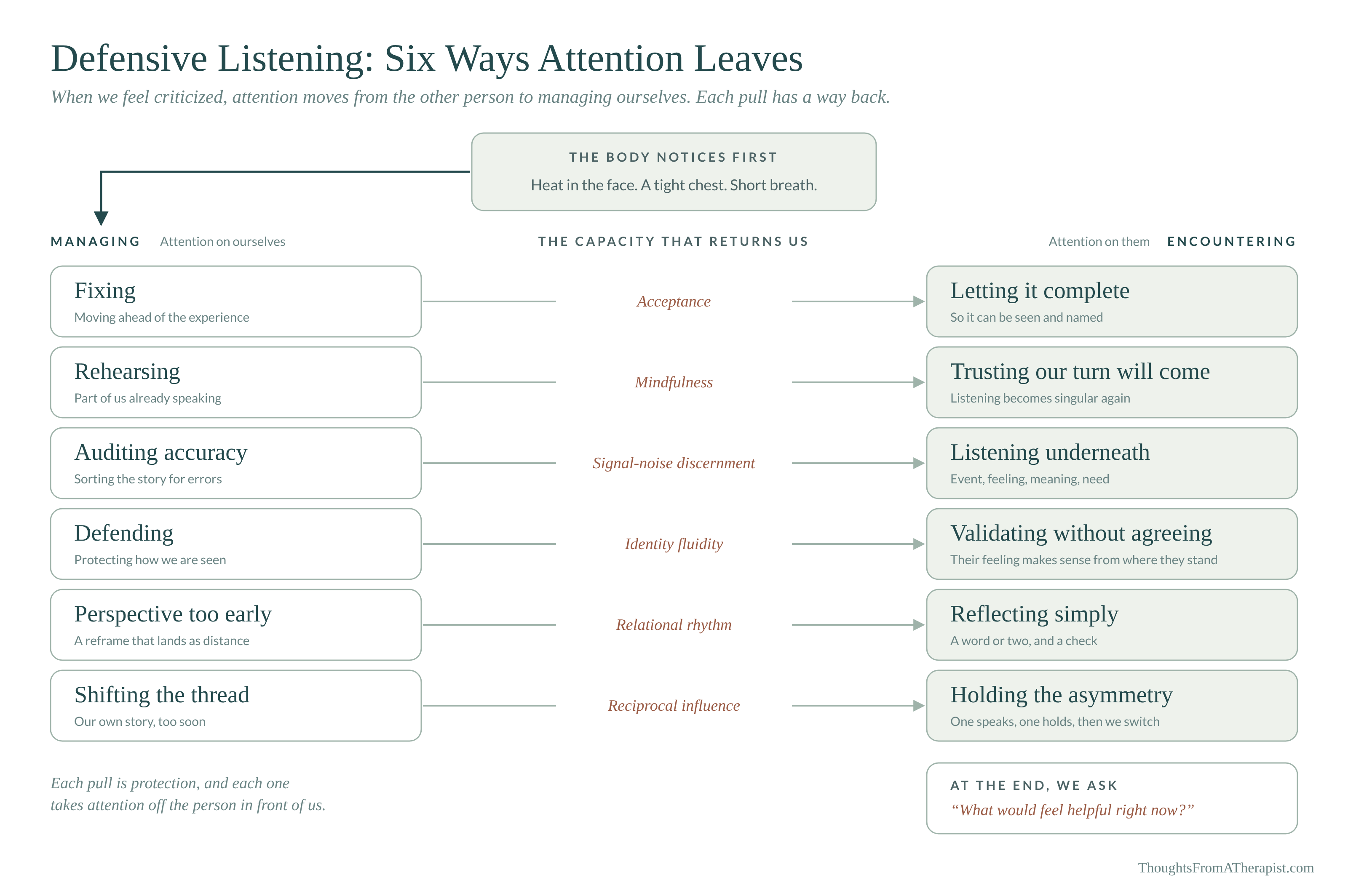
Six ways attention leaves when we feel criticized, and the capacity that brings it back.
Disengagement, Security, and Enmeshment
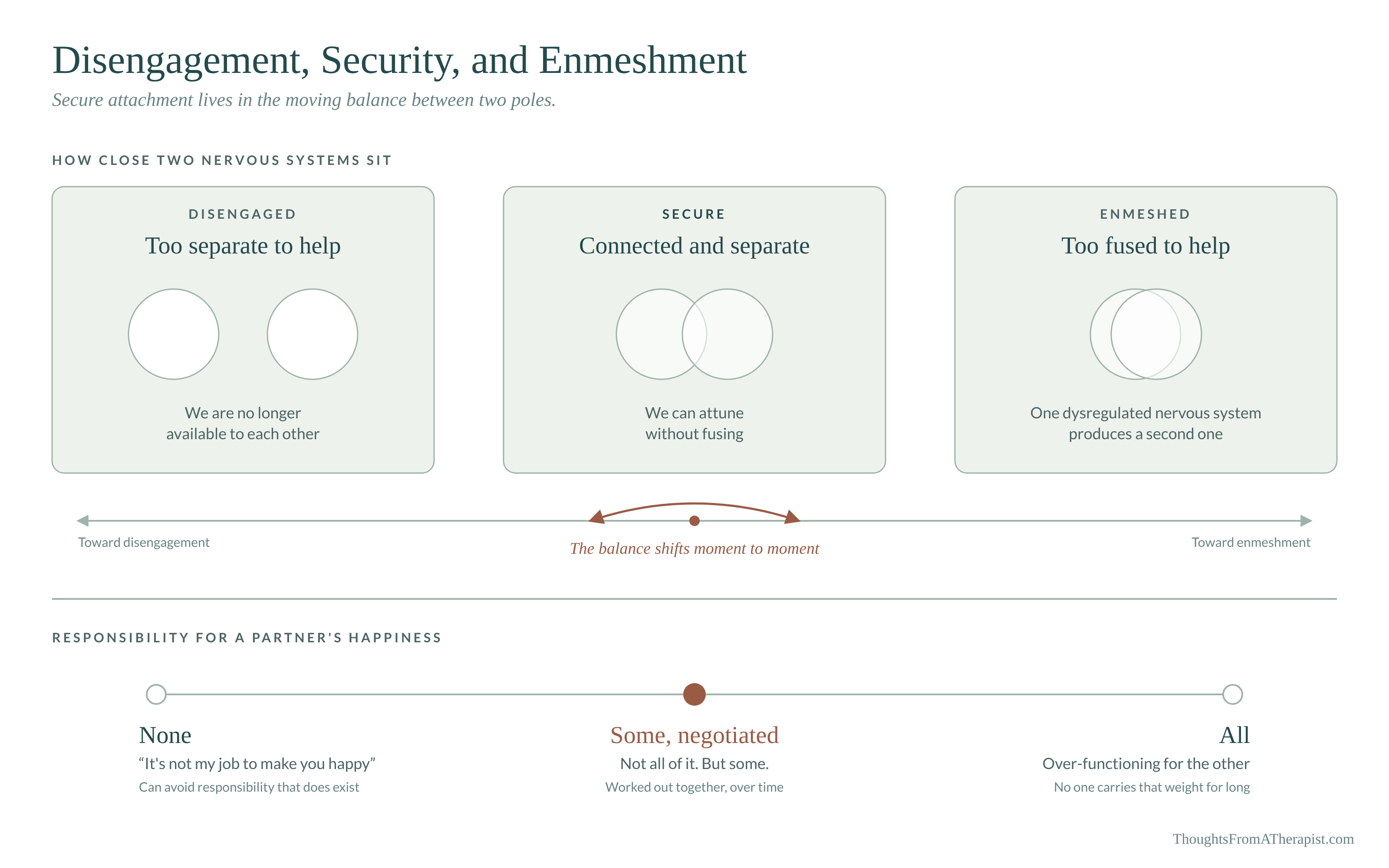
Too separate, too fused, and the moving balance where secure connection lives.
What Is a Long-Term Relationship For?
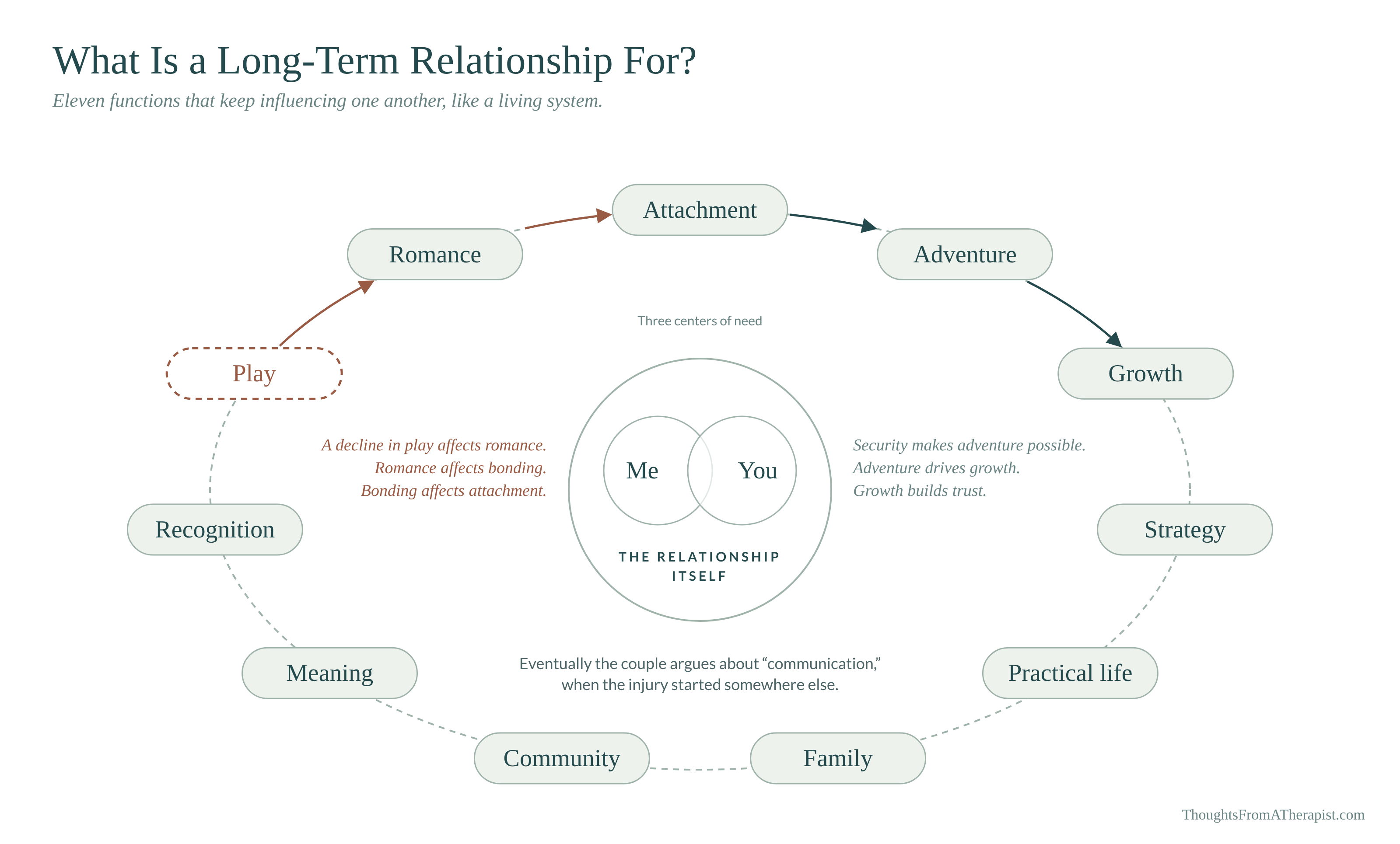
The functions a long-term relationship serves, and how a decline in one spreads to the others.
Work with William
In couples therapy or individual work we find what each of us learned to expect, name the loop we fall into, and practice making and receiving needs directly until security is felt.