
A Living Model of Integration and Wholeness
Mental health is not a fixed state.
It is a living field — fluid, adaptive, endlessly responsive.
It moves through us in patterns of expansion and return, like waves folding within themselves.
We grow by learning to navigate this field — the dynamic space between self and other, emotion and reason, body and world. Each of us becomes a pattern within a greater pattern, an expression of coherence forming and reforming across time.
This framework unfolds through seven interdependent dimensions of being:
Individual → Relational → Embodied → Integrity → Dialectical → Engaged → Interconnectedness
These are not linear stages. They are recurring shapes within a fractal, each reflecting and containing the others. Growth spirals infinitely inward and outward, like a universe breathing through consciousness.
Each dimension of the psyche reflects and refines the others.
Individual awareness gives shape to our experience — a vantage point from which we can witness thought and feeling as movements within a larger consciousness.
Through relationship, that awareness becomes textured and alive; the self meets its reflection and learns the rhythms of connection and distance.
In embodiment, this understanding drops from idea into sensation — we begin to feel life directly, without the constant need to interpret it.
Integrity gathers these layers into alignment, turning values into lived expression.
With dialectical awareness, we discover that coherence is not the absence of tension but the capacity to hold it.
Engagement transforms that tension into participation — the art of living meaningfully within contradiction.
And finally, interconnectedness reveals that none of this ever stood apart: the mind, the body, the other, and the world are all variations of one unfolding field.
Each dimension both births and depends on the others — a living mandala of mind and matter.
To be mentally healthy is not to escape contradiction or eliminate pain.
It is to stay in rhythm with life’s complexity — to hold paradox without collapse, and to move fluidly between the parts and the whole.
What follows is not a ladder of mastery but a fractal field of coherence — a pattern of reciprocal movement between individuality and unity, between matter and meaning, endlessly generating the possibility of wholeness.
Individual — Integration of Self and Story
When coherent: We can see ourselves with honesty and compassion, aware that identity is both real and changing. Our story guides us without completely defining us. Like a musician who knows the melody well enough to improvise, we trust the song of our life while staying open to variation.
When incoherent: We cling to fixed identities or disown parts of ourselves that contradict them. The self becomes brittle or lost, alternating between self-importance and self-erasure, unable to locate continuity within change.
To be a self is to live inside a story.
We speak our identity into being through memory, language, and preference.
Culture, gender, vocation, and era all give contour to that story — they tell us what matters and who we are allowed to be.
These identities are useful; they let others know how to meet us.
But they are also impermanent.
The teenager’s sense of gender differs from that of the elder; the meaning of “faith” in the fifteenth century differs from its expression today.
Identity evolves as life does.
The healthy self knows this. It builds a narrative that feels continuous while remaining permeable — capable of change.
It can hold contradiction: I am strong and uncertain. I am constant and becoming.
Within us are many voices — parts or subpersonalities — each with its own tone, desire, and defense.
One may lead with confidence, another with fear.
To integrate is not to silence these parts but to cultivate relationship among them, allowing each to serve its purpose without domination.
When we can step back and observe these internal dialogues, we begin to differentiate consciousness from content.
We see thought, emotion, and behavior as expressions within awareness rather than as our entire being.
Through this differentiation, self-awareness becomes self-compassion.
We stop confusing who we are with what we feel.
Inquiry for Growth
Bring to mind the constellation of identities that make up your life — your culture, profession, age, passions, and private loyalties.
- Which of these feel most alive, and which feel inherited?
- Which stories still serve you, and which quietly ask to evolve?
- Can you sense the awareness that holds all of them — the one who notices the voices, rather than being any single one?
Integration within the Fractal Field
Each dimension both gives and receives:
- Individual ↔ Relational: A coherent self allows intimacy without enmeshment; relationship mirrors the evolving self.
- Individual ↔ Embodied: Self-awareness anchors in sensation; the body becomes biography made flesh.
- Individual ↔ Integrity: Narrative consistency forms the ground for ethical alignment.
- Individual ↔ Dialectical: Holding inner contradictions strengthens the mind’s tolerance for tension.
- Individual ↔ Engaged: Expression completes reflection; creation becomes identity in motion.
- Individual ↔ Interconnectedness: The personal story expands into participation with all life.
Relational — Trust, Differentiation, and Emotional Reciprocity
When coherent: We connect deeply without losing individuality. Boundaries are flexible but clear, allowing empathy without enmeshment and love without possession. Two trees share sunlight — distinct roots, overlapping canopies, each shaping the other’s growth without eclipse.
When incoherent: We move between fusion and isolation — either merging so entirely that we lose a sense of self, or guarding so tightly that we cannot be touched. Trust becomes either reckless or withheld.
Human beings are formed in relationship.
We find ourselves reflected in the eyes of others — first through attachment, then through the lifelong rhythm of connection and separation.
Healthy trust feels like this: I can feel you completely, and still know that I am here.
And its reciprocal truth: You can feel me completely, and remain fully yourself.
To love well is to move fluidly between joining and autonomy.
It is to sense when closeness nourishes and when boundary protects.
The mature bond holds both freedom and belonging without fear.
One way to imagine this is through concentric circles of intimacy.
At the center are those with whom we feel utterly safe — where vulnerability and truth can live without guard.
As the circles widen, trust dilutes appropriately: we share less not from rejection but from wisdom.
Healthy attachment depends on these gradients of openness and protection.
Insecure attachment distorts this pattern.
Too much fear of loss leads to fusion; too much fear of closeness leads to withdrawal.
Relational health, then, is an ongoing balance — the dance between empathy and self-definition.
To feel another’s emotion while knowing it is theirs — not ours — is the essence of inter-regulation.
In this capacity, we bring calm to distress without collapsing into it.
We nurture another’s pain without shielding them from growth.
This is love matured beyond rescue — compassion guided by differentiation.
Inquiry for Growth
Imagine your relationships as concentric circles.
At the center, who sees you entirely?
At the edges, where is trust partial, boundary essential?
Notice how your emotional body shifts as you picture moving between these circles.
Where does closeness nourish, and where does it constrict?
Where does distance protect, and where does it isolate?
Integration within the Fractal Field
Each dimension both informs and is informed by relationship:
- Individual ↔ Relational: A well-differentiated self sustains intimacy without fusion.
- Relational ↔ Embodied: Emotional resonance travels through the nervous system; connection becomes physiology.
- Relational ↔ Integrity: Boundaries become moral choices; honesty becomes an act of care.
- Relational ↔ Dialectical: Opposites — closeness and distance, self and other — reveal their shared root in belonging.
- Relational ↔ Engaged: Collaboration turns intimacy into creation.
- Relational ↔ Interconnectedness: Personal trust scales into compassion for the collective.
Embodied — Presence, Resistance, and the Movement of Feeling
When coherent: The body is trusted as teacher and ally. Emotion moves through sensation and finds completion; tension gives way to breath. A river unblocked by dams carries leaves, silt, and reflection alike, reshaping its banks but always finding its way to the sea.
When incoherent: We live mostly from the neck up, detached from sensation or flooded by it. The body becomes a battleground for what the mind cannot face — frozen, numb, or endlessly rehearsing emotion without release.
The body tells the truth before the mind interprets it.
Every emotion is first a physical event — a contraction, a surge, a vibration beneath thought.
When we resist an emotion, we resist its movement.
Like trying not to laugh in class, suppression intensifies the feeling.
Western culture praises this restraint, mistaking control for composure.
But unexpressed energy condenses in the body — grief in the throat, anger in the jaw, fear in the belly — until it becomes ache or apathy.
To re-enter embodiment is to return to fluidity.
It begins with awareness of sensation: warmth, pressure, pulse, breath.
From here, curiosity opens the map.
Rather than moralizing emotion — this one good, that one bad — we approach it as art.
What is its texture, its shape, its temperature?
Does it shimmer, tighten, hum, ache?
Made-up words often describe it best: electricy, stone-cold-numb, velvet-heavy.
By meeting sensation as experience rather than problem, we transform resistance into relationship.
Feeling becomes movement; movement becomes release.
The body exhales what the mind was never meant to carry alone.
Embodiment also includes intelligent compartmentalization — our capacity to pause grief long enough to care for a child or complete a task.
But we must later de-compartmentalize, allowing the emotion to move through.
Otherwise, what served as resilience becomes rigidity.
Inquiry for Growth
Close your eyes and bring awareness to your hands.
Feel the air on your knuckles, the stillness between your fingers.
Can you sense your heartbeat within them?
Now turn this attention inward — where in your body lives a feeling that seldom finds air?
What story, image, or word resides there?
Let the body speak in its own language.
Listen without interpretation.
Integration within the Fractal Field
- Individual ↔ Embodied: The story of self finds grounding in sensation; the narrator gains a body.
- Relational ↔ Embodied: Connection flows through mirror neurons and breath — empathy as physical resonance.
- Embodied ↔ Integrity: Somatic awareness becomes moral intuition; the body signals what the intellect denies.
- Embodied ↔ Dialectical: Opposing feelings coexist in one vessel; tension becomes vitality.
- Embodied ↔ Engaged: Movement becomes creation; the artist’s gesture is the body thinking.
- Embodied ↔ Interconnectedness: The body’s rhythms mirror the planet’s — inhale and exhale as tide and wind.
Integrity — Intention, Discernment, and Ethical Alignment
When coherent: Thought, emotion, and action form one conversation. We act with clarity and purpose, aligning choices with values that feel both personal and universal. A compass held to the heart hums quietly when we move in the right direction.
When incoherent: We fragment — saying one thing, feeling another, doing a third. Morality becomes performance or avoidance, and the will splits between desire and guilt.
Integrity is where values become action.
It is the meeting point of intuition and discipline, where feeling and reason collaborate toward coherence.
A healthy mind relies on rationality, pragmatism, and discernment — the humble recognition that actions have causes and consequences.
This is not cold logic but the architecture of care.
To wash our hands, we use water, not wishful thought.
To heal a relationship, we act with honesty, not denial.
Rationality becomes compassion made practical.
Integrity also guards us from deception — our own and others’.
To evaluate what we hear, to test ideas against experience, is not cynicism but self-protection.
The ability to question and verify sustains coherence in a world dense with distortion.
And yet, ethics are not universal formulas.
They emerge from context, culture, and conscience.
A person’s guiding compass must harmonize emotion, reason, and intuition.
Intuition is like harmony in music: there is no single correct note, only resonance within relationship.
Through integrity, we align action with value.
We use strategy and structure to manifest emotional ambition — to become who we claim to be.
I want to be present with my family, so I schedule time for their games.
I value rest, so I choose work that allows spaciousness.
Discipline becomes the servant of meaning.
Integrity matures as we hold paradox: sometimes pleasure supports health; sometimes restraint does.
When moral conviction and practical necessity conflict, integrity listens for balance.
It asks not only what works but what is right.
Ethics, when embodied and lived, become ecology — a way of belonging harmoniously to the systems that sustain us.
Inquiry for Growth
Reflect on one decision before you now — large or small.
- What value does it express?
- What emotion fuels it?
- What logic grounds it?
If these three voices — value, feeling, and reason — were instruments, what would harmony sound like?
Let that be your compass.
Integration within the Fractal Field
- Individual ↔ Integrity: The self’s narrative finds moral direction through intentional action.
- Relational ↔ Integrity: Boundaries become mutual respect; accountability becomes intimacy.
- Embodied ↔ Integrity: Somatic cues guide ethical choice — tension reveals misalignment, ease signals truth.
- Integrity ↔ Dialectical: Opposing imperatives — compassion and justice, freedom and safety — mature each other.
- Integrity ↔ Engaged: Purpose becomes practice; vision becomes behavior.
- Integrity ↔ Interconnectedness: Ethics widen into stewardship; right action becomes harmony with the whole.
Dialectical — Holding Opposites and the Intelligence of Paradox
When coherent: We hold tension without breaking. Paradox becomes a teacher rather than a threat; contradiction expands our view instead of dividing it. We feel the anger of injustice and the gratitude for the opportunity to be the hero.
When incoherent: We polarize — collapsing into either-or thinking. The mind grasps for certainty, unable to tolerate ambiguity; emotion mirrors this rigidity, swinging between defensiveness and despair.
To live dialectically is to hold tension without collapse.
It is to recognize that reality breathes between poles — joy and sorrow, autonomy and belonging, order and change — and that wholeness arises through their interaction, not their victory.
The dialectical mind can sit with contradiction long enough for it to reveal relationship.
Two opposing truths do not cancel each other; they illuminate the spectrum that joins them.
As the Latin root dialectica implies, meaning emerges through dialogue — through the friction that refines thought into wisdom.
This practice is not merely philosophical; it is emotional endurance.
When we resist contradiction, we fracture.
When we engage it, we deepen.
Psychological maturity depends on our ability to say, Both are true, and to stay there long enough to feel what that costs and offers.
Dialectical awareness is also civic intelligence.
Every culture wrestles with paired imperatives — freedom and security, tradition and progress, individual and collective.
Societies thrive when they can inhabit the conversation rather than polarize around it.
The same is true within us.
In Buddhism, this becomes the middle path; in Taoism, the balance of yin and yang; in modern systems theory, the self-correcting loop that maintains equilibrium.
Each names the same movement: life discovering coherence through dynamic tension.
Inquiry for Growth
Recall a tension you are living right now — perhaps between self-care and responsibility, or honesty and kindness.
- What truth does each pole protect?
- What fear would surface if you relaxed your grip on either side?
- Can you imagine the space between them as fertile ground rather than battlefield?
Stay there.
Let the tension breathe you.
Integration within the Fractal Field
Each pole finds its counterpart elsewhere in the field:
- Individual ↔ Dialectical: Identity expands through contradiction — self-consistency becomes self-complexity.
- Relational ↔ Dialectical: Intimacy matures through conflict faced with respect.
- Embodied ↔ Dialectical: The nervous system learns flexibility through cycles of arousal and rest.
- Integrity ↔ Dialectical: Moral clarity is tempered by compassion; law softens into mercy.
- Dialectical ↔ Engaged: Creativity emerges from tension resolved through movement.
- Dialectical ↔ Interconnectedness: Unity reveals itself when opposites dissolve into one motion — life and death as the same current.
Engaged — Creative Participation and the Joy of Being
When coherent: Action feels like flow rather than effort. We act from vitality, not compulsion — expressing creativity as participation in life itself. Dancing without an audience or reason – becoming one with the music – flowing as if without internal or external observation.
When incoherent: We act from anxiety or apathy. Productivity becomes avoidance; stillness feels like failure. The self measures worth by output, mistaking exhaustion for meaning.
Engagement is how consciousness celebrates itself.
It is the impulse to act, to create, to join the flow of existence not for outcome but for communion.
A dancer does not move to arrive anywhere.
A musician does not play to conclude the song.
The purpose of play is the experience itself — immersion so complete that the “I” dissolves into motion.
We see engagement throughout nature: a dolphin leaping through sunset surf, a monkey swinging simply because it can, wind carving dunes with no witness.
Life expresses itself through play.
When engagement hardens into performance, vitality fades.
Productivity replaces participation; meaning becomes a metric.
This is the exhaustion of modern life — a starvation of joy disguised as purpose.
To re-engage is to rediscover the purposeless purpose: to paint without audience, to garden without progress report, to converse without agenda.
Engagement is the soul’s metabolism.
And yet the paradox remains: If I strive to be effortless, I am striving still.
The practice is not to abolish striving but to let it soften into rhythm — effort and surrender alternating like breath.
In mature engagement, joy becomes devotion.
We create not to prove meaning, but to participate in it.
Action becomes prayer; work becomes offering.
Inquiry for Growth
Recall a moment when you were completely absorbed — in conversation, music, or movement.
- What vanished first: time, self, or purpose?
- What sensations marked that disappearance?
- How might you invite that quality of absorption again, without demand that it return?
Create something small for no reason at all.
Let the act itself be enough.
Integration within the Fractal Field
- Individual ↔ Engaged: Expression completes reflection; self-knowledge becomes participation.
- Relational ↔ Engaged: Shared play transforms connection into creation.
- Embodied ↔ Engaged: The body thinks through movement; gesture becomes knowing.
- Integrity ↔ Engaged: Intention shapes spontaneity; purpose breathes through action.
- Dialectical ↔ Engaged: Striving and surrender intertwine — paradox lived as art.
- Engaged ↔ Interconnectedness: Creation becomes communion; every act contributes to the cosmic dialogue.
Interconnectedness — The Ecology of Being and the Infinite Field
When coherent: We sense ourselves as both distinct and inseparable from everything that is. Mortality softens into continuity; empathy expands beyond preference to include all life. A wave remembers it is ocean — rising, cresting, and returning without ever leaving the water.
When incoherent: We feel detached from life’s larger rhythm — isolated, alienated, or inflated into grandiosity. We lose reverence for connection, mistaking separateness for safety or superiority.
Interconnectedness is the widening of identity until separation dissolves.
It is realizing that we belong to systems far larger than the self — biological, cultural, cosmic — all nested within one living pattern.
The soil reveals this first: leaves fall, decay, and feed their own roots.
A butterfly shifts its path, and weather changes continents away.
Every gesture ripples through the web of life.
Ecology is not metaphor; it is mathematics made visible.
Within the body, the same intelligence repeats.
Cells divide through mitosis, organs communicate through chemical speech, and the whole organism improvises toward balance.
Health — personal or planetary — is the ability to self-correct through relationship.
Our ancestors lived by this truth, attuned to the cadence of seasons and migrations.
Modern life, insulated by walls and algorithms, forgets the reciprocity that once defined survival.
Yet the pattern endures beneath our feet and skin.
Beyond biology lies the cosmic field.
The calcium in our bones was forged in stars; the iron in our blood once burned in a sun’s collapse.
Between any two points in the universe — between your palm and its shadow — lies infinity: the endless gradation of space and time.
Infinity is not elsewhere; it is the medium of everything.
Even silence contains infinite tone, the unplayed music between notes.
To feel this is to experience reverence.
Death becomes continuity, not erasure.
When we die, our atoms feed soil, tree, fruit, grandchild — matter returning to motion.
We are continuity disguised as change.
Living with this awareness invites humility and wonder.
If we are the field, then every act reverberates endlessly:
each kindness, each cruelty, each silence shaping the pattern that shapes us.
Interconnectedness calls us to reciprocity over control, stewardship over possession, belonging over ownership.
In the language of science, this is the fractal.
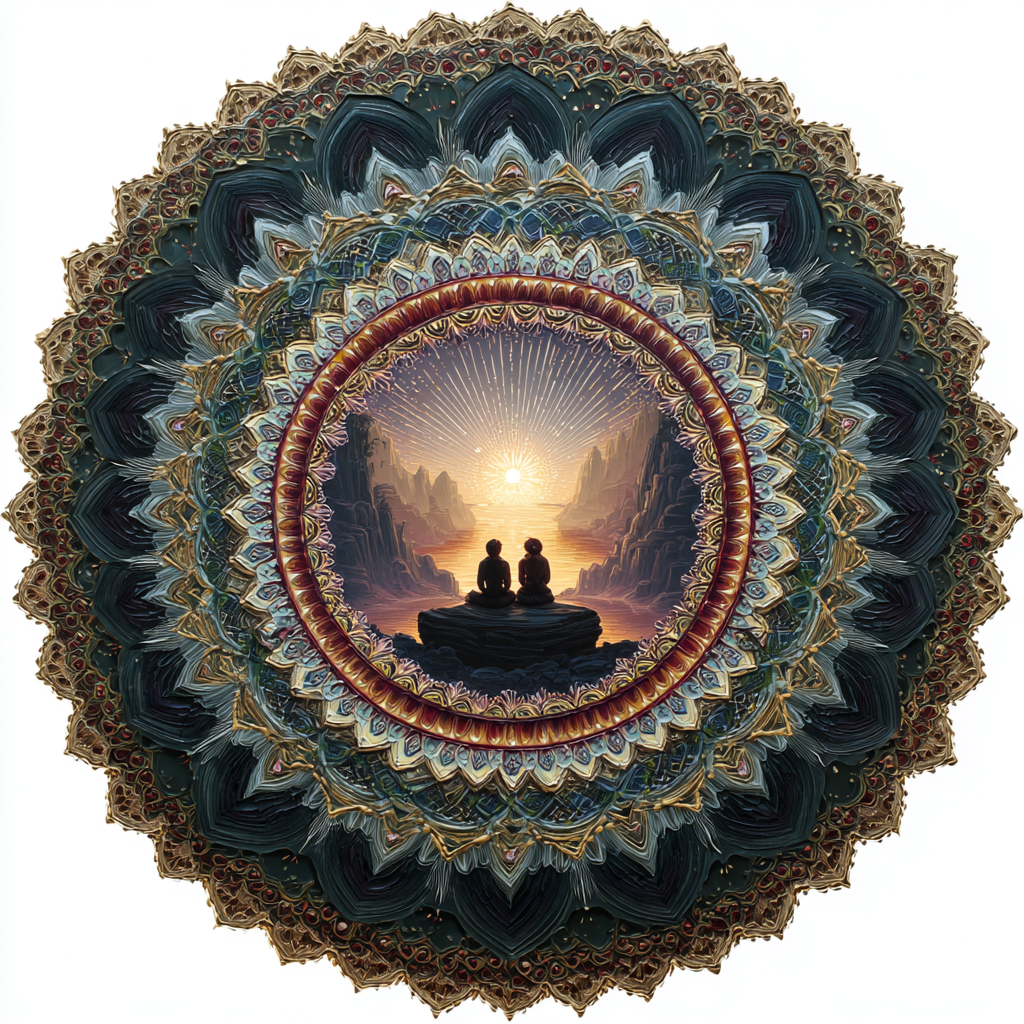
In the language of spirit, the mandala — ancient symbol of unity through infinite differentiation.
Both describe the same truth: every part mirrors the whole, and the whole exists through its parts.
Inquiry for Growth
Step outside, or close your eyes and imagine a living system — a forest, a city, a single leaf.
- Where do you begin and where do you end within that image?
- What rhythm links your breath to its pulse?
- What changes when you sense yourself not beside it but as it — one motion within the infinite weave?
Between any two points, there is infinity.
Between you and everything — no distance at all.
Integration within the Fractal Field
- Individual ↔ Interconnectedness: The personal story unfolds into the universal narrative.
- Relational ↔ Interconnectedness: Compassion scales from intimacy to ecology.
- Embodied ↔ Interconnectedness: Breath mirrors tide; heartbeat echoes gravity.
- Integrity ↔ Interconnectedness: Ethics widen into stewardship; right action harmonizes with life.
- Dialectical ↔ Interconnectedness: Life and death, being and becoming, reveal themselves as one motion.
- Engaged ↔ Interconnectedness: Creation becomes communion; contribution becomes cosmic dialogue.
Closing Integration — The Living Fractal Field
We return to where we began — not in a circle, but in a living spiral, infinitely inward and outward.
Each dimension — Individual, Relational, Embodied, Integrity, Dialectical, Engaged, Interconnectedness — reflects and contains the others.
Together they form a fractal field: coherence unfolding from neuron to ecosystem, from breath to cosmos.
At the center is awareness — not as concept but as presence.
The self we once tried to perfect is not an object but a rhythm of participation, gathering and dispersing in endless renewal.
Mental health, seen this way, is not a static achievement but a capacity for relationship — with self, others, and the wider field of being.
Each dimension contributes a distinct intelligence:
- Individual: Story and self as evolving pattern.
- Relational: Empathy and boundary as reciprocal flow.
- Embodied: Sensation and movement as truth-telling.
- Integrity: Values enacted through disciplined compassion.
- Dialectical: Paradox held until it ripens into understanding.
- Engaged: Creativity as devotion, joy as service.
- Interconnectedness: Belonging within infinity — the self as world, the world as self.
When one falters, another compensates; when one awakens, all brighten.
Health is not perfection but continuity of exchange.
This is what the ancient mandala portrayed — the union of opposites within sacred geometry.
Science names it fractal; psychology calls it integration.
Each gestures toward the same truth: wholeness through relationship.
To live within this field is to allow paradox without panic, movement without fear.
We fall out of balance, and we return — endlessly, rhythmically, humanly.
Each re-entry deepens coherence, like breath expanding the lungs of being itself.
When we realize coherence is not something to earn but something we already are, the search quiets.
What remains is participation — presence, creativity, care.
We belong to the pattern, and the pattern belongs to us.
We are one — infinitely inward and outward.


