07
Topic guide
Start here
Political conflict often tests whether our values still overlap. This guide follows how positions form, why belonging makes disagreement feel dangerous, and a method for the problems we share, from a family table to a country.
Read these first
- When Politics Isn’t Really About PoliticsCulture as a shared operating system, and the question that returns people to each other.
- Most Disagreements Aren’t About the FactsWe agree on the facts and weigh our values differently.
- How to Make Problems NavigableThe method: deconstruct, hold the tension, design with named costs.
Questions this topic answers


Culture is the shared operating system that lets people cooperate, and politics is where we argue about how to run it. Most of those arguments are about how we weigh values we already share. The same patterns run from a couple to a country, and so do the capacities that let us disagree without leaving each other.
We often believe we are arguing about politics. Sometimes we are. More often, two people who think they are debating legislation are testing whether the person across the table still shares their deepest commitments. Underneath the policy is a more personal question: can I still trust the operating system we built together?
What are we trying to protect, and who will pay for protecting it?
Why politics feels so personal
Every culture develops customs, rituals, rules, and values, the shared code that lets social mammals cooperate. It offers predictability, meaning, and identity. A healthy culture needs enough stability to preserve the values that make cooperation possible. It also needs enough flexibility to bend when reality shifts beneath it. Those two needs live in permanent tension.
The parties, institutions, and movements we build to protect a culture can come to endanger it. The symbol replaces the purpose. Instead of asking whether this still reflects our values, we begin asking whether this is what our group believes.
A family is its own culture. A marriage is its own culture. A friendship is a small and intricate culture of two.
Sometimes two people fight for opposite policies while protecting the same value. Without curiosity, that distinction vanishes, and what is left is a collision of identities. Identities are almost impossible to negotiate. Values are far more workable.
A different question
What are you trying to protect?
“Which side are you on?” sorts people into camps. “What are you trying to protect?” returns them to each other. When Politics Isn’t Really About Politics begins there, and Spiral Dynamics and Political Polarization maps what happens when several value systems have to govern side by side.
We agree on more facts than we think
We don’t simply have values. We weight them. A community needs a train between two cities. One route is cheaper and faster and displaces 2,000 people. The other displaces no one and costs more. We can agree on every number and still disagree about what to build, because the question underneath is how much weight each consequence should carry.
Facts cannot determine how much we should value the competing consequences those facts reveal.
From inside our own weighting, the answer feels obviously right. The disagreement began earlier, in how the variables were weighted. Facts still matter, and not every value system is equally coherent. Most Disagreements Aren’t About the Facts starts with ten hungry people and two cheeseburgers.
Weighting also moves with scale. At a crowded public pool in a dense city, I become almost fundamentalist about the rules: depth signs, no glass, no running. At an older couple’s private pool in rural North Dakota, I don’t care whether there are depth signs or whether they swim all night. Nothing here has changed about me. What has changed is the scale of the system and the reach of the consequences. Used this way, liberal names an orientation toward flexibility and conservative an orientation toward maintenance. They are strategies, and in the scientific method both work at once: the new idea is liberal, the validation conservative.

Seen this way, the labels stop clarifying. Government regulation of parts of healthcare is structurally conservative. Minimal regulation of firearms is structurally liberal. People on each side advocate the other side’s structures in some contexts, and the label no longer predicts the position. The better question asks what balance of freedom and structure serves the goal we say we care about, here, at this scale. The answer is allowed to vary because the contexts vary. More in Contextual Intelligence and Political Identity.
Belonging, tribe, and why facts bounce off
The tribe as a secure base
Belonging helps organize safety, identity, and orientation, so possible abandonment by the group can register as more than disagreement. A fixed label gives us belonging and certainty, and tells us in advance what we think. Those are real needs. The cost is contextual intelligence. Once a label is part of who we are, disagreement starts feeling like a threat to the self. Changing our minds no longer feels like learning. It feels like betrayal. The Realities of Rigid Identity follows the same rigidity from a person to a party.
Families and parties run the same pattern. A family that cannot tolerate a member holding a distinct position produces one of two outcomes: fusion, where everyone agrees and no one is present, or cutoff, where the one who disagreed is gone. The capacity to disagree while staying connected is the marker of a family that can adapt, and it is the marker of a party that can govern.
Belonging that survives disagreement
The work is finding belonging that can hold a distinct position, and staying in relationship with people who would set the dial differently.
When someone we love goes somewhere extreme
Extremism can work as an emotional survival structure. After chaos, binary moral frames regulate anxiety, and certainty feels safe even when it is false. Shame says that if I was wrong, then I am bad, so people double down. For some, the group is the first place they have been called by name. That is why facts so rarely work. They threaten access to belonging.
We cannot walk someone out of their shame. We can sit near them long enough for them to remember who they were.
Part of us wants to call out the hypocrisy and make them feel what we feel. Shame can only deepen what it tries to correct. Contact over contempt is a choice we make when we can, and not everyone will come home. Some will. Intervening with Extremism holds both.
The economy is one game we all play
When we talk about the economy, we sound like rival teams arguing over whose pain counts most. One person says working families are putting in eighty hours a week and still drowning. Another says the stock market matters to retirees whose savings are tied to it. Neither of them is wrong. In basketball, fairness defined as strict equality regulates the game into paralysis, every possession stopped and reviewed. Total freedom lets someone throw a punch and pay the referees to look away. Rigidity breaks the game. Chaos breaks the game.
An economy holds together while enough players believe effort can reach outcome. When people stop believing that, disengagement stops being a mood and becomes a rational response. Freedom protects movement, innovation, incentive, and agency. Regulation protects fairness, legitimacy, safety, and the possibility of meaningful participation. Both are guarding something worth guarding.
The harder seat
Argue the other side. Not to surrender your values. To prove you can still think.
The inability to argue the other side usually means our identity has moved inside the position and our nervous system is defending it. The Economy Is a Game We All Live Inside follows the argument from basketball to Monopoly.
Seeing clearly when information is trying to steer us
Discernment is the capacity to remain psychologically organized while information is attempting to organize us. Manipulation arrives as something that feels reasonable, morally obvious, or socially reinforced, and it reaches the nervous system before the thinking mind. “Job creators” and “wealthy elite” arrange sympathy and suspicion in opposite directions before analysis begins. Repetition makes familiar ideas feel self-evident. Tribal activation moves the question from “Is this accurate?” to “Whose side am I on?” Intelligence does not confer immunity, and neither does expertise.
Manipulation thrives on urgency. Discernment requires regulation.
Under threat, the brain prioritizes speed over accuracy. Slowing down is regulation, and the goal is awareness sufficient to restore choice. Learning to See Clearly walks through fourteen pathways influence takes, and the manipulation worksheet takes one news story or political ad through them, regulating first and then checking the claim.
When the news is loud
Fear spreads through a group without anyone deciding to pass it on. So does anger. Threat leads to vigilance. Vigilance leads to enemy identification. Enemy identification generates more evidence of threat. We have built systems that sell grievance back to us as attention.
We are very good at coordinating consumption. We have become very good at coordinating contempt.
Inside that loop there are two ways to lose our footing. One is flooding, where outrage becomes identity and we mistake it for agency. The other is numbing, where we stop believing effort can reach any outcome. Both make it easy to confuse resonance with competence. When a leader names our anger with precision, the body settles, and the relief feels like an answer. The question that protects us takes one sentence: I hear that you understand the problem. Do you actually know how to build the solution?
First
Regulate
Slowing down restores what urgency narrows.
Then
Name the value
When the heat arrives, ask which value feels threatened.
Then
Find the part we can carry
Nobody has to solve the whole thing. People need a way to find the part they can carry.
Then
Act small, on purpose
Repair, curiosity, and collaboration strengthen with repetition, the same way contempt does.
Hope here is more demanding than positivity. Agency and collaboration can spread the way fear and outrage spread. What If Hope Is Contagious Too? follows that possibility from a family in distress to a country.
Forming positions that are ours, and taking a side
A label tells us where we have been sorted. A position tells us what we want done. The label gives us people to stand with, and it answers dozens of questions for us without ever showing us what the questions were. A country is a set of shared responsibilities. We can believe we are under-regulating our relationship with the land, so that soil is losing the nutrition that made food worth eating, and believe at the same time that we are over-regulating our schools, so that teachers shape a year of curriculum around a standardized test. Neither belief fits on a line from left to right. Both are positions.
| Question | What it asks |
|---|---|
| Capacity | What it asksWhat should we build, fund, staff, maintain, or make available? |
| Constraint | What it asksWhat should we permit, prohibit, require, or regulate? |
| Control | What it asksWho decides: individuals, families, communities, professions, markets, towns, states, or the federal government? |
| Trajectory | What it asksInnovate, maintain, or let go? Doing nothing is a position with costs of its own. |
| Dialectics | What it asksWhich legitimate values are in tension, who benefits now, and who pays later? |
Political identity compresses these choices. A political position opens them again, and it does not have to be complete to be real. How to Create Your Own Political Positions runs every domain through the five questions, and the political positions worksheet gives us room to answer them and notice how we weigh our own values.
Dialectical maturity is not neutrality. Sometimes each side holds part of the truth. Sometimes one side really is more accurate, and the honest move is to say so. When I evaluate leadership, I place considerable weight on the means: character, humility, how opponents are treated. Someone else may weigh whether a leader accomplishes the policy outcome. Recognizing that we grade with different rubrics doesn’t require me to abandon mine.
The language of values
I understand the outcome you’re hoping for. I actually share it. I’m not convinced this policy gets us there, but I respect the value you’re trying to protect.
A method for shared problems
Much of this page rests on a method called Dialectic and Deconstruction Solutions, or DDS. It grew out of the therapy room, where a therapist looks beneath a symptom for the conditions that made it necessary and holds more than one person’s reality without erasing either. DDS carries that work to civic scale through three disciplines. The method, the book, and the finished blueprints live at SolveSomething.com.
Deconstruction
Trace it upstream
We cannot solve a symptom. We trace the problem to the driver that carries the load, and stop the moment actionable leverage appears.
Dialectics
Hold the tension
Most problems arrive at a collision between two values that both matter. Each pole protects something essential.
Solution Design
Build a blueprint
Name the driver, the value weighting, who carries the cost, the emotional weather, readiness, and a kill switch.

Deconstruction asks what an issue is made of. Gun control becomes: how are weapons accessed, by whom, with what screening, for what purpose? Abortion becomes: what conditions lead to unwanted pregnancy? “Healthcare is expensive” is too shallow to act on. “Our incentives reward volume of services over health outcomes” is actionable. When the problem is bad people, the only intervention is punishment. When the problem is broken incentives, redesign becomes possible.
Blame produces shame. Structure produces movement.
Deconstruction is also an act of care. Bureaucracy tends to grow where trust has collapsed. Over-policing grows where safety was already absent. Asking what a pattern was protecting lets change occur without humiliation.
Dialectics begins at the collision. Freedom and safety, the individual and the collective, efficiency and humanity, justice and mercy recur across civic life, relationships, and inner experience. When a couple fights about money, one partner is usually protecting security and the other aliveness, and the way through is a design that honors both.
Solution Design is where responsibility becomes real. If the Colorado River is to be preserved, somebody changes irrigation practices a family organized its life around. Someone is going to be angry. The solution has created the next problem, and that alone does not make it wrong. The question is whether we can see the loss clearly, decide whether it is proportionate, mitigate what can be mitigated, and remain resilient enough to solve the next problem rather than returning to paralysis.
The kill switch
Without a kill switch, solutions become institutions. With one, they remain tools.
Sometimes maturity means saying: this is better, and it still hurts someone. Then we stay, listen, adapt, and keep solving. How to Make Problems Navigable gives the whole arc, and Why Dialectics and Deconstruction Are Essential for Solving Real Problems is the short version. The DDS worksheet runs the three disciplines on a personal problem, down to the part we can carry.
Coherence and its two failures
In the Fractal Field of Mental Health, culture and politics live mostly in the interconnectedness dimension, our relationship to the larger systems we belong to, and they lean on the dialectical one. Each dimension can be balanced, overexpressed, or deficient.
Balanced
Belonging with a place to stand
We experience belonging within a larger context while maintaining individuality. Meaning feels grounded rather than imposed.
Overexpressed
Responsible for everything
We feel responsible for the whole world with no workable place to stand, or meaning hardens into rigid ideology.
Deficient
Outside the system
We feel isolated or alienated from the systems we live inside, mistaking separateness for safety or superiority.
There is a dialectical version of the same imbalance. When the dialectical dimension is deficient, the mind grasps for certainty, unable to tolerate ambiguity, and every disagreement becomes a collision of identities. When it is overexpressed, we understand every side so well that we never advocate for our own. Holding tension forever, without the capacity to differentiate when the situation requires a position, is its own failure mode. People who are too humble may suppress important insights, fearing they will overpower others. It looks like missing assertiveness, a value we never argue for, an ambition we never say out loud.
How this connects
Relationships
Relationships, Couples & Communication
Tribalism is the attachment system at the scale of a group.
Family
A family is a culture with its own operating system, and political rifts land hardest there.
Self-worth
Self-Awareness, Self-Worth & Integrity
Integrity and belonging meet at civic scale, where we learn to disagree and stay connected.
Therapy
DDS is the clinical work at civic scale. The clinical work is the method at the scale of one life.
We do not need to share a theology to share a watershed, or vote alike to agree that a child should be fed and a street should be safe. The people who would set the dial differently live downstream of the same river we do. The capacity to disagree without leaving each other is the one a family needs at its table, and it is the one a country needs everywhere else.
Worksheets, self-reflections, and diagrams
Worksheets for this topic
How to Form Your Own Political Positions Worksheet
Seven domains, five questions, and how we weigh our own values.
How to Spot Manipulation in News and Political Ads Worksheet
Regulate first, then check the claim, the pathway, and whether it is a sign or a menu.
How to Solve a Personal Problem WorksheetDialectic and Deconstruction (DDS)
Trace a personal problem upstream, hold the tension, and design the part we can carry.
How Dialectic and Deconstruction Solutions Works
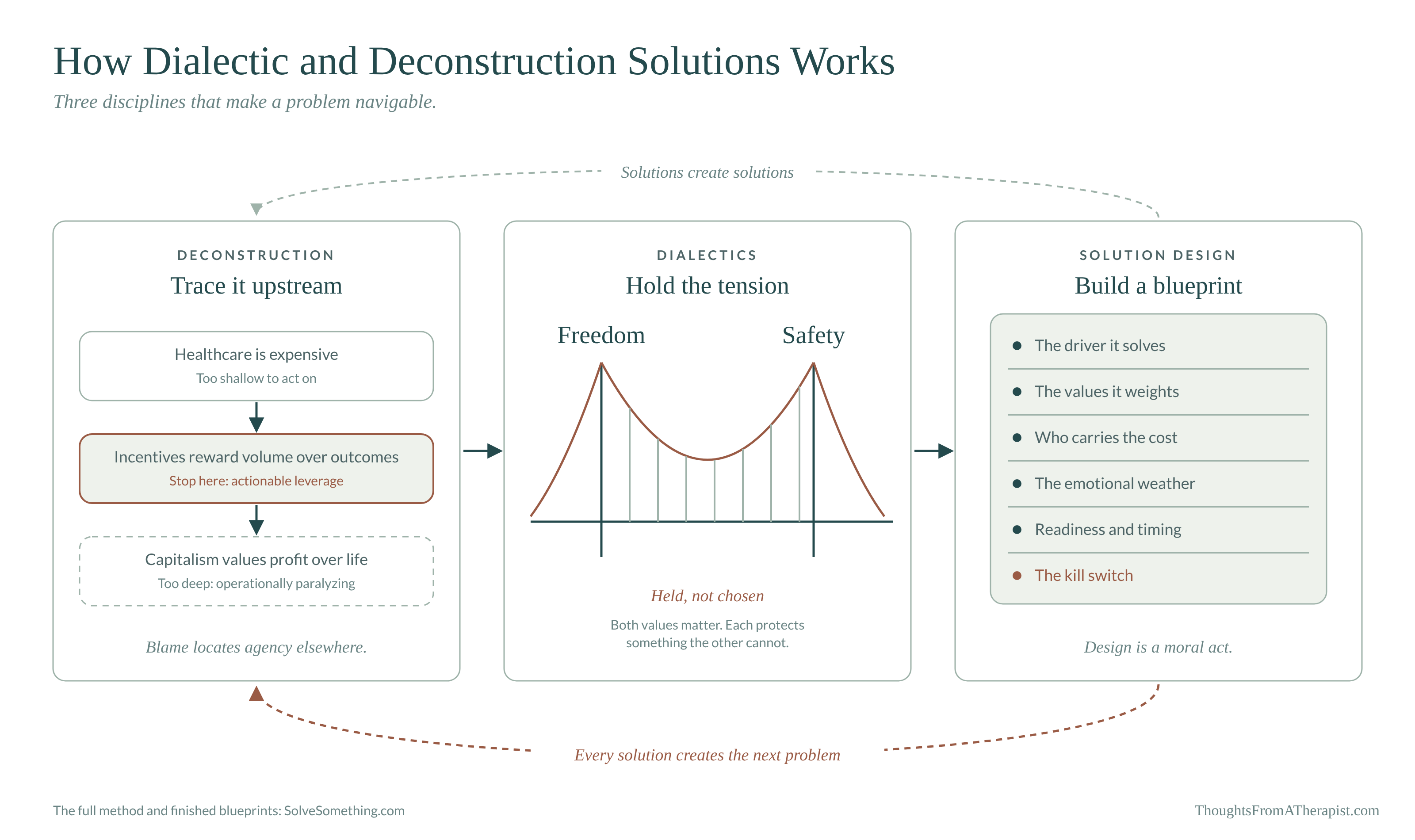
Deconstruction, dialectics, and solution design: three disciplines that make a problem navigable.
Liberal and Conservative as Strategies
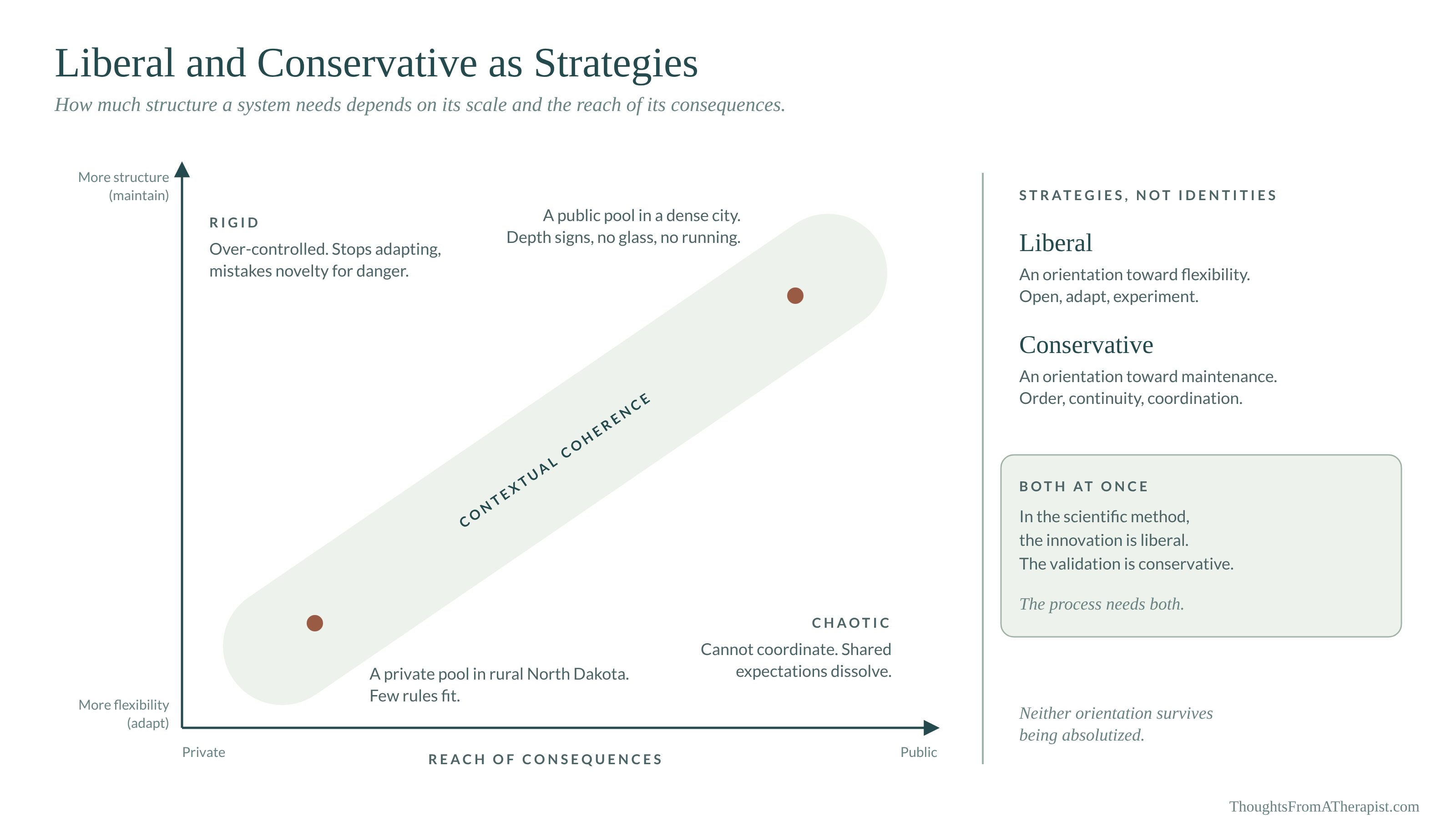
Liberal and conservative as strategies for how much structure a system needs.
Work with William
In therapy this shows up when politics has come between partners or family, when the news is running the nervous system, and when we want positions that are our own.