05
Topic guide
Start here
Meaning sits under every other topic on this site. This guide follows why a good life can feel disappointing, what enough would be, and how freedom, responsibility, play, and an ending shape the lives we are actually living.
Read these first
- Why Am I Disappointed Even When Things Are Good?How expectation makes what goes well almost invisible.
- The Question of EnoughEnough as the moment the body no longer braces.
- Anxiety as a Signal of MisalignmentExistential anxiety and the space between who we are and how we live.
Questions this topic answers
- Is it worth breaking my values to reach a goal?
- Why does avoiding stress so carefully create more stress?
- Why can’t my partner stop doing and just float?
- Why do I feel like I’m performing my life instead of living it?
- If it wasn’t my fault, why is it my responsibility?
- Can hope spread the way fear does?


Fulfillment is the recognition that a life feels like our own. It shows up when what we value, what we feel, and how we live move in the same general direction. That movement happens inside a few facts every life shares: we are free, we are responsible for what we do with that freedom, we are finite, and the largest questions stay open.
Happiness is an emotion. It arrives and it leaves, the way every emotion does, and when we make it the goal, its absence starts to feel like a failure we should be ashamed of. Meaning asks something different of us. It is practiced through what we choose, what we make, and what we are willing to carry.
Does the life we are living feel like our own, and what would enough be?
When a good life doesn’t feel good
What we register from an experience is roughly its quality minus what we expected from it. A surf trip we expect to be a nine that turns out to be a nine leaves nothing gained. A seven, still a good trip, registers as a disappointment. When expectation becomes the baseline, what goes well can become almost invisible, and imperfection stays vivid because it violates the standard. We remodel a kitchen and cannot stop looking at the one tile that is slightly misaligned.

Efficiency sharpens this in capable people. We learn what something should cost and how long it should take, then carry that standard into places where we no longer control the variables. At a slow, expensive dinner we can be physically present with someone we love and psychologically engaged with the waiter, the kitchen, and the bill. Eventually we are no longer enjoying, participating, or receiving. We are auditing.
A perception can be accurate and still become disproportionately important.
Expectations help us recognize mistreatment and maintain accountability, and some deficits should never be reframed into gratitude. What can change is how much authority an unmet expectation receives. This is not positive thinking. It is an effort to keep our emotional attention proportionate to our actual values. The full piece is Why Am I Disappointed Even When Things Are Good?, and the expectations worksheet sets what we expected against what happened and asks whether the shortfall deserves the attention it is taking.
Four facts under every life
Underneath the crooked tile sit larger facts no life gets to skip. Existential philosophy names them, and they arrive in therapy in ordinary clothes. Each has a way we meet it and a way we avoid it.
| Fact | How we avoid it | What meeting it asks |
|---|---|---|
| Freedom | How we avoid itLetting the group choose for us | What meeting it asksCarrying the weight of our own choice |
| Responsibility | How we avoid itAnchoring in fairness and blame | What meeting it asksOwnership of what happens next |
| Finitude | How we avoid itBusyness and endless escalation | What meeting it asksAdmitting the edges of time and energy |
| Uncertainty | How we avoid itCertainty, or the conclusion that nothing matters | What meeting it asksStaying inside questions that do not close |
Freedom
On a backcountry ski trip with new friends, the snowpack looks unstable, no one has dug a pit, and the group’s excitement is carrying everyone toward the descent. Speaking up risks belonging. Staying silent risks our lives. Overriding our own knowing risks self-betrayal. There is no option without fear. The only question is which fear we select.
From an existential lens, this is simply the weight of choice. There is no one to hide behind. The group no longer absorbs responsibility for us. More in Fear of Abandonment vs. Integrity, and The Dialectic of Courage asks when moving through fear becomes too much.
Responsibility
The problem in front of us often was not our fault, and the solution is still ours to hold if we want to move forward. When we anchor ourselves in fairness, we remain stuck at the point of injury. When we take responsibility, we reclaim direction. Responsibility does not mean blame. It means ownership of what happens next, and choice expands as ownership expands. The Difference Between Fault and Responsibility holds both halves.
Finitude
Our time and energy have edges, and life ends. A life that will not admit its edges runs as if nothing could be enough, and a full schedule can hold that life together while keeping the question of meaning from ever arriving. Some of us are fighting life by doing, believing without knowing we believe it that if we stop we will be annihilated.
There is joy in being without purpose, in walking through a forest without direction, in not requiring every sunset to ask something of us.
Treading Water follows what this does inside a partnership.
Uncertainty
What happens after we die. What existed before time. Whether consciousness emerges from matter or matter from consciousness. These are not only intellectual questions. They are emotional experiences, and many of us were handed answers before we had permission to feel what not knowing is like. The certainty that forms around those answers protects us from a reality that cannot be fully resolved. Its mirror is the nihilist, who holds that any search for meaning is meaningless and can always return to that loop. Both close the question early, and both stop the inquiry in the same place.
Faith can hold the unknown. Certainty cannot.
The Realities of Rigid Identity traces what certainty protects us from, and Why Are We So Afraid of Artificial Intelligence? carries the open questions into consciousness, direction, and the limits of what we can know.
What is enough?
Enough is the daily face of finitude. For many of us it becomes a variable without edges. The nervous system adapts to intensity, what once felt engaging becomes ordinary, and the ordinary begins to feel insufficient. Then shame arrives, and we conclude that we have not done enough to achieve satisfaction with enough.
Without a defined threshold, the mind defaults to escalation, and the nervous system interprets that as activation. Rest is the physiological recognition of enoughness, a moment in which the organism registers that this is sufficient and it may stand down. Thresholds differ. Some people need extended stillness to feel regulated, and others come alive inside complexity and challenge. Their enough has little to do with the enough of others, and sometimes something genuinely is not enough.
From my own life
What my own system may need right now is to walk into the next room, turn on a Down Easy track, and pick up my bass. The nervous system does not evaluate restoration by appearances. It responds to coherence.
Enough is less a number than a physiological recognition, the moment when the organism no longer braces. Contentment is what that moment feels like from the inside, sometimes as stillness and sometimes as absorbed doing. The Question of Enough stays with the question without forcing it closed.
Chasing and receiving
Two sentences are true at once, and this guide leaves them side by side.
It cannot be seized
Reaching for happiness raises the bar. When we optimize our way out of dissatisfaction, the optimizing occasionally works, and it also raises the expectation attached to the next experience. A strategy can reproduce the state it was built to escape. We leave early for the airport to avoid feeling rushed, the morning needs another thirty minutes, and we become hurried and activated in the name of avoiding hurry and activation. Sometimes relief begins when we stop organizing ourselves around the demand altogether. If I strive to be effortless, I am striving still. More in The Anxiety of Efficiency.
It does not arrive in a life no one chose
Joy also needs a life with someone’s wanting inside it. We use strategy and structure to manifest emotional ambition, to become who we claim to be, and discipline becomes the servant of meaning. The failure on this side belongs to people who understand every position so well that they never claim one. Every path stays equally valid, so no life gets chosen, and nothing gets wanted simply because we want it.
It can look like wisdom. It feels like drift.
Living between them
The practice lets striving soften into rhythm, effort and surrender alternating like breath. Intention and the joy of a moment are often reciprocal. More intention can make room for joy, and joy can free us to act with intention. Either can also crowd the other out. A life lived by plan can be predictable and reflective, with a deficit of joy. A life lived for the moment can be full of spontaneous connection and short on security, congruence, and purpose.

Neither pole is universally best, and resolving the tension early in either direction costs something. On some weekend mornings the wiser thing is to beat the parking lot to the mountain. On others, after too hard a week, it is to let skiing go for the day.
Play sits closer to presence than to purpose, and Spirituality, Creativity & the Present Moment follows it there.
Purpose without a destination
We are often taught to name a goal and stay focused on the outcome, and rarely invited to examine how we get there. We are shaped by the means as much as by the outcome. If we consistently compromise our values to win, we arrive at the finish line changed.
I have come to think the deeper purpose of life is exactly this: to become congruent. To align what we know, what we feel, and how we act, and to let emotions point toward what brings meaning. Existential anxiety shows up in the space between who we are and how we are living. There is also a smaller register, where nothing we are doing is wrong, exactly, and none of it serves anything. That is where futility lives. Part of the answer is something chosen rather than merely consumed, however small.
Congruence
Musical harmony is the presence of relationship among notes, and dissonance belongs to it. Congruence is that same principle applied to the self.
A performed life has a recognizable feel. What comes back from it is pre-formed. It is coherent, and it fits, and it is not alive. Purpose rarely asks us to carry everything. Nobody has to solve the whole thing. People need a way to find the part they can carry, and some experience that their presence here can be useful. Do the Ends Justify the Means? makes the case for congruence, Anxiety as a Signal of Misalignment reads the anxiety that appears when a life drifts from it, and What If Hope Is Contagious Too? widens the question to what we might build together.
Living with an ending
Finitude is a structure before it is a threat. Facing an ending can make a life larger, because mortality asks for proportion more than urgency. The same scale that makes a crooked tile small makes a conversation large.
When we die, our atoms feed soil, tree, fruit, grandchild, matter returning to motion. Death becomes continuity. That view does not settle what death is, and it does not have to. Questions of purpose, belonging, wonder, and mortality can be explored with the people we love without being answered.
Grief is the part of an ending that cannot be strategized. It asks for being, and it is hardest for people whose lives are organized around fixing things. Fear is present tense. Grief is past tense.
Something can be over and still matter. The point is that it becomes past.
What Is Happening to Me When My Trauma Is Triggered? follows how mortality can go on living in the body and what lets it acquire an ending.
Questions to sit inside
Existential work is more questions than answers. These are for carrying a while, with no score at the end.
Enough
Rest
Do I have enough rest for my nervous system to register safety?
Purpose
Time
Is my time oriented toward what feels existentially meaningful?
Congruence
The means
Does this approach reflect who I want to be? Will this action require me to disconnect from myself?
Proportion
The complaint
The complaint may be correct. How much of the evening does it deserve?
Anxiety belongs inside these questions too. When we treat it as a messenger rather than a malfunction, we uncover where change is asking to happen. One question can hold the rest for a week: what would we make or do for no reason at all, letting the act itself be enough?
Coherence and its two failures
In the Fractal Field of Mental Health, fulfillment lives mostly in the engaged dimension, with the existential questions running underneath it. Each dimension can be balanced, overexpressed, or deficient.
Balanced
A life that feels like our own
Action feels like flow rather than effort. We act from vitality, not compulsion, and fulfillment is the recognition that our life feels like our own.
Overexpressed
Chasing
We chase meaning as an identity. Ordinary life feels inadequate, purpose becomes pressure, and we mistake exhaustion for meaning.
Deficient
Hollow
Life feels hollow, directionless, or disconnected. Achievements lack depth, and meaning collapses into nihilism.
There is a dialectical version of the same imbalance. Some of us hold every perspective so evenly that we never advocate for our own. The same sensitivity that makes us valuable becomes the reason we hesitate to advocate for what we value, and the openness that looks like wisdom becomes a life no one chose. Others grasp for certainty and resolve the open questions too quickly. The adult work is staying present with uncertainty while still moving with intention.
How this connects
Anxiety
Anxiety, Stress, Triggers & Trauma
Existential anxiety is the distance between who we are and how we are living.
Self-worth
Self-Awareness, Self-Worth & Integrity
Congruence is where values become behavior, and advocating for our own is part of it.
The present moment
Spirituality, Creativity & the Present Moment
Enough is a bodily recognition, and play and wonder live there as immersion.
Relationships
Relationships, Couples & Communication
Much of what makes a life meaningful is reached through other people.
Most of us were handed answers before we were invited into the questions. What enough would be, what we are free to choose, what we are willing to carry, and how to live inside something that ends stay open for as long as we are alive. A life organizes itself around them whether or not they are ever asked out loud.
Worksheets, self-reflections, and diagrams
Worksheets for this topic
Why Am I Disappointed When Things Are Good? Expectations Worksheet
Expected against actual, and whether the shortfall deserves the attention it takes.
Why Good Experiences Can Feel Disappointing
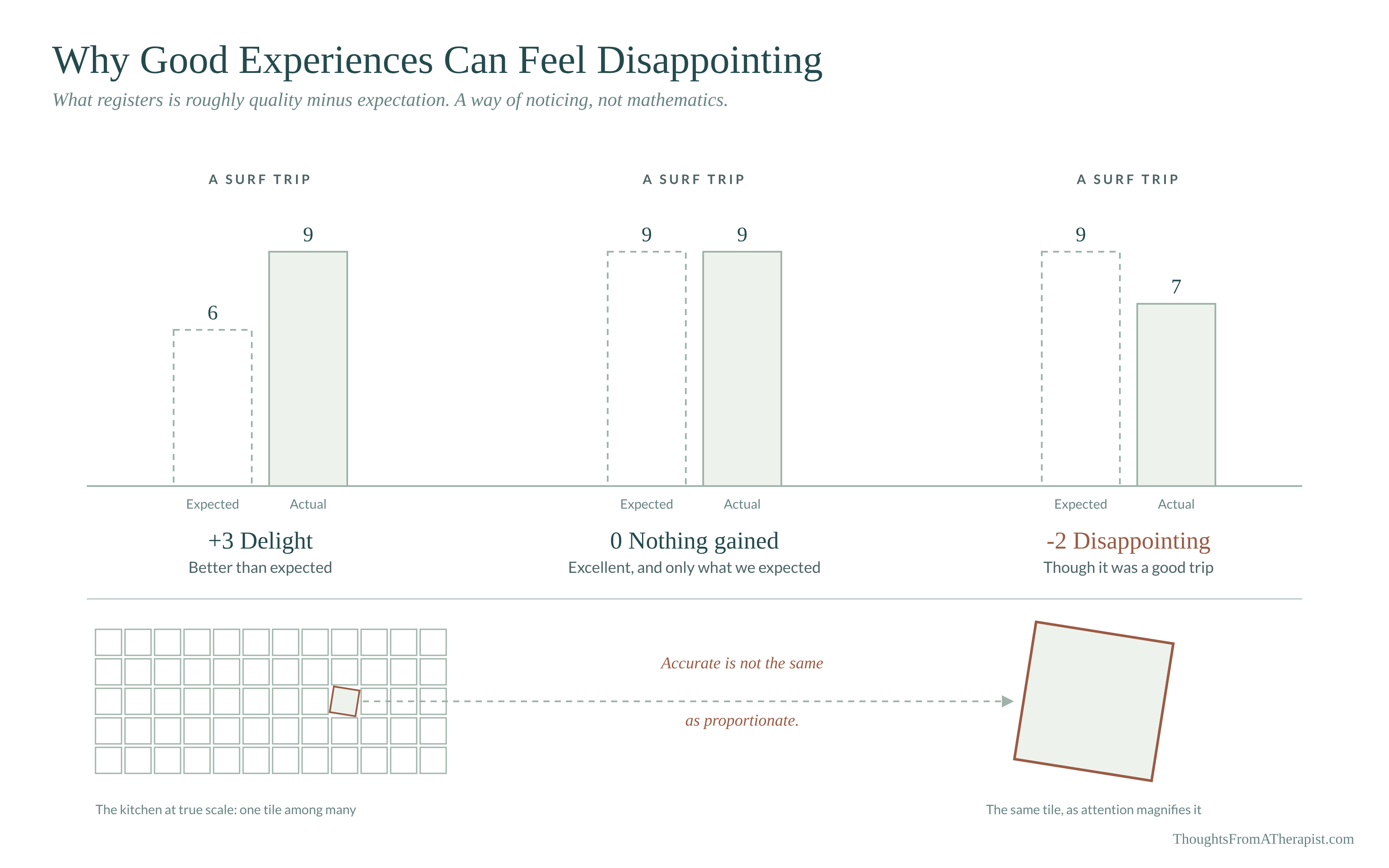
What registers is roughly quality minus expectation. A way of noticing, not math.
Intentionality and HappinessLiving by Plan or in the Moment
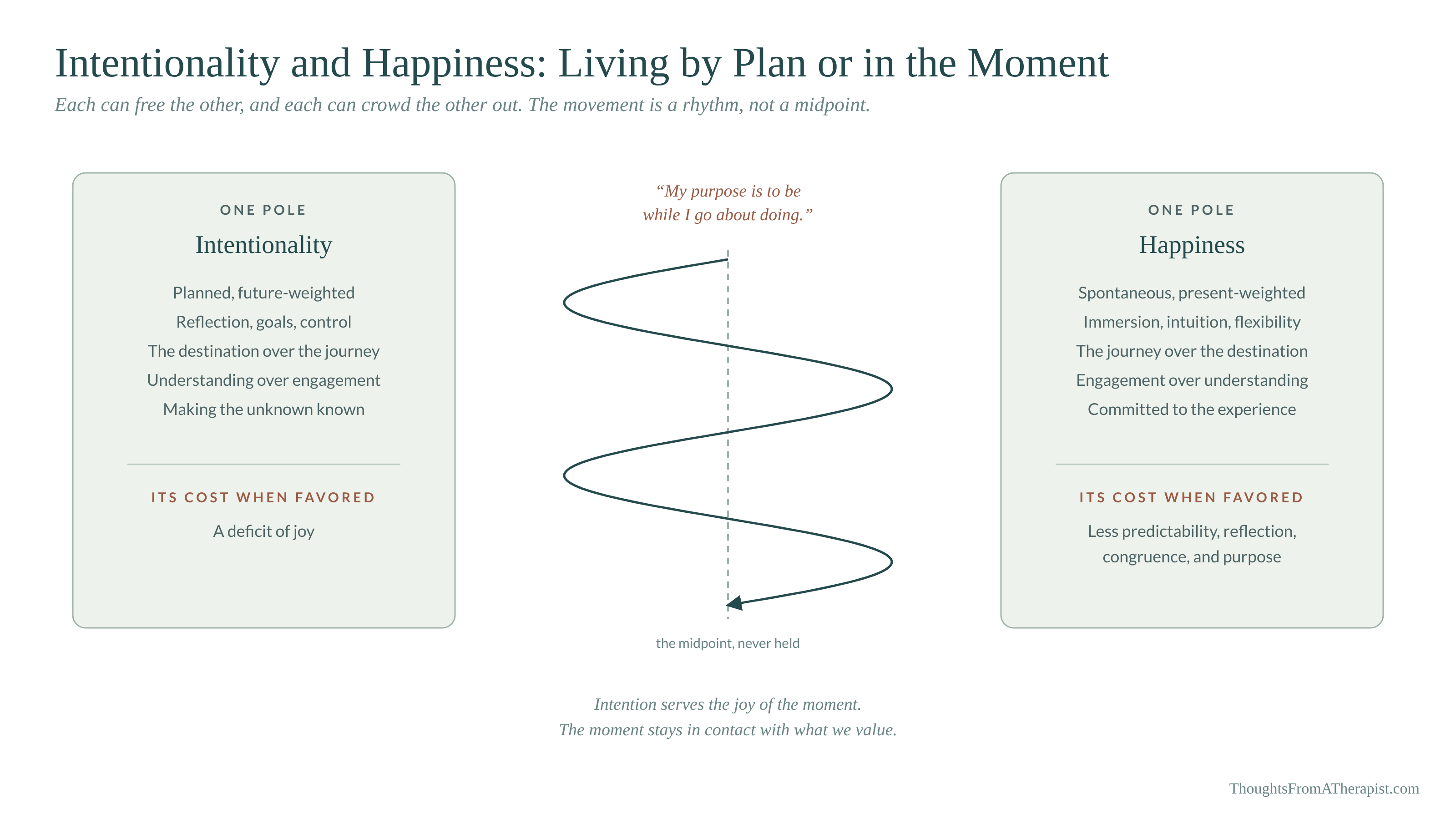
Planning and presence can crowd each other out. The movement is a rhythm, not a midpoint.
Work with William
In therapy we sit inside questions most of us have never been invited to ask, like what enough would be, and let our own answers reorganize how we spend a life.