
08
Topic guide
Start here
Most people arrive at therapy asking what is wrong with them. This guide follows what a symptom is trying to do, why understanding ourselves is rarely enough, and what actually changes people, with a section for clinicians and supervisees near the end.
Read these first
- An Integrative Alternative to the DSMSymptoms as adaptations, and coherence instead of labels.
- Is My Job to Make You Feel Better?Comfort or growth, and knowing which a session needs.
- Can AI Conduct Therapy?Some growth needs a person who could leave.
Questions this topic answers


Therapy is a relationship in which another nervous system is present. Most people arrive asking what is wrong with them. This guide starts somewhere else: what a symptom is trying to do, why understanding ourselves is rarely enough, and what actually changes people. A section for clinicians and supervisees sits near the end.
Many symptoms are coherent responses to the conditions a person lived in. Therapy, as I practice it, is less the application of techniques than the restoration of communication within a living system, and much of that restoration happens inside the relationship itself.
The question shifts from what is wrong with me to which part of me is asking for attention.
What a symptom is trying to do
Much of what we call dysfunction is really adaptation. Much of what we shame in ourselves is, at some level, a gesture toward safety or dignity. Being controlling may have offered structure in a chaotic home. What once protected us can become what constrains us when it persists beyond its original context.
A hibernating bear meets many of the criteria we associate with depression: slowed movement, reduced appetite, withdrawal. Within its ecology, those behaviors are intelligent adaptations. Human experience is far more complex, and the principle holds. Without context, we risk mistaking protective strategies for primary pathology.
Context does not dilute responsibility. It restores it to scale.
Not everything is a wound. Sometimes a behavior is a trauma echo. Sometimes it is who we are. Often it is both. Curiosity Without Judgment asks what a pattern was protecting, and Nature, Nurture, and the Rhythm of Our Relationships holds the other side.
A map instead of a label
The DSM offers a shared language for describing distress, and shared categories make research and coordinated care possible. Classification is necessary and insufficient. It describes patterns without the systems that give them meaning.
Its lines are also binary. The manual draws its line where an insurer needs one drawn, at the point where a response becomes debilitating. Trauma, depression, addiction, and attention are not switches in lived experience. They are degrees. The question is never whether we have it. It is how much of it we have, and in what context.
The Fractal Field of Mental Health asks how coherence is functioning across seven dimensions, each of which can be balanced, overexpressed, or deficient.
| Dimension | What it holds | When it narrows |
|---|---|---|
| Individual | What it holdsOur sense of self and narrative continuity | When it narrowsLiving inside a story that no longer fits |
| Relational | What it holdsHow we connect while remaining differentiated | When it narrowsCloseness treated as danger, or distance as safety |
| Embodied | What it holdsHow experience lives in the nervous system | When it narrowsThe body decides before the mind understands |
| Integrity | What it holdsThe alignment of values and action | When it narrowsValues present, without the support to enact them |
| Dialectical | What it holdsHolding tension without collapse | When it narrowsChoosing a side too early for the comfort of certainty |
| Engaged | What it holdsCreative participation in life | When it narrowsMistaking survival for living |
| Interconnectedness | What it holdsOur relationship to larger systems of meaning | When it narrowsIsolated in community, or responsible for the whole world |
Change in one dimension reverberates across the others. When the body feels safer, thinking becomes more flexible. A diagnosis describes, and a coherence map orients. It gives a client a language of recognition, a way to see experience as patterns within a system that is trying to reorganize itself. The full argument is in An Integrative Alternative to the DSM.
Where each kind of therapy enters
Cognitive approaches clarify thinking. Somatic approaches restore regulation. Relational therapies reshape attachment. Existential approaches deepen meaning. Each is accurate within its scope, because each restores communication within one part of the system. I am an integrative therapist, and for me therapy is less about choosing the right modality than recognizing which domain of the field is asking for attention.

This changes what we make of being stuck. A common hidden cost in clinical work is mistaking a mismatch of domain for a lack of effort, insight, or motivation. Interventions in Relational Counseling lays out the families of intervention a therapist moves between.
Why understanding ourselves is not enough
Insight and growth are not synonymous. Insight quiets the commentary. It does not lower the cortisol. Through inter-regulation, a person borrows enough stability from someone else to recover access to their own. The therapist’s breathing, face, voice, pacing, and lack of alarm become part of the present evidence.
Over time, something else happens. A client can disappoint me and discover that the relationship survives. They can disagree with me, become angry with me, and find that I am still sitting there. A caring person can remain caring when we disagree. A boundary can exist without ending attachment. Closeness does not have to eliminate choice.
We do not reason our way into secure attachment. We develop it through repeated experience.
Therapy can be one of the relationships where a different expectation develops, alongside a grandparent, a mentor, a friend, or a partner. The old prediction stays available under stress while a new one gradually becomes possible. What Are the Four Attachment Styles? follows that change, and Why Can’t I Change Even When I Understand My Patterns? stays with the gap.
Staying with what is alive now
A client tells a story, and something starts to surface: a shift in tone, a tightening, a brief hesitation. Then they summarize and move on, and the moment closes before it has fully opened. Immediacy slows the moment with something as small as I notice your voice softened just now. It adds no new content. Clients rarely need help telling their story. They need support in staying with the parts of it that are still alive in them. More in Using Immediacy in Therapy.
When the therapist uses themselves
Sometimes I name my own reaction, tell a story from my life, or use humor. If I leave a session feeling talked at, that feeling may be what the people in a client’s life have been struggling to describe. The therapist’s experience does not tell us who is right. It tells us what the interaction organizes. Before offering it, we differentiate what belongs to us from what is being organized between us. The thing to watch for is a disclosure that asks the client to take care of the therapist, or feedback in the wrong moment that confirms the fear the person walked in with. Why Does My ADHD Make Me So Anxious? shows that double bind from inside a session.
Comfort or growth: what a session is for
Therapy has two primary roles on a continuum. One is to nurture, comfort, and help settle the nervous system. The other is growth, which asks us to question the stories we have become attached to and to assume more responsibility, because responsibility is where our influence lives.
The question worth holding
Am I here today to feel better, or am I here to grow?
A successful session may leave someone more uncomfortable than when they arrived, and that discomfort is not necessarily evidence that therapy failed. Early on, a person may need us to lend them our stability. Later, they may ask us not to. Is My Job to Make You Feel Better? follows a long-term client who asked for the second. The Getting the Most Out of Therapy worksheet helps sort what today is for, along with fit and feedback.
Growth between sessions needs accountability without shame. It is closer to rehabilitating an injured knee, where the therapist helps us trust that this particular discomfort is serving healing. Without that, therapy becomes a place where life is understood but never changed. Understanding Anxiety Is Only the Beginning takes up the distance.
Pacing, rupture, and repair
Every method enters through a relationship in which pacing, consent, and the freedom to stop affect whether the work becomes usable. Saying stop without having to submit, disappear, or escalate is corrective in itself. A stop can also become the place where the work repeatedly ends, and the therapist stays curious about that without overriding the person.
Therapists get it wrong. We move too quickly toward a new interpretation, or soothe what needed to be felt. Repair means recognizing the rupture and re-entering the relationship, owning our part without collapsing. Clients learn more from a repaired rupture than from an hour where nothing went wrong, because the repair demonstrates that a relationship can survive impact.
When therapy is not working
Comfort organizes every hour and we never meet anything to grow against. Insight accumulates and nothing in our life moves. We feel categorized more than understood. The most useful response is to tell the therapist directly. How that feedback is received is part of the treatment.
AI and therapy
AI may become astonishingly good at some of what therapists do: psychoeducation, pattern recognition, journaling, preparing for a difficult conversation. I use it myself. Its ease is also its limitation. Something whose entire function is to keep trying to understand us cannot be disappointed in us, tire of us, or leave, and some growth requires a person who can. ChatGPT offered me the phrase for it: consequential otherness. Learning to remain ourselves while deeply connected to someone who experiences the world differently may be one of the central developmental tasks of being human.
AI can help me understand that. Another person gives me somewhere to practice it.
Fluency is not evidence of experience. AI can serve understanding and preparation, and what it surfaces still needs a relationship to be practiced in. Can AI Conduct Therapy? makes the full case, and Why Are We So Afraid of Artificial Intelligence? widens it.
What we can ask of therapy
A client holds more authority over the work than many people assume. These are fair things to ask for, and fair things to refuse.
Before changing a pattern
What did it protect?
Within what context does this response make sense?
Each session
Comfort or growth
We can say which one we need today.
Pacing
The freedom to stop
A no that is respected without the relationship ending.
Between sessions
Practice
Insight that becomes something we do, with accountability that does not turn into shame.
Underneath these sits the method I bring to most of the work.
Dialectics
Both at once
Fault and responsibility, comfort and growth, the old prediction and the new one.
Deconstruction
What it protected
The adaptation traced back to the need beneath it.
Differentiation
Separate from the label
“I am anxiously attached” becomes “I have an anxious response in this relationship.”
Coherence and its two failures
In the Fractal Field, the therapy relationship lives mostly in the relational dimension: how we connect while remaining differentiated. The therapist’s presence can be balanced, overexpressed, or deficient there.
Balanced
Regulated and separate
Regulated without becoming distant, caring without becoming possessive, consistent without using consistency as leverage.
Overexpressed
Help that outruns the client
We soothe what needed to be felt, or take on the client’s physiological state instead of offering ours.
Deficient
Competence out of reach
We become cognitive and remote. The client meets a therapist who is calm and unreachable.
There is a dialectical version of the same imbalance. A therapist can validate every side of a client’s story and never take a position. Comfort organizes the hour, and the client never meets resistance they could grow against.
For clinicians: the self of the therapist
Training gives us models. What it rarely develops with the same rigor is the instrument. Two clinicians can hold the same credential, run the same protocol, and produce outcomes that do not resemble each other. The difference is usually the person carrying it.
Each capacity sits on a spectrum. We often miss the failures at the high end because they arrive wearing the costume of virtue. The therapist who feels everything the client feels is not more empathic. The therapist who never wavers is not more grounded. Burnout in our field is more often dedication with no counterweight.
The instrument and the person are not separable. Whatever coherence we find is the coherence available to the room.
Equanimity, not certainty
Our own regulation is a clinical variable. The dysregulated system entrains toward the regulated one, and the inverse happens as readily. Rather than instructing a client to breathe, it is usually better to breathe. Our formulation is an event in consciousness, never a fact about the person. Supervision is where most of this becomes visible, because what we can see alone is limited by our current organization.
For clinicians and supervisees
Self of the Therapist: The Capacities maps each capacity when it runs thin and when it runs hot. Self of the Therapist: Core Dimensions follows what we carry in. Somatic Descent Into the Hidden Narrative is a clinical vignette.
The Self of the Therapist Inventory checks where forty-seven capacities sit on an ordinary day and on the hardest one. The reflection worksheet maps what we bring into the room, and the immediacy practice log gives immediacy a place to be practiced session by session.
How this connects
Relationships
Relationships, Couples & Communication
Therapy is one of the relationships where a new attachment expectation can form.
Anxiety
Anxiety, Stress, Triggers & Trauma
The four stages of a reaction are how a therapist times comfort and challenge.
Self-worth
Self-Awareness, Self-Worth & Integrity
The gap between insight and change is the reason the relationship matters.
Most of what brings us to therapy was organized around something that once made sense. Seeing that loosens the shame. The organization itself changes where it meets a different experience, repeated, with another person who is free to misunderstand us and is still there. Some of that happens in a therapy room. Most of a life happens outside one, among people who are equally free.
Worksheets, self-reflections, and diagrams
Worksheets for this topic
Getting the Most Out of Therapy WorksheetFit, Feedback, and What I Need Today
Comfort or growth today, fit, feedback, and what to ask for in therapy.
Types of Therapy ExplainedWhere Each Approach Enters
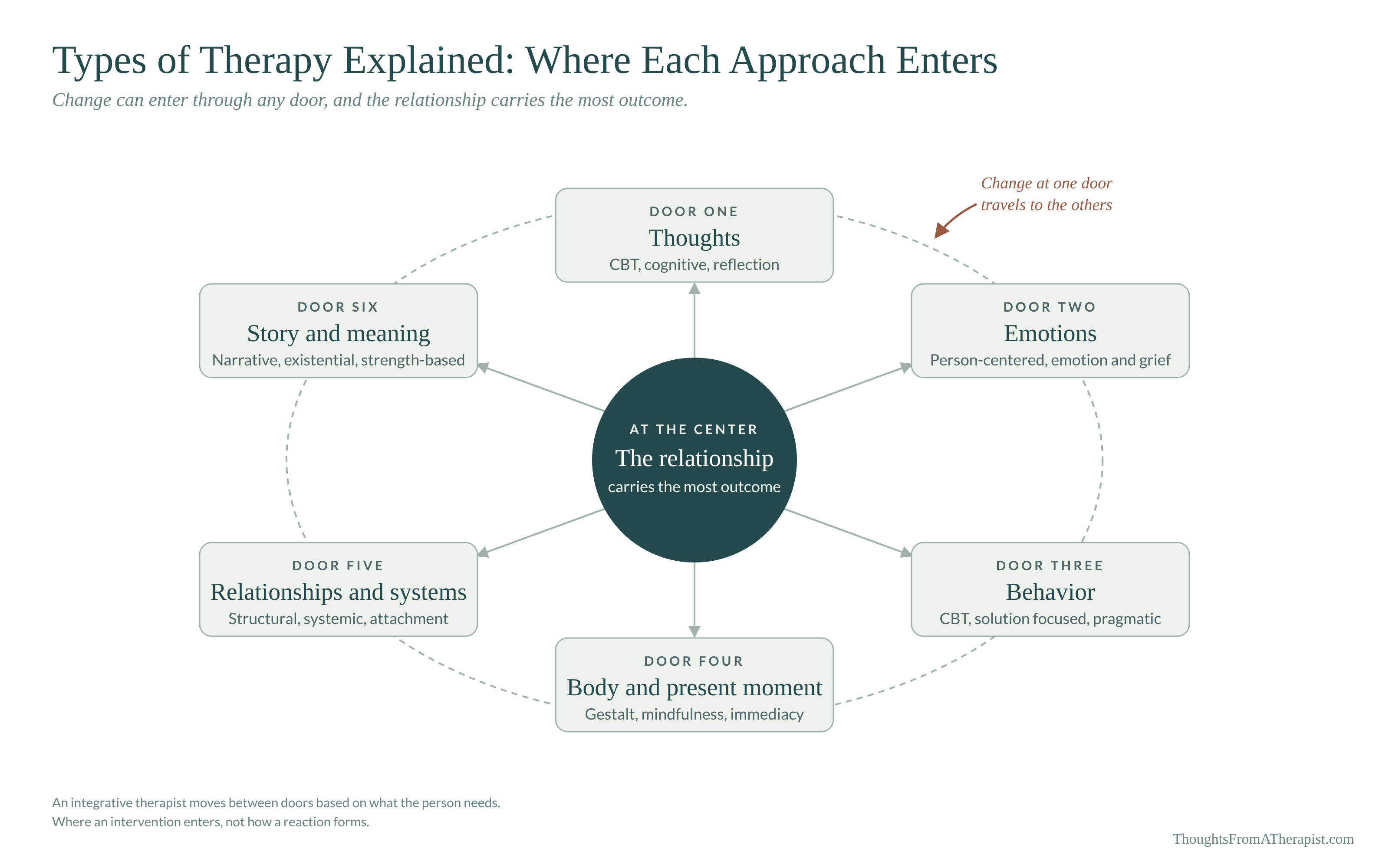
Where each approach to therapy enters, and why the relationship carries the most outcome.
Self of the Therapist Reflection WorksheetWhat I Bring Into the Room
For clinicians and supervisees: what we bring into the room, from family role to blind spots.
Immediacy in Therapy Practice Log for Therapists
For clinicians and supervisees: a log for practicing immediacy in session.
Self of the Therapist InventoryClinical Capacity Drift Check
For clinicians and supervisees: forty-seven capacities on an ordinary day and on the hardest one.
Work with William
In therapy we look at what a pattern protected, agree on whether today is for comfort or growth, and use the relationship itself, ruptures included, as the place change is practiced.