
03
Topic guide
Start here
Parenting asks the same love to keep changing its expression as a child grows. This guide follows the roles a parent moves between, what adolescents are building, the family as a system, co-parenting after divorce, and how raising children changes the parent.
Read these first
- The Four Roles of ParentingFour roles whose mix changes as a child grows.
- Five Core Tasks of Adolescent DevelopmentWhat teenagers are building, learned mostly by watching us.
- How Parenting Made Me More ControllingCare that starts as control and learns to loosen.
Questions this topic answers
- When should a child push through, and when should we step in?
- Why doesn’t my child listen when I say no?
- Did my parenting decide my child’s attachment style?
- Whose need wins when both co-parents want the same time?
- How do we co-parent with an emotionally immature ex?
- Why does parenting make us more controlling?


Parenting is four roles, managing, teaching, mentoring, and nurturing, whose proportions change with the child, the situation, the stakes, and the capacity being developed. The love stays constant. Its form keeps changing, and so does the parent. A family is also a system, and much of what looks like one person’s problem lives between people.
If we wait until a child can manage an experience perfectly before allowing them to have it, we create a circular problem. We require a capacity as the condition for entering the experiences through which that capacity develops. Age gives us probabilities. It does not tell us what a particular person can carry.
What does this moment need from us, and what can this child already carry?
Four roles, not four stages
We tend to manage very young children, teach growing children, mentor increasingly independent children, and nurture adolescents. Development is not that clean. All four roles are present from the beginning, and their proportions keep shifting.
Managing
Protecting without replacing development
Temporary external structure while the child develops more internal structure of their own.
Teaching
Knowledge without making ours the only answer
Making danger legible and giving the child something they can use.
Mentoring
A life to watch, without requiring a copy
Influence without constant intervention.
Nurturing
Available without removing every consequence
The form of care the other person can receive.

A two-year-old does not have the executive functioning required to organize a two-year-old’s life, so someone else has to supply it. The purpose of management is to make itself less necessary, and that transition requires us to tolerate mistakes. When the consequences are real and also containable, a mistake may be part of how readiness develops. When we anticipate every problem and prevent every recoverable failure, the child gets less experience carrying uncertainty.
Teaching makes danger legible, and it loses power once information is no longer the central need. A child may need us to show them how to cook an egg. Eventually we may fail to notice that we are no longer teaching them how to cook an egg. We are teaching them how we prefer an egg to be cooked, and continued correction communicates that difference is error.
Children watch how we respond to frustration, how we treat people when we have more power, and whether we apologize. Mentorship can also become another form of control when we expect the child to become a version of us. Shared activity becomes relational when the other person’s interests are allowed to shape what we share.
Nurturance does not disappear as a child grows. Its language changes. One child wants a hug, another wants a favorite sandwich, another wants to tell the whole story, and another wants us somewhere nearby. Comfort becomes rescue when we use it to remove every consequence. Nurturance is what makes it possible for management to recede, because the child has somewhere relationally safe to bring the scraped knee.
Sometimes intervening protects development. Sometimes not intervening creates it.
Each role carries its own dialectic, and The Four Roles of Parenting follows all four. The four roles worksheet maps the mix we offer now, area by area, and works one situation through.
Growing up is uneven
We are more likely to manage a two-year-old, teach a four-year-old, mentor an eight-year-old, and meet a stronger demand for autonomy in a fourteen-year-old. These are developmental probabilities, and they are not laws. A child may be intellectually advanced and emotionally young. Illness, grief, stress, or an unfamiliar responsibility can temporarily increase the structure someone needs.
A fourteen-year-old may need management around medication, teaching around money, mentorship in athletics, and nurturance after heartbreak, in different parts of the same day. No role is inherently more developed than another. The question is whether the role fits the person, the capacity, the stakes, and the moment.
Adversity is part of that development. Children learn self-regulation and resourcefulness when they face manageable challenges and discover they can meet them. Some adversity is so disproportionate or so senseless that it builds learned helplessness instead. A double bind, the instruction to jump in the pool without getting wet, offers no perseverance to find, only confusion and shame.
| The challenge | What it teaches | What it asks of us |
|---|---|---|
| Difficult and developmentally appropriate | What it teachesPerseverance, and the discovery that we can meet it | What it asks of usPatience |
| Beyond the child’s developmental threshold | What it teachesHelplessness more than strength | What it asks of usStructure and support |
| Nonsensical, double-blinded, or belligerent | What it teachesThat their boundaries and logic cannot be trusted | What it asks of usEmpowerment and advocacy |
The task is to know when to model acceptance and when to model advocacy. Adversity and Advocacy offers the metric, and The Necessity of Adversity looks at chosen difficulty, the hike we take on purpose and name as practice, as a way to widen the range a nervous system can hold.
Teenagers: independence through dependence
Adolescence is a structured developmental process with identifiable tasks. Five capacities are under construction: regulation, identity, foresight, relationship, and agency. Each carries a dialectic, the felt tension between two truths, and a paradox that describes how development resolves that tension over time.
| Task | The tension | How it resolves |
|---|---|---|
| Regulation | The tensionAutonomy and dependence | How it resolvesIndependence through dependence |
| Identity | The tensionPermanence and fluidity | How it resolvesStability through variability |
| Foresight | The tensionKnowing and the unknown | How it resolvesKnowing through the unknown |
| Relationship | The tensionAutonomy and belonging | How it resolvesBelonging through boundaries |
| Agency | The tensionFreedom and responsibility | How it resolvesFreedom through responsibility |
Adulthood begins when these functions move from being borrowed and situational to being internally accessible most of the time. The nervous system develops by tracking how adults carry tension, make choices, and stay grounded in real relationships. We do not teach teens how to become adults by explaining adulthood to them. We teach it by letting them live inside it.

Self-regulation is built through repeated experiences of being regulated by others. When a teen breaks curfew, the adult may notice a thought (they don’t respect me), an emotion (anger and fear), and a body (tight chest, clenched jaw, held breath). Differentiation means separating and observing these layers instead of being overtaken by them.
In the moment
This is a thought. This is fear. This is tension.
The adult then works with the body first, slowing the breath, softening posture, steadying the voice, before engaging. The teen learns that difficult conversations are survivable. We will also get it wrong, which lets both of us take part in repair. Teens learn relational complexity by watching adults hold competing truths aloud: “You want freedom, and a safety plan is still needed.”
Adolescence also brings nurturance back as one of the most available forms of influence. Management is resisted or concealed, and teaching can be heard as distrust. The adolescent is asking to encounter more of the world without having every encounter administered by a parent.
Let me ride the bicycle. Let me fall. Please be there when I scrape my knee.
Five Core Tasks of Adolescent Development gives each task its predictable fear and the response adults can model. The teen development worksheet notices where each capacity already belongs to a teen and where it is still borrowed, and most of it is about what we model.
What children learn to expect from us
A coach benches a child at a soccer game. The child feels cast out from the team and texts a parent: I am having a hard time. Can you come sit with me? The parent has not even arrived, and the expectation of support has already changed the experience. The child is less alone the moment the text is sent.
Expectations like this form through repetition. Caregiving that was chaotic, loving and regulating at times and unavailable or frightening at others, teaches a child that there is no way to predict what connection will bring. Emotional neglect, chronic misattunement, or premature expectations of independence teach a child to stop sending the text. If reaching does not bring relief, we stop reaching. The need is still there. It has become harder for anyone, including the child, to see.
Probabilities, not predictions
Early caregiving shapes a child’s first expectations, and there is no one-to-one relationship between a particular childhood and a particular adult pattern. Temperament, later relationships, and the meaning a person makes of experience all enter the system.
We will get it wrong. Children do not need a performance of flawless adulthood. They benefit from seeing how an adult recognizes a mistake, accepts consequence, apologizes without collapsing, and changes course. Security grows through repeated experience more than through insight, and repair is a repeated experience. A grandparent, teacher, mentor, or friend can also offer a different experience from the one a child learned to expect.
What Are the Four Attachment Styles? follows these expectations from childhood into adult relationships.
How parenting changes the parent
Parenthood begins with control because it has to. A two-year-old running toward traffic does not need a philosophical conversation about autonomy. They need us to grab them. Control becomes an expression of care, and it works. Most adaptations exist because at some point they were useful. The trouble begins when the environment changes and the adaptation does not.
At first, good parenting requires intervention. Eventually, good parenting requires tolerating non-intervention.
Our children have to make decisions we would not make. They have to fail, get hurt, and discover what their own bodies, minds, relationships, and values can withstand. And we have to tolerate watching. Each transition asks a parent to surrender a familiar kind of usefulness. Relinquishing control can feel disturbingly similar to relinquishing care, and they are different things.
Loosening control does not have to mean becoming less responsible. It may mean holding responsibility with a looser grip. Safety and aliveness are both legitimate human needs, and maximizing one can impoverish the other. How Parenting Made Me More Controlling follows this through fourteen years of fatherhood and a fall over the handlebars of a mountain bike.
The family as a system
A family is its own culture. A marriage is its own culture. Much of therapy is the work of helping those cultures stay stable enough to feel safe and flexible enough to keep growing.
Psychological distress often reveals what happens when one part of a system is treated as though it exists alone. A person becomes the identified problem for a family. A symptom carries a conflict the relationship cannot name. An intelligent adaptation continues after the conditions that required it have changed. The individual looks irrational until the surrounding system becomes visible.
Systems also organize around comfort. Change is anxiety and responsibility, so we sometimes collude with the people we love to keep things the same, often under the guise of kindness, patience, or harmony. Growth in one person can expose underdevelopment in another, and codependence takes root in the effort to shield each other from that exposure. Codependence and the Quiet Agreement Not to Grow names the cost.
What we look at first
The behavior that brought the family in. The conflict the adults have not been able to name. Who is carrying the regulation for everyone, and for how long.
When volatility becomes predictable, a family reorganizes around it. We soften language, delay requests, choose timing carefully, and carry more than we should. Responsibility consolidates in the more stable person, and the load becomes difficult to redistribute. One person changing their part changes the system, even when the system resists first. The genogram worksheet draws the family across three or four generations to find where a concern of ours also lives, which loosens self-blame, and who in the family already found a way through.
After divorce: co-parenting and double binds
In any post-divorce family there are moments when both parents have legitimate, emotionally compelling reasons to want the same limited time with their child. Both people can be right about their own suffering, and there is still only one child and one stretch of time. Degrees of subjective pain cannot be compared or adjudicated.
The parenting plan is a decision rule agreed during a calmer phase. Deferring to it acknowledges that both sets of reasons are valid, and because of that, the way out of chronic warfare is to uphold the structure both people chose in advance. We show compassion for the double bind by respecting the plan, without renegotiating it every time the double bind appears.
Compassion without structure leads to chaos. Structure without compassion leads to rigidity. The parenting plan exists to hold both.
With an emotionally immature co-parent, the difficulty is instability in how disagreement is held. A bedtime or a small adjustment does not stay contained. Over time we begin to orient around what will not escalate rather than what would support coherence. The most meaningful variable is the other parent’s relationship to their own experience. Where some self-awareness exists, communication can move things forward in small increments. Where it is limited, structure becomes the primary organizing tool.
Orientation
Our own reference point
Resilience here organizes around orientation more than endurance.
Islands of stability
One steady environment
Predictable routines, emotional availability, and clear expectations give a child an anchor across contexts.
Protected capacity
Energy where it has influence
Limiting engagement that produces no change.
Unresolved
Some issues stay open
Holding conflicting truths without forcing them into a single position.
Double Binds in Co-Parenting After Divorce and Co-Parenting with an Emotionally Immature Parent go further. The co-parenting after divorce worksheet separates a double bind from a pattern that repeats, and the co-parenting worksheet for couples helps two parents who are still together find why each of them parents the way they do.
What helps
Each moment calls for its own role, and the help has to fit the moment.
The role
Ask what this moment needs
Whether the role fits the person, the capacity, the stakes, and the moment.
Consequence
Let what is containable teach
And ask how ridiculous the adversity is before deciding to wait it out.
Regulation
Regulate before we educate
A thought, a fear, a tension. Then the body, then the conversation.
Repair
Model it
Recognize the mistake, accept the consequence, apologize without collapsing, and change course.
Placement
Give the energy somewhere to go
Name the destination along with the limit.
Structure
Return to the plan
Respect the agreement made in a calmer phase.
“Do not throw the ball in the house” sounds like a complete instruction. A younger child may receive almost no useful information from it. Their body is saying they feel fidgety, they want to have fun, and they have a ball. A child throwing a ball in a living room is not doing something wrong; they are doing something right in the wrong room. What was missing was placement, not correction. Why Don’t People Listen to Me? follows the same pattern into adult requests.
In family therapy and parent coaching, we look at the whole system before treating a child as the problem. We find the role a child needs from us now, and we work on the part of the pattern that belongs to us. Every worksheet for this topic is collected below the guide.
Coherence and its two failures
In the Fractal Field of Mental Health, parenting lives mostly in the relational dimension: connecting deeply without losing individuality, with boundaries flexible and clear. Each dimension can be balanced, overexpressed, or deficient.
Balanced
The form fits the moment
The love may remain constant while its expression has to keep changing.
Overexpressed
Too much parent
Management, teaching, mentoring, or comfort that crowds out the child’s development. Comfort becomes rescue.
Deficient
Too little parent
Structure or presence withdrawn before the capacity is there. What looks like autonomy may exceed the capacity currently available.
There is a dialectical version of the same imbalance. Either-or parenting, strict or permissive, protect or let go, is the deficient form. The overexpressed form sees every side so fully, the child’s feelings, the teacher’s constraints, the other parent’s reasons, that no one holds the limit or advocates for the child. When adversity becomes absurd, our responsibility is to intervene, not to spiritualize the suffering.
How this connects
Relationships
Relationships, Couples & Communication
The family is where expectations of help first form, and the couple is its foundation.
Anxiety
Anxiety, Stress, Triggers & Trauma
Children borrow our regulation, and they borrow our dysregulation too.
Culture
Culture, Politics & Shared Problems
A family is a small culture, and the same patterns repeat at every scale.
The present moment
Spirituality, Creativity & the Present Moment
Protecting children can crowd out aliveness, theirs and ours.
We remain responsible while gradually transferring responsibility. A family keeps reorganizing around each person’s growth, and the parent is one of the people growing. The person in front of us continues becoming someone we could never have fully managed, taught, modeled, or imagined, while the love stays where it was and its form goes on changing.
Worksheets, self-reflections, and diagrams
Worksheets for this topic
Which Parenting Role Fits This Situation? Four Roles of Parenting Worksheet
Which role fits this situation? Split ten points across the four roles, area by area.
Teen Development Worksheet for ParentsFive Core Tasks of Adolescence
The five core tasks of adolescence, and what we model while they practice them.
Co-Parenting Worksheet for CouplesParenting Values and Disagreements
Parenting values, where they came from, and how two parents pull the same stroke.
Co-Parenting After Divorce WorksheetDouble Binds and a Difficult Co-Parent
Double binds, a difficult co-parent, and the plan we return to.
Genogram WorksheetFamily Patterns Without Blame
Draw three or four generations and find the patterns without assigning blame.
The Four Roles of Parenting
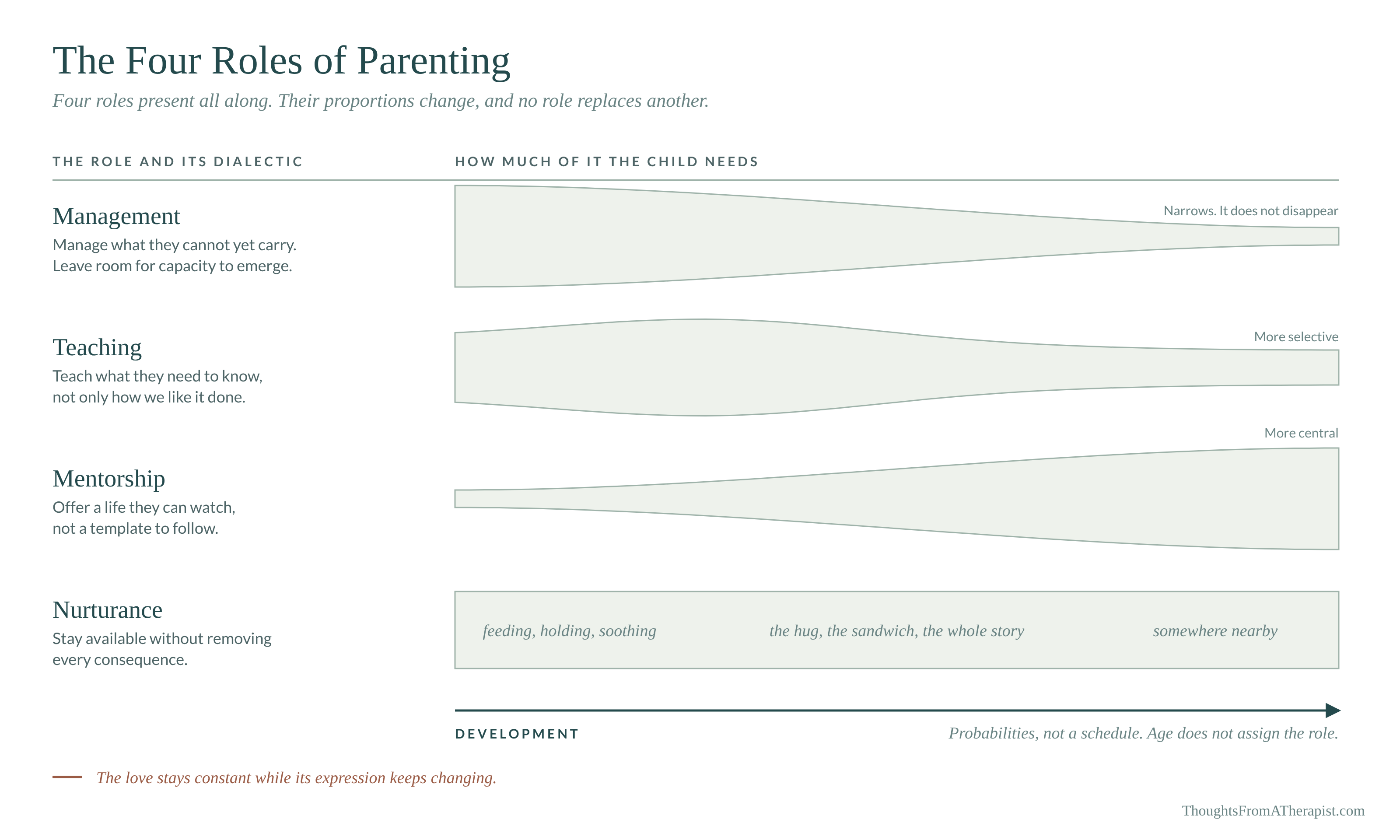
Management, teaching, mentorship, and nurturance: how the mix changes as a child grows.
Five Core Tasks of Adolescent Development
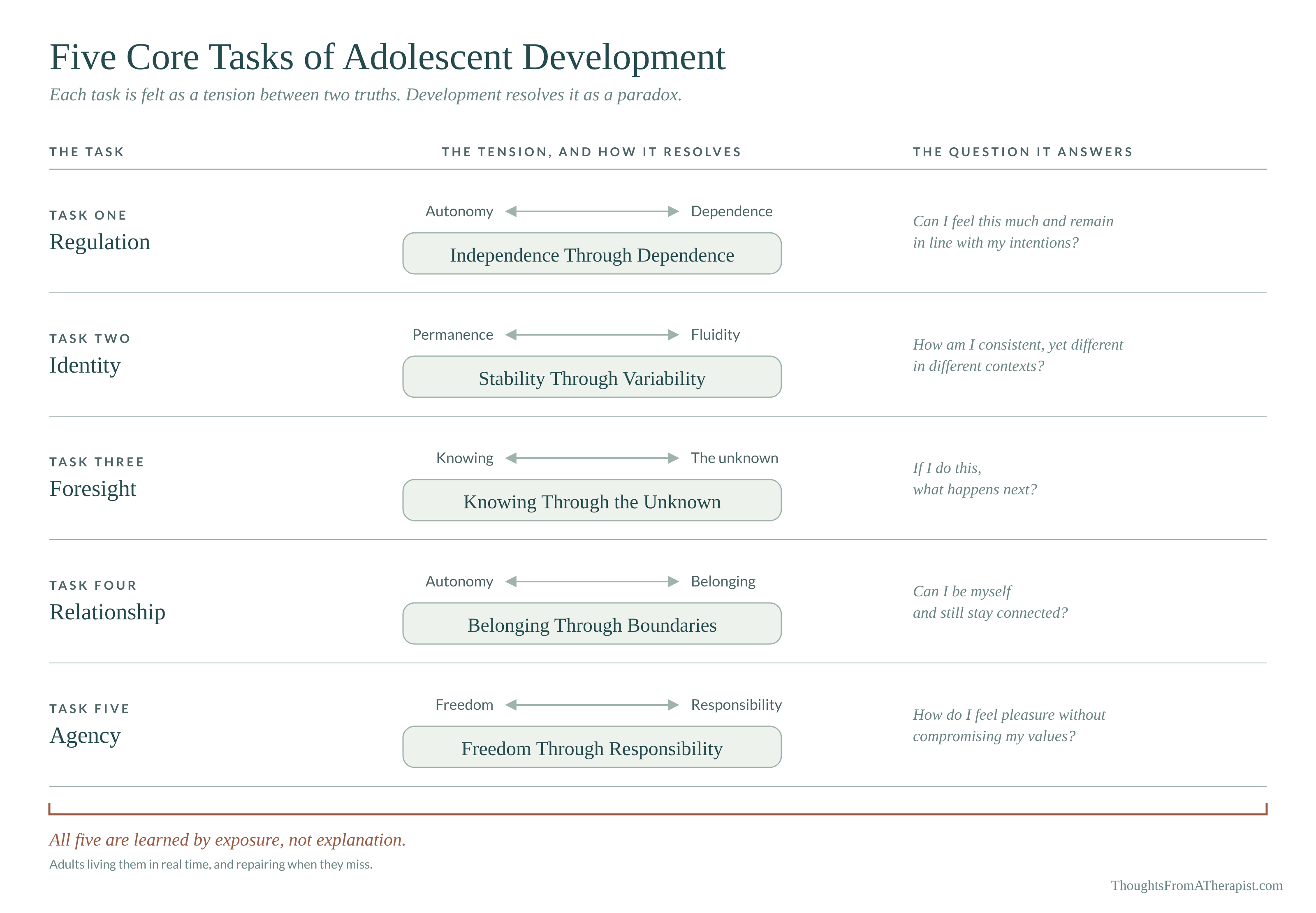
Five tensions every teenager works through, each one a paradox.

A Sample Genogram
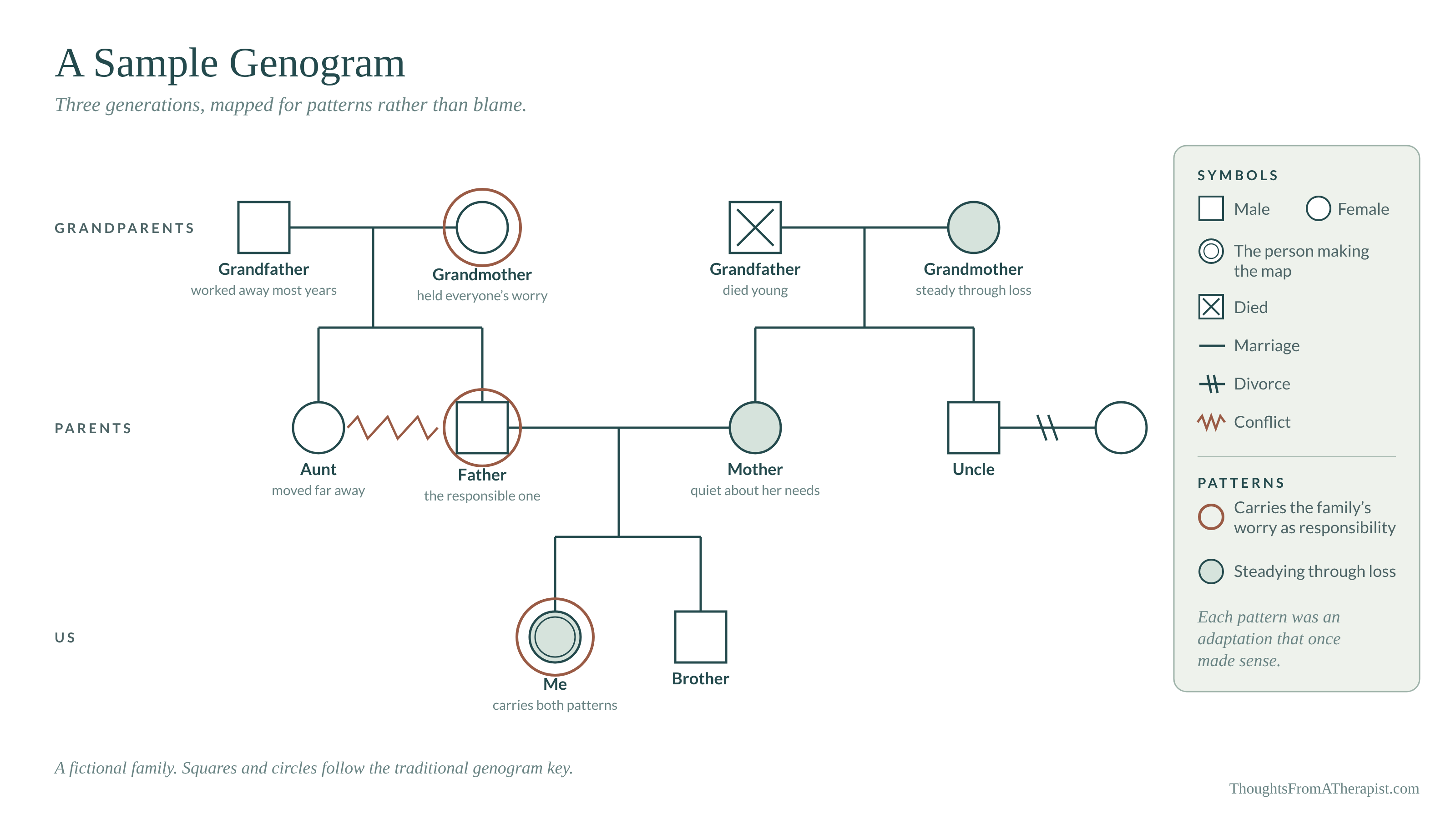
A fictional three-generation family mapped for patterns rather than blame, with the standard genogram symbols.
Work with William
In family therapy and parent coaching we look at the whole system, find the role a child needs from us now, and work on the part of the pattern that is ours to change.