01
Topic guide
Start here
Anxiety is often information arriving faster than we can read it. This guide follows stress, triggers, and trauma from the first spike in the body to the return, and shows where our influence lives inside that sequence.
Read these first
- Why Do I Get Triggered So Easily?The cornerstone map: spike, interpretation, behavior, and return.
- Why Am I Anxious?Four kinds of anxiety, each moving through the four stages.
- What Is Happening When My Trauma Is Triggered?Trauma, collapse and protection, and how the past acquires an ending.
Questions this topic answers


Anxiety, stress, triggers, and trauma move through the same sequence: a spike in the body, an interpretation, a behavior, and a return to baseline. The first spike arrives before choice. Most of what hurts is added after it, and that is where change becomes possible.
Some nervous systems weigh the world in milligrams. A scale that detects what another scale misses is not malfunctioning. It is doing precisely what it was built to do. Our lives are not failed monasteries. The milligram scale goes on reading milligrams. What can change is that every milligram no longer has to become a verdict about who we are.
When anxiety arrives, where is it coming from, and what is it asking for?
Why it happens so fast: the four stages of a reaction
Every emotional reaction moves through four stages. They are numbered for the order in which they usually arrive, and any of them can be the place where the cycle repeats or opens.
Stage one
The spike
The physiological surge, arriving before we have decided anything.
Stage two
The interpretation
What we decide is happening, filled in from what a life has taught us to expect.
Stage three
The behavior
What we do with that meaning. Thinking counts as doing.
Stage four
The return
Re-regulation toward baseline, and the whole event recataloged as learning that shapes the next spike.

The interpretation does not wait for enough information. A child hears the roar of an excavator the day after a dinosaur movie, and for a second there is a dinosaur in the park. An adult hears the same sound as a truck about to back over the path. The mechanism is identical. Only the library has changed.
Stage three is where a private reaction becomes a systems event. Explaining, justifying, and building the case are behaviors when we do them in response to a feeling. The interpretation was a guess made before awareness. The proving is a behavior made after it, and it is the behavior that turns a guess into a verdict.
The gap we cannot find between the spike and the interpretation is available between the interpretation and the behavior. It is small, and it is real. Repair lives there.
The full model is in Why Do I Get Triggered So Easily?, and Why Do I Feel Things I Know Are Irrational? follows what happens when the feeling keeps its authority after the mind has corrected it. To map one of our own reactions, the trigger worksheet works backward from the feeling to the story under it.
Not all anxiety means the same thing
Anxiety comes from four different places, and all four can feel the same in the body. Knowing which one we are in tells us whether to protect ourselves, help the body recognize that the danger is over, examine our own thinking, or move toward a life that fits what we value.
| Snake | Where the spike comes from | What it asks for |
|---|---|---|
| The snake is in the room | Where the spike comes fromA real threat | What it asks forProtection, and someone steady afterward |
| The snake was in the room | Where the spike comes fromA present cue resembling a past danger | What it asks forRecognizing that the danger has passed |
| There might be a snake | Where the spike comes fromThe mind’s own hypotheses | What it asks forExamining the hypothesis and tracing arousal to its source |
| My life is out of alignment | Where the spike comes fromBehavior and values that have drifted apart | What it asks forMovement toward congruence |
When we talk about emotional interpretation, it is easy to create the impression that the person has misunderstood a benign situation. That is frequently inaccurate. Sometimes the person we love is leaving. Sometimes the danger is ongoing. Many highly intuitive people learned vigilance in a home where reading the room was survival, and they go on doubting a reading that is almost always right. They look for evidence, find none, and dismiss what the nervous system already knew.
What I often say
An absence of evidence is different from evidence of safety. I would bet your read is correct.
The fourth kind asks for something different again. Reassurance does little for existential anxiety, because the anxiety may be accurate. Returning to baseline without changing anything returns us to the same incongruence that produced the signal. Why Am I Anxious? places all four inside the four stages, The Snake in the Room began the map, and Anxiety as a Signal of Misalignment stays with the fourth.

The Why Am I Anxious? worksheet sorts a single episode into the four kinds and matches each with its response.
When the past is still happening in the body
A trauma reaction carries an old danger into the present through a cue that resembles it. The body receives more than the present. The present has not disappeared intellectually. It has lost its authority.
Is it over?
Before we call it the past, we have to ask whether it is over. An abusive partner may still have access. A family member may continue to threaten. Regulation still matters in those conditions, and it serves a different purpose. It creates enough access to choice for advocacy, safety, and the gradual recovery of power. We cannot regulate someone into tolerating what remains unsafe.
Collapse and protection look opposite and serve the same function. Collapse reduces exposure when fighting or leaving is impossible. A protector creates strength when softness is unsafe. Each tells us something about what the environment once required, and neither tells us that something is fundamentally wrong with the person.

Trauma exists by degree. The question is how much, and in what context.
The rock
Some of us become calm and capable in a crisis. The fear gets put somewhere, the hands keep working, and the people who need us get what they need. That behavior protects everyone in the room. It also interrupts the return, because the emotion that would carry us through the fourth stage is the emotion the behavior was built to hold off. Compartmentalizing is not the same as metabolizing.
Fear is present tense. Grief is past tense. The arrival of grief is evidence that the event has acquired an ending.
The full account is in What Is Happening to Me When My Trauma Is Triggered?, and When Intimacy Feels Unsafe follows the same process into closeness.
The same cycle in different minds
The four stages hold across nervous systems. What changes is the weight of each stage and how much room there is between them.
ADHD
More arrives at once, and the pause between the spike and the response is close to zero. Cognition itself becomes the behavior. The thinking is not a step before the action. It is the action. Intelligence does not protect us from the loop. It gives the loop more convincing material. More in Why Does My ADHD Make Me So Anxious?

OCD
In OCD the rule exists before the spike, and the trigger is the gap between the rule and what happened. The interpretation arrives as pain, and it scales like pain. That is why correcting the thought accomplishes so little. We are not arguing with a belief. We are arguing with a ten. More in Why Does It Hurt So Much to Not Do the Compulsion?

The mind that thinks harder
A mind built for complexity can prove the fear right with great rigor, or prove it irrational so that it no longer has to be felt. Both leave the body where it was. The complexity of the justification is itself a stimulus, and the tool registers it.
The same intervention does not help everyone. Some people already monitor every change in the body, and an invitation to notice more becomes more material to analyze. For others the feelings never register at all, and they need a guide the way a gallery visitor does. One person needs less looking. The other needs to be shown where to look. Intellectualization in Relationships follows what happens when insight replaces contact.
How another person helps us come back
Nervous systems borrow steadiness from one another. Through inter-regulation, a person borrows enough stability from someone else to recover access to their own. In turbulence, a calm flight attendant changes the cabin before any explanation does. The words are ordinary, and the voice tells us whether someone with more information believes the structure is holding.
Inter-regulation requires contact, and contact is different from venting. Repeated venting can compile an experience rather than metabolize it. Something has to happen between two people that was not already contained in the story.
Repair and reassurance
Repair restores contact while the uncertainty remains. Reassurance tries to remove the uncertainty as the condition of contact.
Relationship runs through all four stages. A secure relationship changes how intensely threat is received, which interpretations are available, which behaviors are possible, and how quickly the body returns. The milligram scale seems to measure in grams when we are holding the hand of someone we love. It also means our own behavior reaches the person we are reaching for. How effective can someone be at regulating us if we have dysregulated them before they had the chance to interact with us? What Are the Four Attachment Styles? follows attachment through every stage.
What helps
Each stage has its own kind of help, and the help has to fit the stage.
The spike
Grief instead of shame
Understanding what the instrument does lets grief replace shame. Grief can hold that tension. Shame cannot.
The interpretation
Dialectics, not dismissal
He was rude. He may be having a bad day. My reaction is real. This will pass.
The behavior
Repair, or change the ecology
Reach for contact, or change the conditions. I take a run. I jump into a cold lake. I ask for a hug.
The return
A regulated other
Sleep, movement, time, and above all the presence of a steady nervous system.

Understanding changes our relationship to anxiety. Action changes the conditions that keep producing it. In therapy that means a regulated presence in the room, pacing that respects our authority over the work, and helping the past acquire an ending. Understanding Anxiety Is Only the Beginning takes up the distance between the two. The anxiety self-care plan and the stress tolerance worksheet turn the conditions into a plan, and every worksheet for this topic is collected below the guide.
Coherence and its two failures
In the Fractal Field of Mental Health, anxiety lives mostly in the embodied dimension, and each dimension can be balanced, overexpressed, or deficient.
Balanced
Coming home
Not becoming someone who never feels anxiety. Becoming someone whose body remembers how to come home.
Overexpressed
Activation that will not stand down
We maintain high arousal for too long, normalize tension, or stay activated even when safety has returned.
Deficient
Out of contact
We live mostly from the neck up, detached from sensation.
There is a dialectical version of the same imbalance. Some of us understand everyone’s side so well that we never advocate for our own. As children, a boundary would likely have led to escalation, so we learned to placate. The adult work is learning to advocate.
How this connects
Relationships
Relationships, Couples & Communication
Relationship is the ecology of every trigger, and attachment moves through all four stages.
The present moment
Spirituality, Creativity & the Present Moment
Returning is the fourth stage practiced on purpose.
Self-worth
Self-Awareness, Self-Worth & Integrity
The spike was never ours to prevent. What we do next is our responsibility.
We do not stop reacting. The body can learn that intensity ends, and it learns that fastest alongside another steady nervous system. What we are left with is an instrument that will go on reporting at the resolution it was built for, inside a life that either has somewhere for the reading to go or does not.
Worksheets, self-reflections, and diagrams
Worksheets for this topic
Why Did I React That Way? Trigger Worksheet
Map one reaction through the four stages, working backward from the feeling to the story under it.
Why Am I Anxious? Four Kinds of Anxiety Worksheet
Sort a moment of anxiety into the four snakes and match the response to the kind.
Anxiety Self-Care Plan WorksheetSleep, Movement, Breath, and Connection
Sleep, movement, breath, stimulation, and connection: a plan for the body when insight is not enough.
Build Stress Tolerance WorksheetEarly Signals and Chosen Adversity
Track early signals and practice one chosen adversity at a time.
Addiction Replacement Behavior WorksheetWhat Is the Habit Doing for Me?
What the habit is doing for us, and what could do the same job.
Social Anxiety WorksheetWhat Am I Trying to Control?
The quiet contract behind social anxiety: what we are trying to control, and what was never ours to author.
The Four Stages of an Emotional Reaction
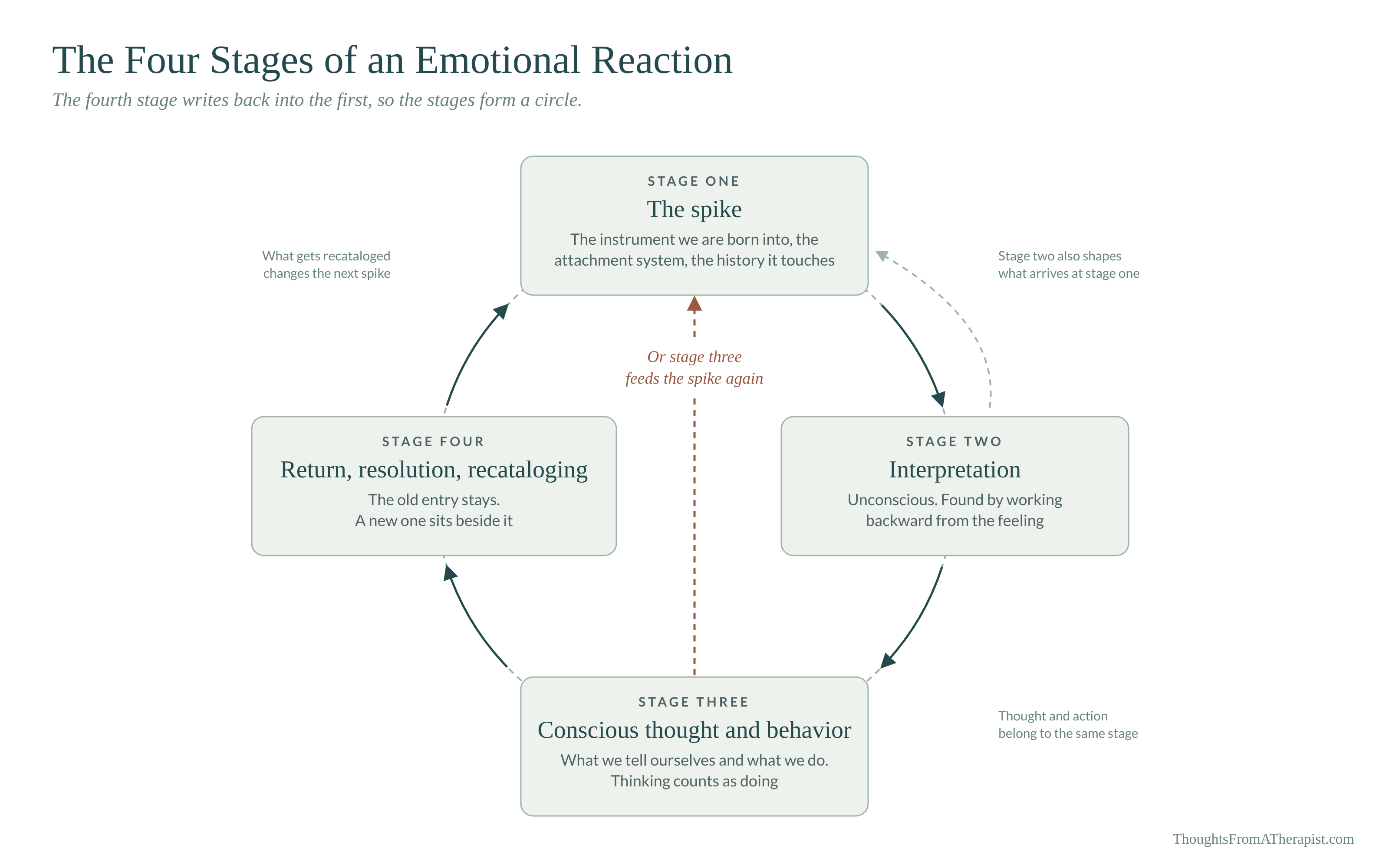
The spike, the interpretation, conscious thought and behavior, and the return that rewrites the next spike.
Four Kinds of Anxiety
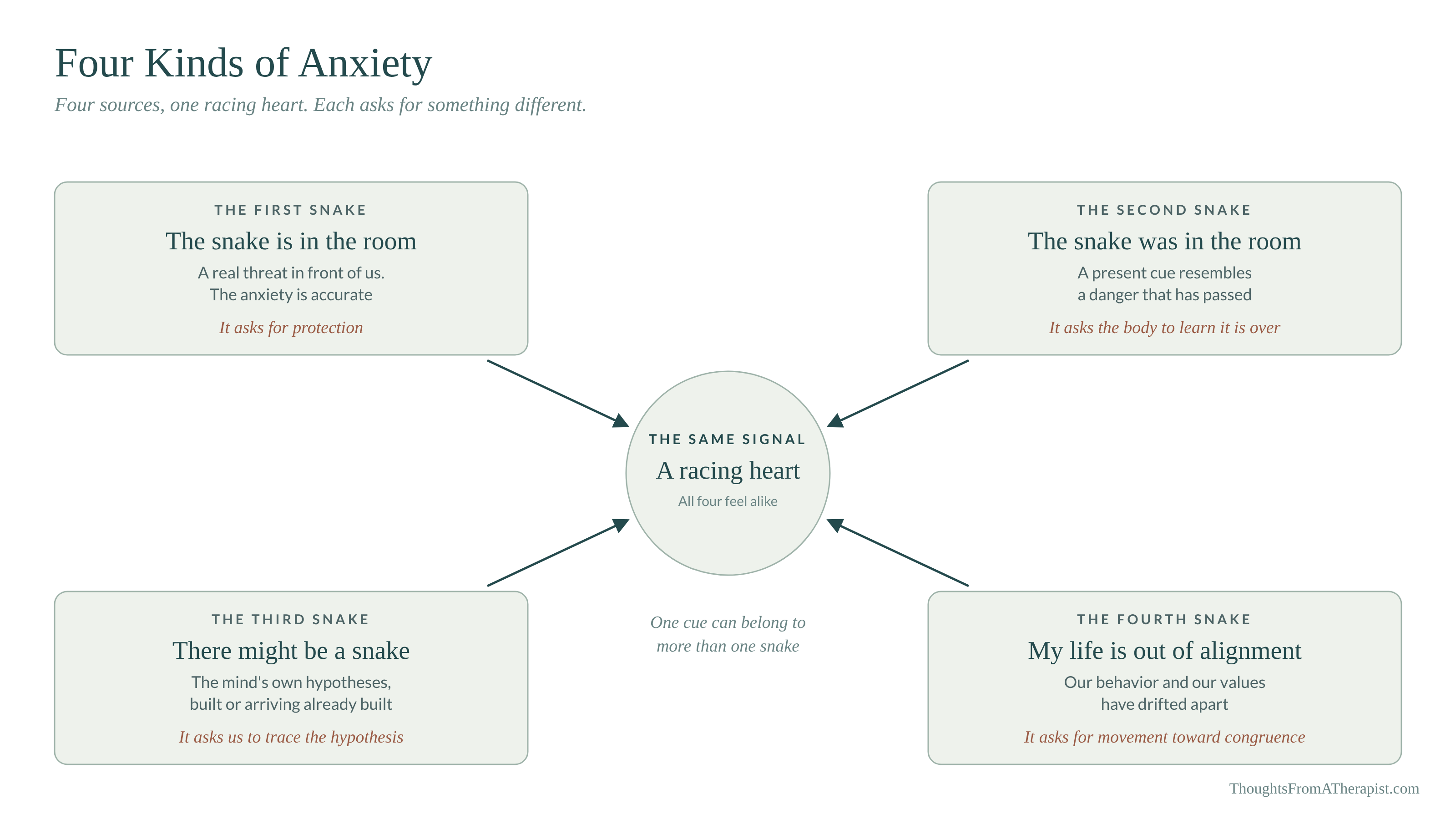
Four places anxiety comes from, one racing heart, and what each kind asks for.
Stress Tolerance
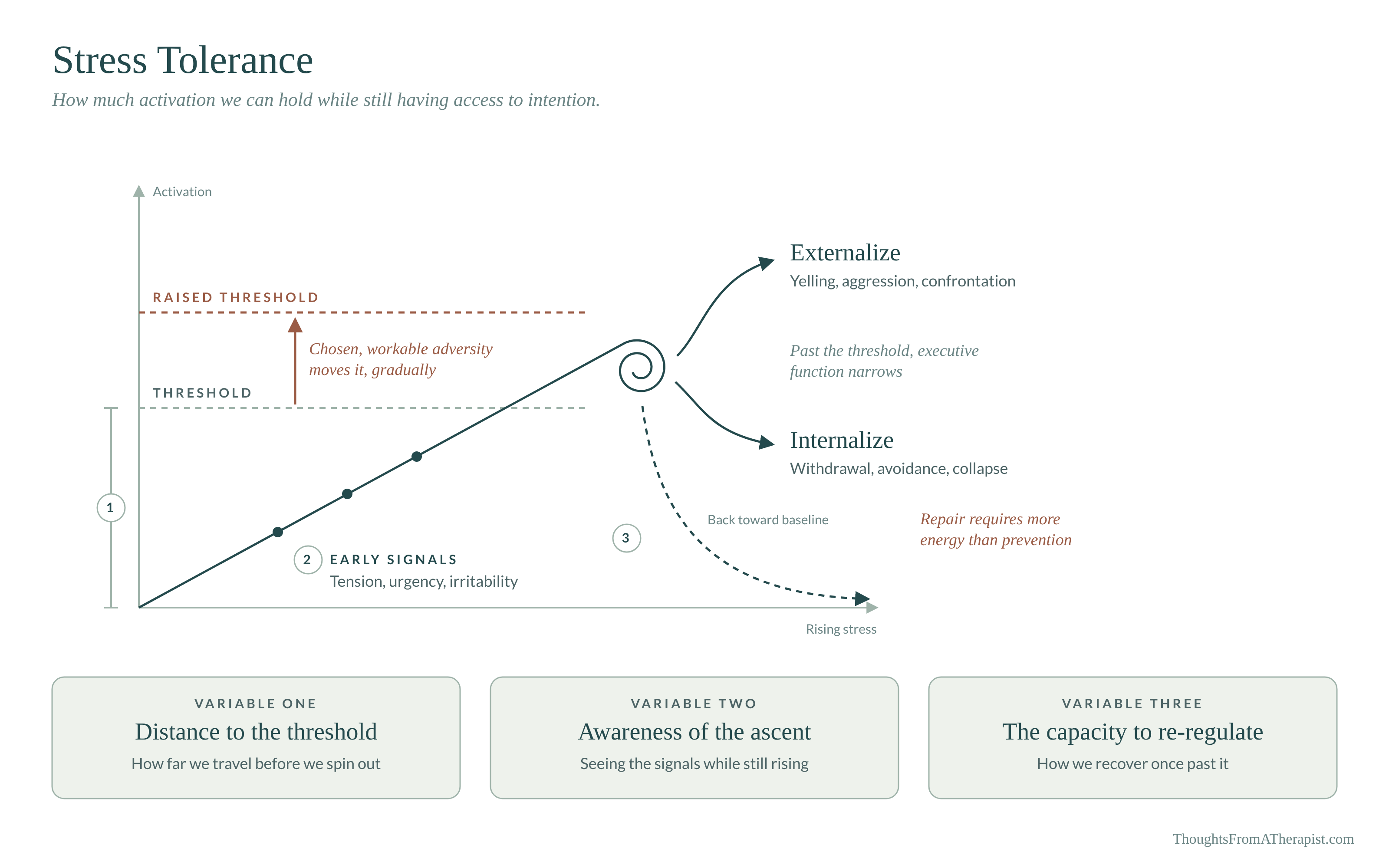
How far we travel before we spin out, and how chosen adversity raises the threshold.
OCD and the Four Stages
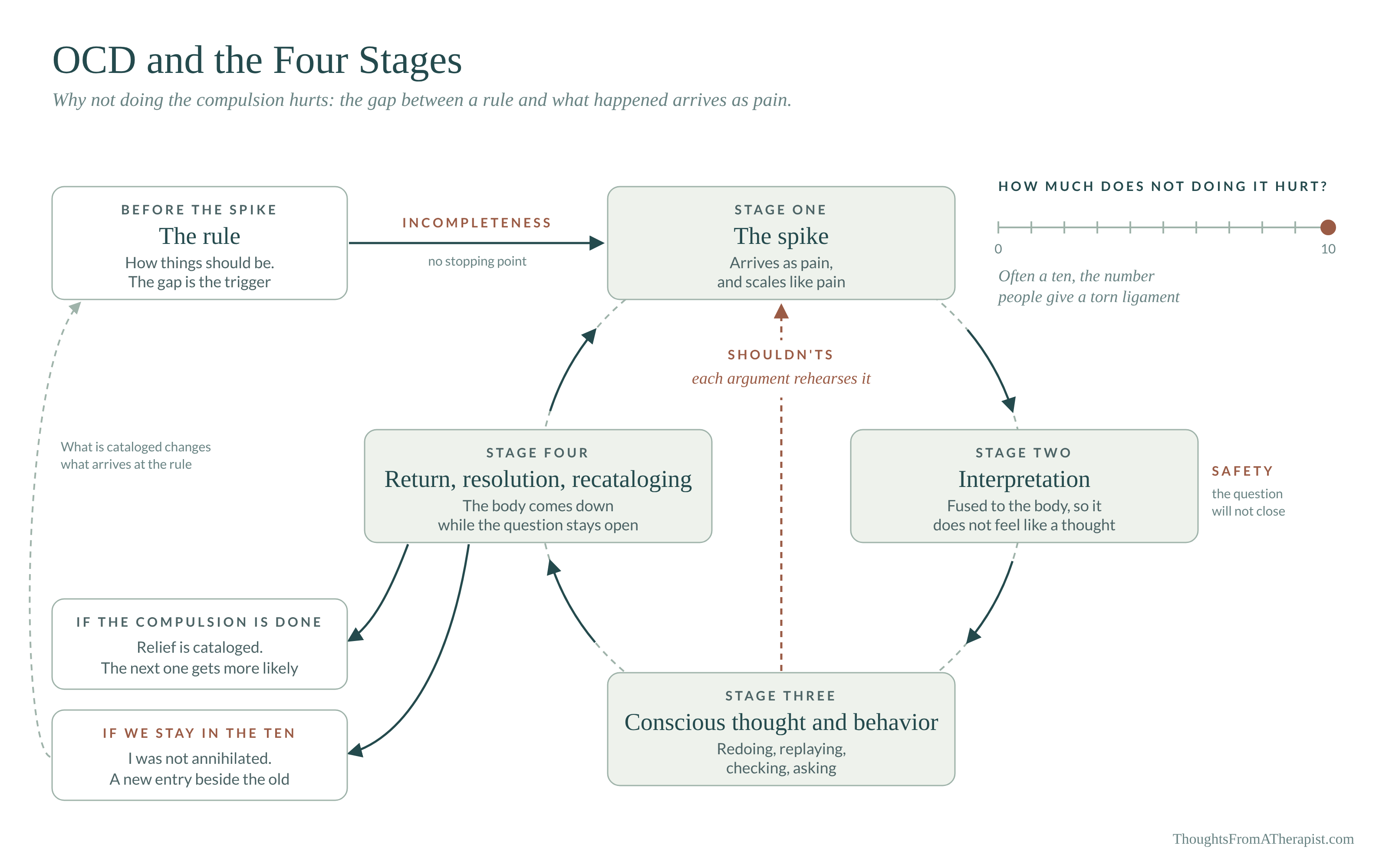
Why not doing the compulsion hurts: the rule arrives before the spike.
PTSD Triggers on a Spectrum
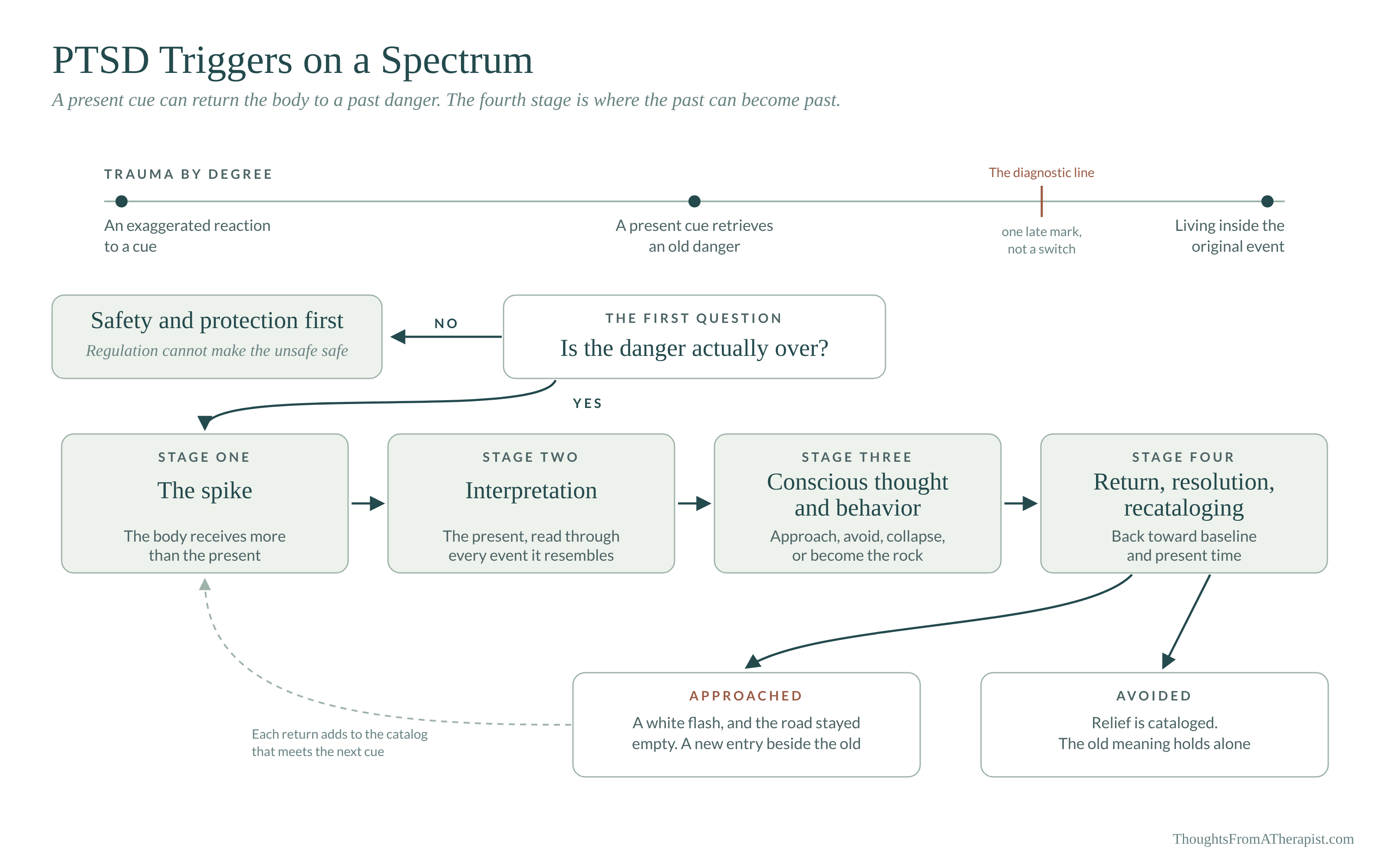
Trauma by degree, and the question that comes first: is the danger actually over?
ADHD and Anxiety
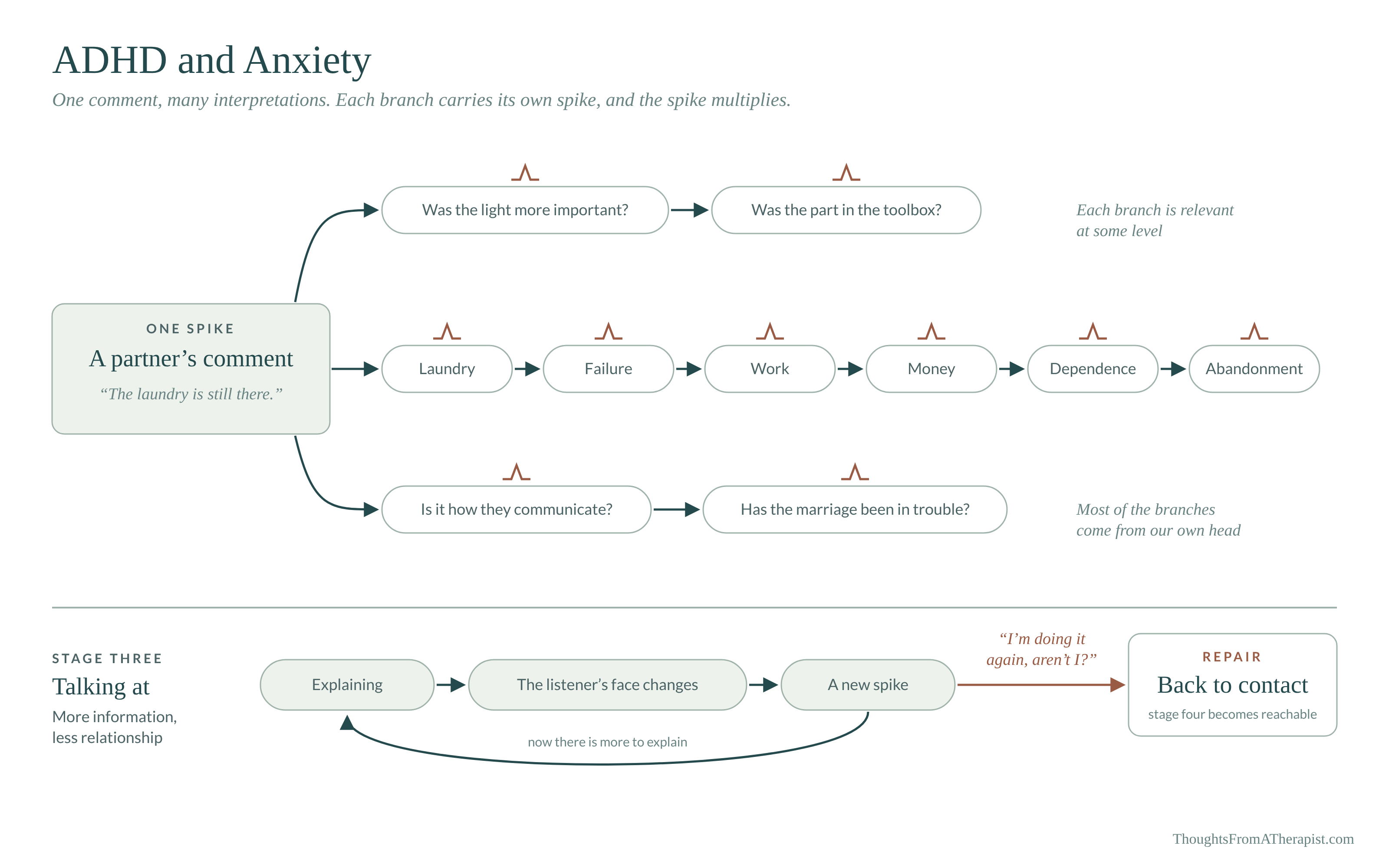
How one comment branches into many worries, and the repair that brings us back.
Work with William
In therapy we map our own four stages and practice the return with a regulated person in the room.