04
Topic guide
Start here
Self-worth is built by seeing ourselves honestly, keeping promises to ourselves, and standing somewhere. This guide follows shame and guilt to their source, separates the observer from the judge, and looks at what integrity costs and what it gives back.
Read these first
- Guilt for Being Who We AreWhere the sense of not being enough starts, and meeting it with compassion.
- Fear of Abandonment vs. IntegrityEvery choice costs a fear. Integrity is choosing which one to carry.
- Do the Ends Justify the Means?Congruence, shame, and why living our values keeps us whole.
Questions this topic answers


Self-worth is built from seeing ourselves honestly, keeping promises to ourselves, and standing somewhere. Approval cannot supply it, because other people’s inner worlds are outside our control. This guide follows where the sense of not being enough comes from, how we watch ourselves without becoming the judge, and what integrity costs.
Most of us arrive through one of three doors: guilt for being ourselves, defensiveness when we meant to be sorry, or a pattern we understand well and repeat anyway. The work moves through differentiation, deconstruction, and dialectics. We step back far enough to see the pattern, ask what it was protecting, and hold two truths long enough to choose.
Can we see ourselves clearly without turning what we see into a verdict?
Where “not enough” comes from
Much of what feels like low self-worth began as attunement. A sensitive nervous system registers a flash of disgust, the small tightening of a face that means I wish they weren’t here. Before any of it reaches the level of thought, the system draws a simple conclusion: my existence causes discomfort. No harm was done. Our existence elicited an emotion inside someone else, and we took responsibility for it without ever deciding to.
That equation does not stay contained. It begins to organize a life. I should take the safer job. I shouldn’t stand out. I shouldn’t make anyone uncomfortable. At the far end of the spectrum someone learns that their race or sexuality unsettles the people around them, with no choice involved at all, and the same conclusion forms.
The guilt is not a thought we can argue with. So we turn toward the part of us that learned this lesson, and offer it compassion instead of correction.
What compassion sounds like
Of course you feel guilty. You were trying to protect other people. I understand why this guilt formed. I can see the goodness that created it. And I no longer need it to organize my life.
Guilt for harm is different. When we hurt someone, guilt allowed to inform us points toward a conversation: I see how my action impacted you. Shame is an organizing force. If it accumulates without repair, we split off from the part of us that feels bad and consolidate around a more defended version of ourselves, one that justifies, minimizes, or rationalizes.
Grief says this is difficult and I wish it were different. Shame says this is difficult because I am defective.
Shame speaks in labels. I am an anxious person. I’m a bad parent. Narrative therapy loosens the label by placing the problem beside the person, so a stubborn person becomes a person who uses stubborn behavior. The externalizing worksheet rewrites a self-label this way, and the guilt vs shame worksheet sorts guilt for harm from guilt for being who we are. The full accounts are in Guilt for Being Who We Are and Resilience, Humility, and the Temptation to Be Neurotic.
Not our fault, and still ours
Sometimes someone did do something that left a mark: trauma, neglect, betrayal. It was not our fault. The solution is still ours to hold if we want to move forward. When we anchor ourselves in fairness, we remain stuck at the point of injury. When we take responsibility, we reclaim direction. Responsibility is ownership of what happens next.
Some of us, shaped by unpredictable homes, reach for the opposite reflex: how is this my fault? Over-responsibility masquerades as accountability and reduces a complex situation to a single cause, me. A wider lens includes what others were responsible for and the conditions that shaped the moment. It restores responsibility to scale, so we can be honest without being self-erasing. More in The Difference Between Fault and Responsibility.
Watching ourselves without becoming the judge
Differentiation is the ability to anchor our consciousness in the role of the observer, rather than becoming overly identified with our thoughts, emotions, desires, or even behaviors. It is a steady presence that can hold our experience without being overtaken by it, and everything else on this page depends on it.
The observer
“I was thinking to myself that I ought not trust my thoughts.” Who was thinking, and who was observing? Several selves are in conversation, each speaking with the voice of I, and differentiation lets us recognize them without getting lost in them.
One part of me
Ah, that’s one part of me speaking. I can listen, but I don’t have to obey.
I once built a fire on a flagstone to spare the grass, and it exploded. So I’m stupid. Later I fixed a broken oven. So I’m really smart. Watching both, I am the observer and the observed, which strangely feels a lot more free and easy than being smart and stupid. When we stop defending against contradiction, we discover something more stable than self-esteem: equanimity. More in The Practice of Differentiation and The Observer and the Observed.
The observer can harden. Awareness becomes self-monitoring. We observe ourselves so closely that ease disappears and our attention turns into tension. Self-awareness is a capacity like any other, with a balance point between too little and too much: enough clarity to understand ourselves and enough spaciousness to respond deliberately.

The emotional intelligence self-assessment is a self-reflection on these capacities in two settings, because balance at work can be drift at home. The map is in Emotional and Social Intelligence as a Living Balance.
An identity that stays open
To be a self is to live inside a story. Identities let others know how to meet us, and they are impermanent. The healthy self builds a narrative that feels continuous while remaining permeable: I am strong and uncertain. I am constant and becoming.
Most of us present a different self with family, at work, and when we feel judged. The useful question is which one we would choose to present. The Who Am I in Different Settings? worksheet maps those selves and the expectations that shape each one.
Through this differentiation, self-awareness becomes self-compassion. We stop confusing who we are with what we feel.
Why understanding a pattern doesn’t change it
The analytical why makes a problem legible. We trace the history, identify the variables, and look for the conditions that allowed the pattern to emerge. Analysis does not move into action on its own. Without an off-ramp we know more about the problem while feeling increasingly convinced that nothing can be done about it. Insight quiets the commentary. It does not lower the cortisol.
Sometimes the pattern is protected by an identity. People don’t just have beliefs. They organize around them, and once that organization becomes rigid, the belief is no longer something they’re holding. It’s something that’s holding them. The victim, the nihilist, the perfectionist, and the spiritual bypasser each have a line to return to, and because there is always a way back, there is always a way to avoid the next step. From the outside this looks like resistance. From the inside it feels like truth, so insight doesn’t land.

Arguing with the identity tightens it. Enough safety for grief, shame, and uncertainty to surface lets the structure loosen toward a wider tolerance for what identity has been keeping out. More in The Realities of Rigid Identity.
The other help is a different kind of why.
The judgmental why
A verdict disguised as a question
Why did I do that again? Why can’t I stop? What’s wrong with me?
The curious why
Locating the function
What part of me believed this behavior would help? What was I attempting to protect, express, or avoid?
Many present difficulties began as adaptations that were once necessary, and when we acknowledge that a strategy was useful, our grip on it loosens.
To an old strategy
Thank you for getting me through that time. You don’t need to protect me in the same way anymore. There’s something else I need now.
The analytical why helps us understand how a pattern works. The curious why allows us to remain with the person living inside it. Why Can’t I Change Even When I Understand My Patterns? and Curiosity Without Judgment go further, and the Why Do I Keep Doing This? worksheet traces one repeating behavior to what it once protected.
What builds worth
A worth that depends on approval has to be managed constantly. Control seeks safety through prediction and management. Congruence offers safety through coherence and orientation to self. It aligns what we know, what we feel, and how we act, and it allows us to rest internally, even when life is complex externally.
Values are a direction, and they become behavior through structure more reliably than through motivation. I want to be present with my family, so I schedule time for their games. I value rest, so I choose work that allows spaciousness. Discipline becomes the servant of meaning.
Motivation is a feeling, and it comes and goes. Discipline can be practiced without it. I started doing ten squats whenever I thought of it between sessions, a goal too small to negotiate. Soon running bass scales with a metronome, the least exciting part of becoming a better musician, became noticeably easier. I don’t think I had become more motivated. I think I had been practicing discipline.
Every successful repetition becomes evidence that we keep promises to ourselves.
The building discipline worksheet sets up a ten-second habit, and the values and integrity worksheet compares a week of what we do with what we say matters. Exercise Snacks and Do the Ends Justify the Means? take each further.
We will act against our values at times. Integrity in balance allows space for imperfection, learning, and repair. Repair the next morning is an apology that neither collapses nor defends: I see how my action impacted you, and I’m sorry. Three defenses tend to get there first.
| What we say | What it protects |
|---|---|
| That wasn’t my intention | What it protectsOur motives, treated as more real than the other person’s experience |
| I guess I just can’t do anything right | What it protectsOur own discomfort, through a collapse into guilt |
| You shouldn’t feel that way because | What it protectsOur certainty, by arguing the emotion out of existence |
Character lives in that ordinary practice: congruence with values not governed by environmental rewards and punishments. Character Matters takes the question to the scale of leadership.
When care and open-mindedness become a way of disappearing
Every emotional strength becomes a liability when taken to an extreme. Two of them pass for maturity, which makes them hard to see.
Compassion that silences self-worth
For those with a natural instinct to care, guilt and worth are the first emotions to surface when a boundary needs to be drawn. The very sensitivity that makes us valuable becomes the reason we hesitate to advocate for that value. Empathy without discernment becomes one-sided caretaking, and what begins as kindness often ends as resentment.
Strength depends on where we begin. Hyper-empowered people hold too much control and not enough openness. Hypo-empowered people collapse their needs and avoid conflict for fear of being too much. One hides behind invulnerability. The other disappears in over-functioning. Growth moves in the direction that challenges our particular imbalance, toward restraint for some and assertion for others.

Saying “I value what I bring” is clarity. When someone feels uneasy as we assert our worth, the unease often means a long-standing imbalance is being corrected. More in When Compassion Silences Self-Worth and Strength Is Contextual.
Seeing every side and still standing somewhere
A dichotomy says everything is good or bad, the chicken or the egg. A dialectic says everything is good and bad, the chicken and the egg. I like skiing with my friend, and he has health care views I disagree with. The dichotomy costs us the friend. The dialectic keeps him.
Holding tension this way makes us humble and more compassionate, and it has its own failure. Some of us understand every side so well that we never say what we want. People who are too humble may suppress important insights, fearing they’ll overpower others, and deprive others of perspectives that could be necessary. Holding tension forever, without the capacity to differentiate when the situation requires a position, is non-commitment dressed as sophistication.

Both are true is where dialectical thinking begins. And I want this is where we enter the field ourselves. A value can matter because it matters to us, without our proving it is the only right answer, and ambition can belong to a person who sees every side. The dialectical thinking worksheet rewrites an either/or as a both/and and then asks what we will do with the tension.
The price of integrity
On a backcountry trip with new friends, the snowpack doesn’t look stable and no one has dug a pit. A few people sound confident, and confidence alone begins to move the group. Three fears are active at once. If we speak up, we risk abandonment. If we stay silent, we risk death. If we override our own knowing, we risk self-betrayal.
There is no option without fear. The only question is which fear we select.
Courage in that moment sounds like “This doesn’t feel safe to me. I’m going to head down.” It is a clean statement of reality and boundary, with no accusation or lecture inside it. Some people will take the risk and be fine. We still made the right decision for ourselves.

Fear of abandonment is wired into us, because being cast out of the group was once a survival threat. Values live at that same depth. Chronic people-pleasing trains the body to equate being liked with being unsafe to be honest. Each time we tolerate the fear of abandonment rather than the fear of self-betrayal, we teach our nervous system that belonging does not require self-erasure.
Fear of Abandonment vs. Integrity tells the whole story, The Dialectic of Courage weighs the two failures, and Social Anxiety and the Burden of Control follows what happens when we try to author other people’s approval. We can belong to ourselves even when we are not immediately approved of by others.
Coherence and its two failures
The Fractal Field of Mental Health maps mental health as coherence across seven dimensions: individual, relational, embodied, integrity, dialectical, engaged, and interconnectedness. They are not stages. When one falters, another compensates, and each can be balanced, overexpressed, or deficient.

This topic lives mostly in two of them. The individual dimension is the self and its story. Integrity is where values become action.
Balanced
One conversation
We see ourselves with honesty and compassion, aware that identity is both real and changing. Thought, emotion, and action form one conversation.
Overexpressed
Fixed and rigid
We cling to fixed identities. Integrity becomes rigidity, with standards that leave no room for humanity, error, or growth, and morality becomes performance.
Deficient
Lost and inconsistent
We disown the parts of ourselves that contradict the story, and the self becomes lost. We act in ways that conflict with our values, and self-trust weakens.
The dialectical dimension narrows the same two ways: either-or verdicts on one side, and every side with no stand on the other. The Mental Health Self-Inventory is a self-reflection across all seven dimensions: where we are coherent, where we tighten, and with whom.
How this connects
Relationships
Relationships, Couples & Communication
Differentiation is the same move between people: I can feel you completely, and still know that I am here.
Anxiety
Anxiety, Stress, Triggers & Trauma
A trigger becomes a verdict about who we are unless fault and responsibility stay separate.
Worth grows where we can see ourselves without a verdict, keep small promises, and say what we value out loud. Many of us learned the opposite in rooms where our presence seemed to cost someone something. What remains is the same sensitivity that read those rooms, inside a life that either makes room for our own voice or keeps asking us to become someone smaller.
Worksheets, self-reflections, and diagrams
Worksheets for this topic
Values and Integrity WorksheetAm I Living by What I Value?
Compare a week of what we do with what we say matters.
Guilt vs Shame WorksheetGuilt for Harm or Guilt for Being Yourself
Sort guilt for harm from guilt for being who we are, and respond to each.
Externalizing the Problem WorksheetLoosening Self-Labels
Rewrite self-labels so the problem is something we live with, not who we are.
Why Do I Keep Doing This? Understanding a Pattern Without Judgment
Look at a repeating behavior with curiosity: where it came from and what it once protected.
Who Am I in Different Settings? Identity and Family Roles Worksheet
How we show up in different settings, and which self we want to present.
Dialectical Thinking WorksheetHolding Two Truths
Rewrite an either/or as a both/and, and decide what to do with the tension.
Building Discipline WorksheetTen-Second Habits and Kept Promises
Ten-second habits, kept promises, and removing a choice we keep reopening.
Mental Health Self-InventoryThe Fractal Field Across Seven Dimensions
A reflection across the seven dimensions of the Fractal Field: where we are coherent, where we tighten, and with whom.
Emotional Intelligence Self-AssessmentToo Little, Too Much, or Balanced
Twenty-four capacities marked in two contexts: where we are balanced and where we drift.
The Fractal Field of Mental Health
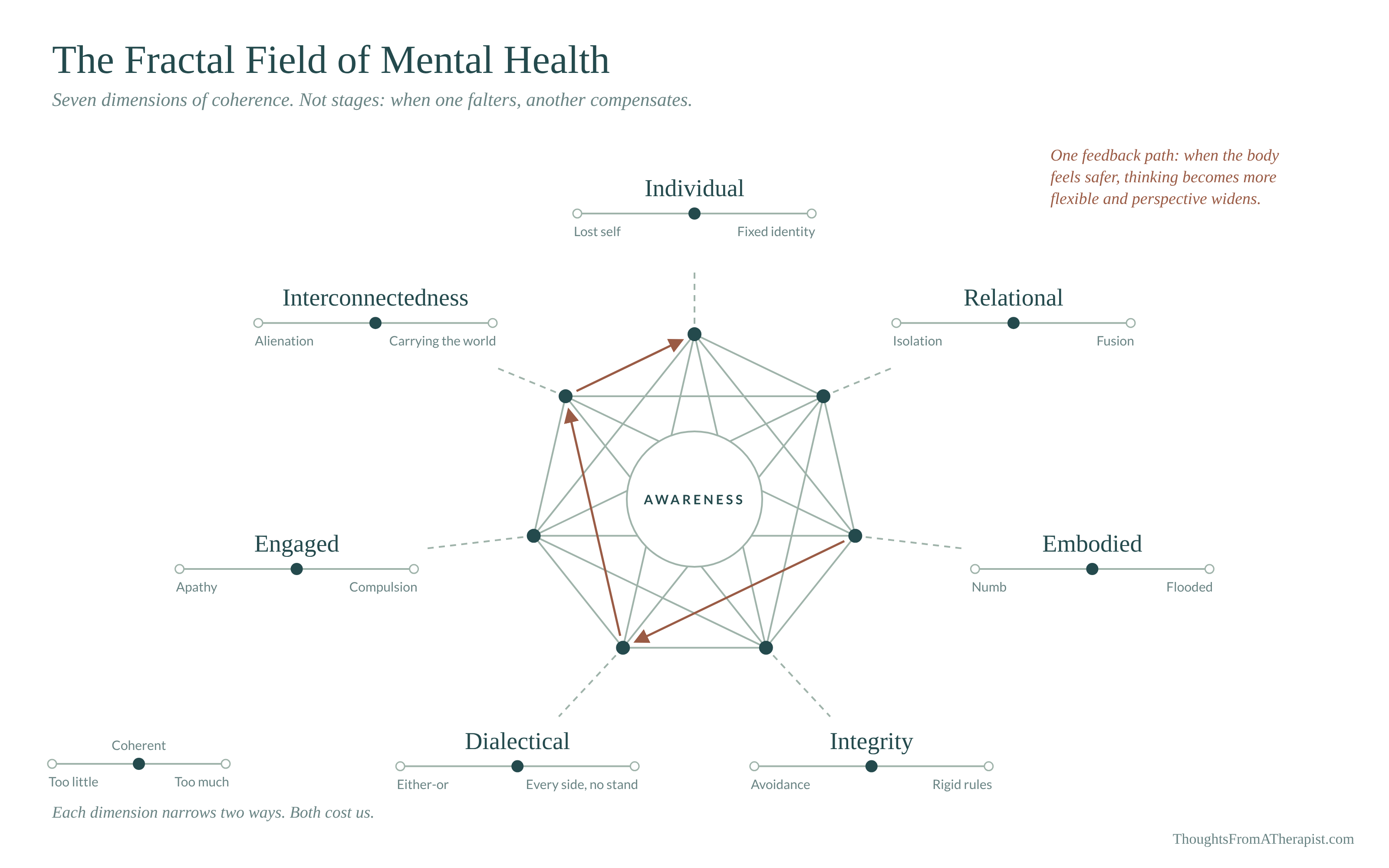
Seven dimensions of coherence: individual, relational, embodied, integrity, dialectical, engaged, and interconnected.
Emotional and Social IntelligenceA Living Balance
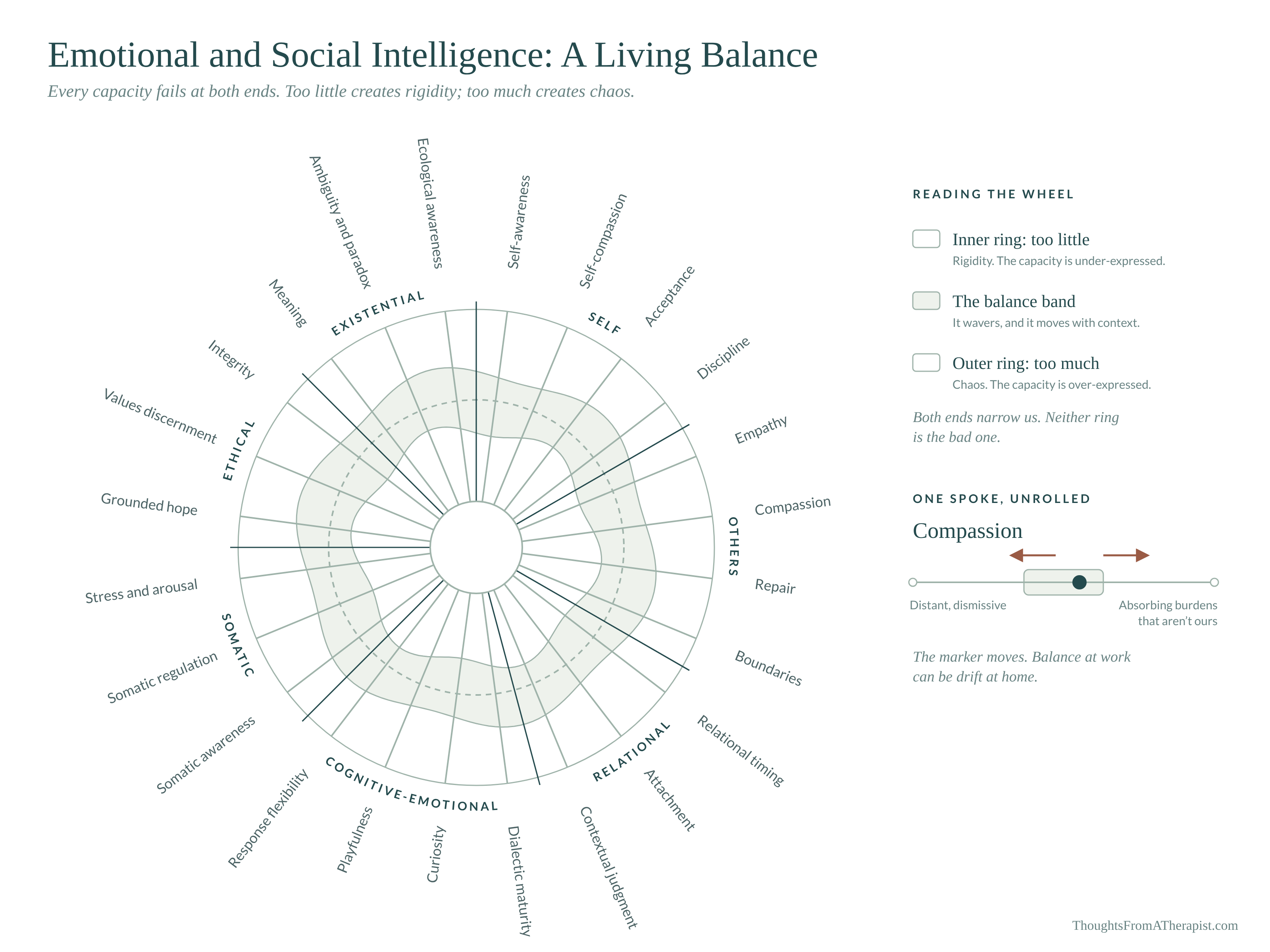
Every capacity fails at both ends. Too little creates rigidity, too much creates chaos.
People-Pleasing and IntegrityThe Three Fears
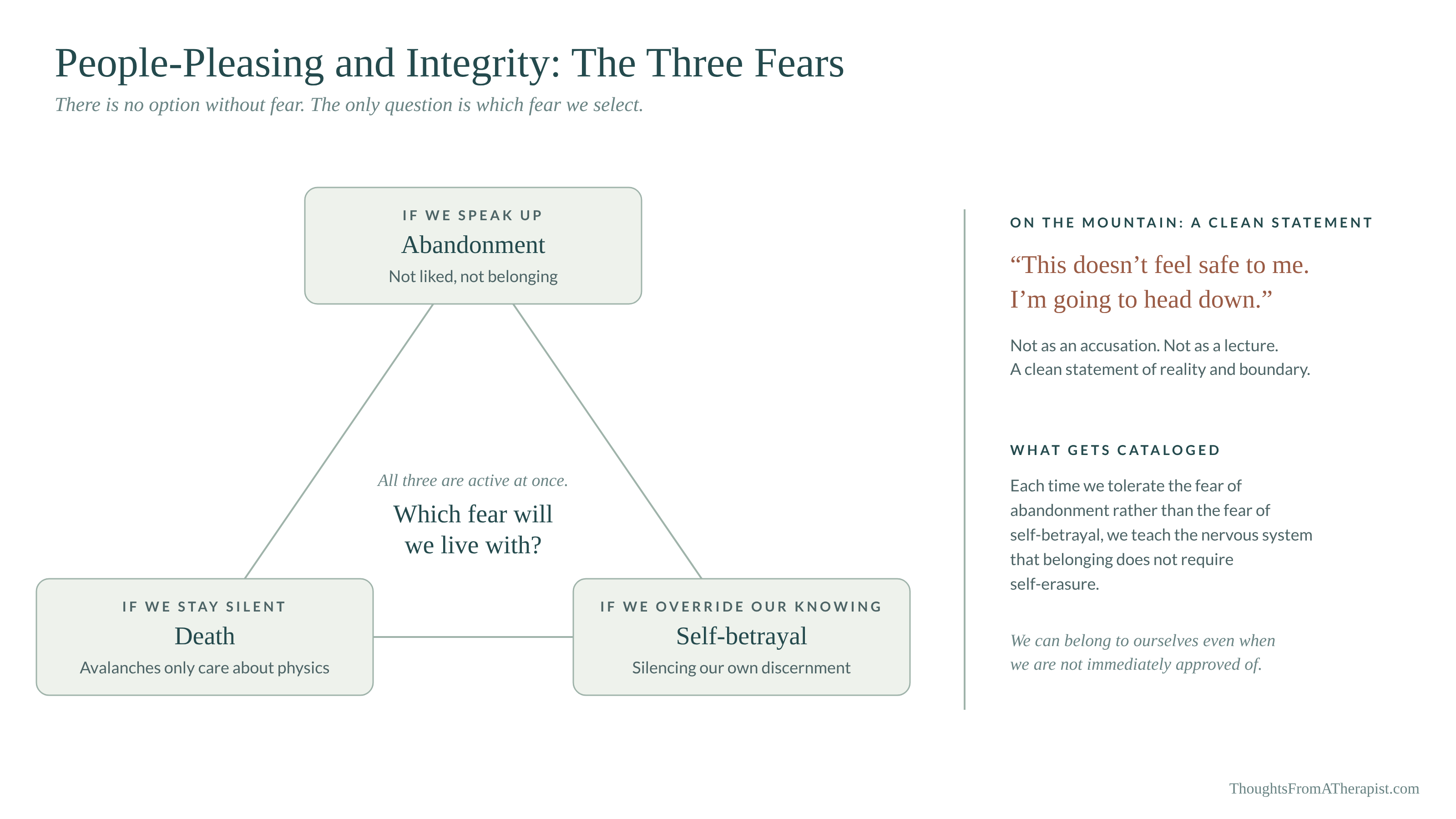
Abandonment, death, and self-betrayal: which fear will we live with?
Rigid IdentityFour Self-Sealing Loops
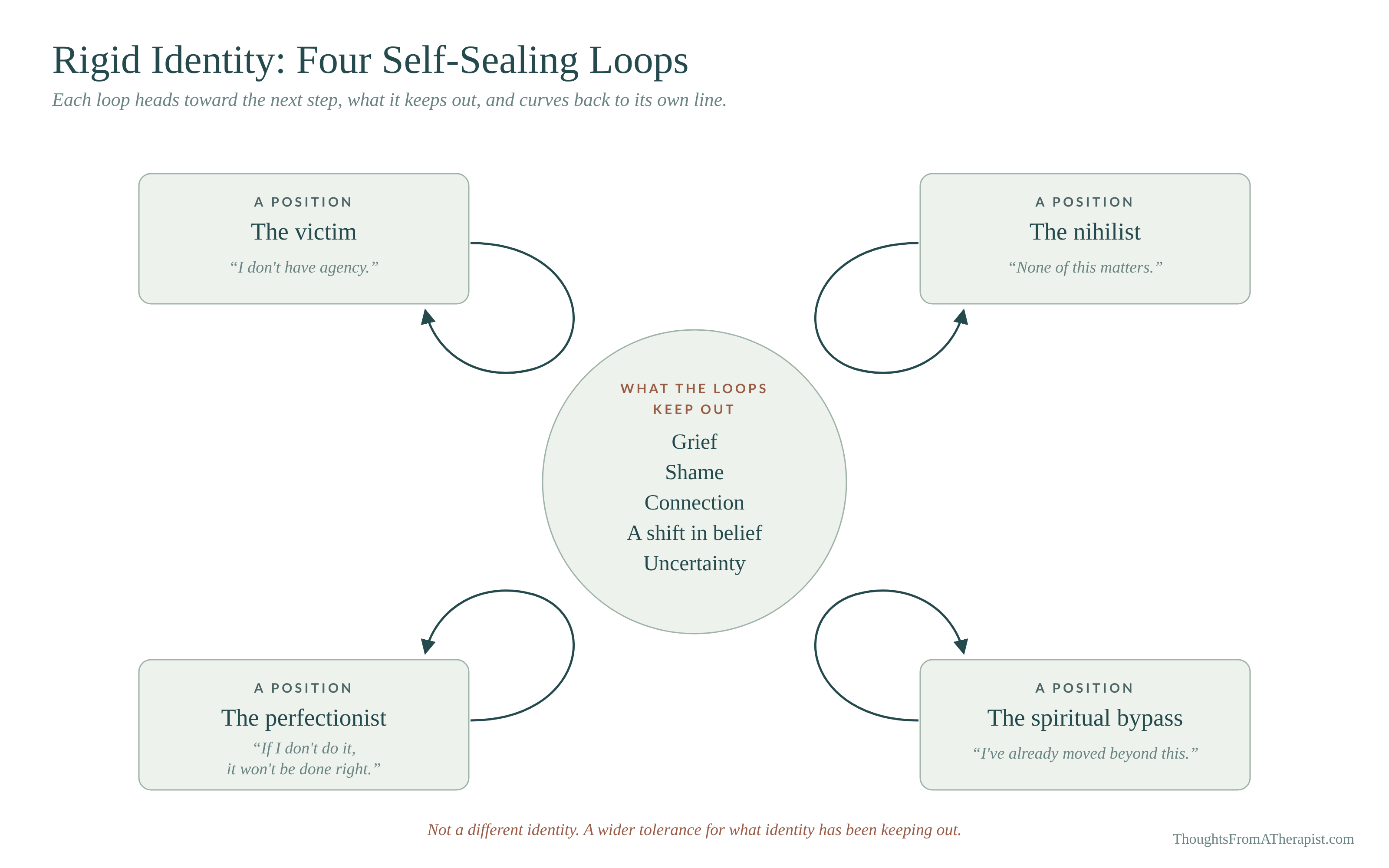
Victim, nihilist, perfectionist, and spiritual bypass: four loops and what they keep out.
Strength Is ContextualHypo- and Hyper-Empowerment
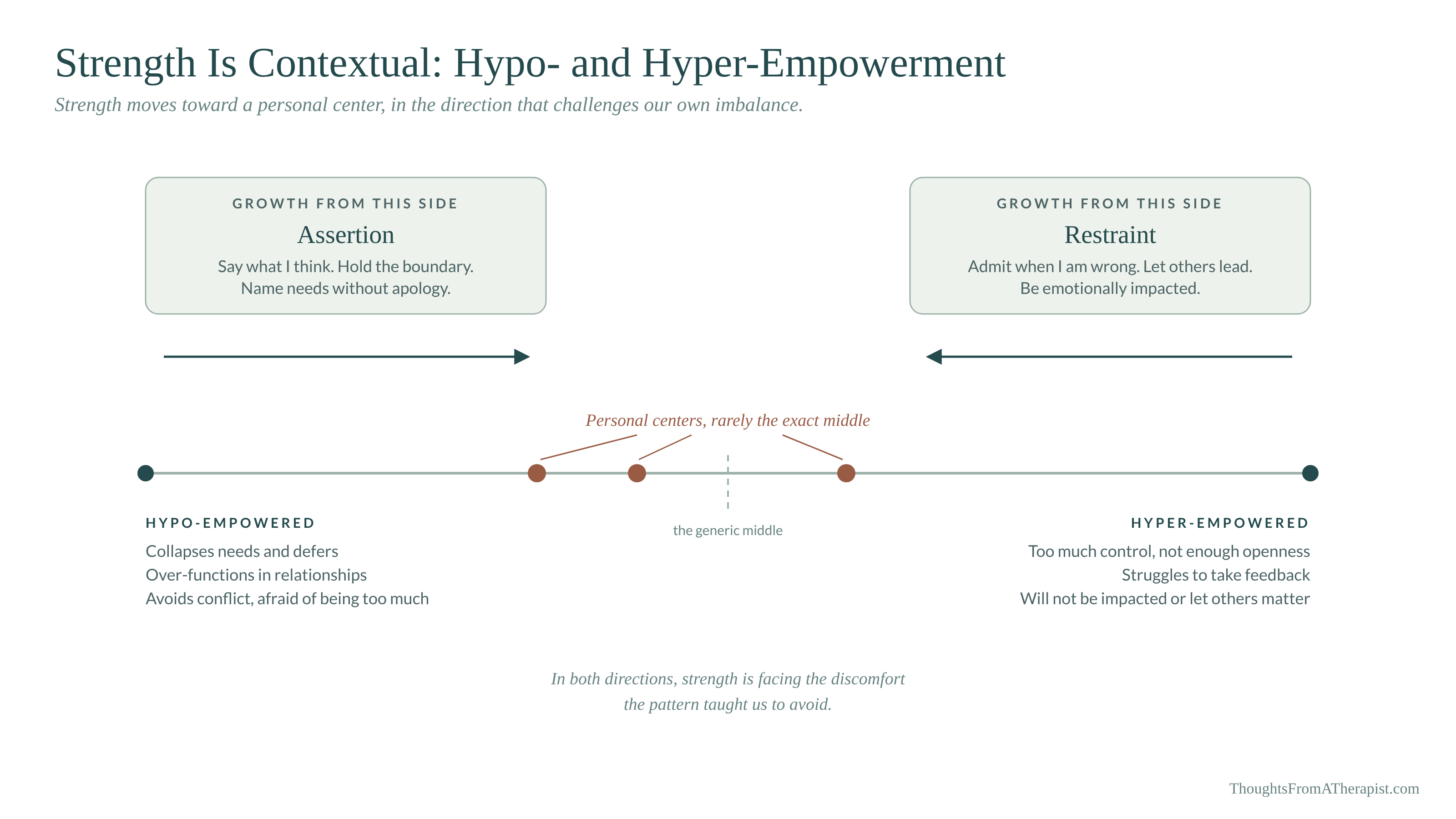
Strength moves toward a personal center, through assertion or through restraint.
Dichotomy vs DialecticEither/Or and Both/And
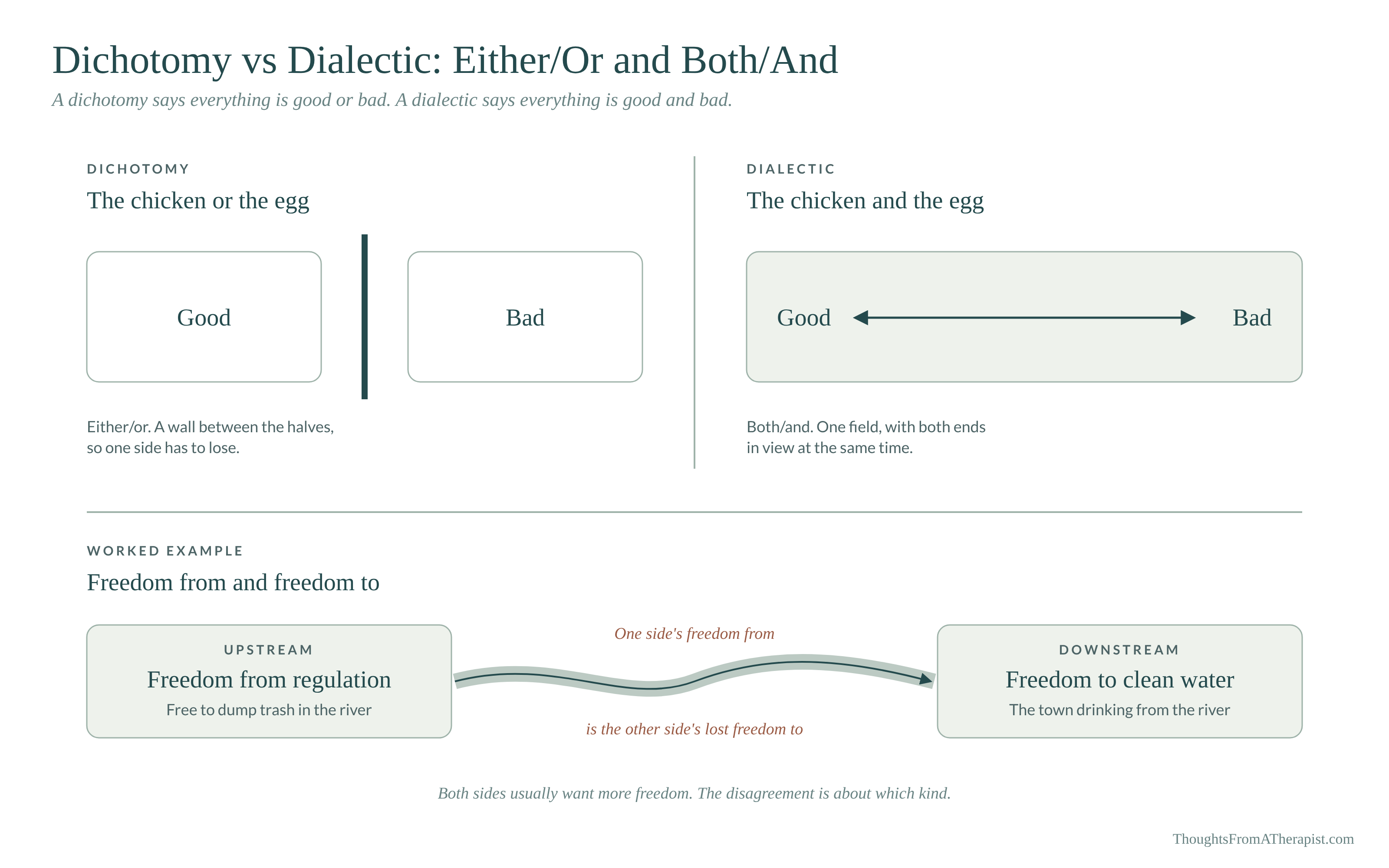
Either/or thinking against both/and, with freedom from and freedom to.
Work with William
In therapy we slow down the moment a pattern turns into a verdict, find what it was protecting, and practice saying what we value out loud, in the room, before we have to say it anywhere else.