06
Topic guide
Start here
Spirituality begins where certainty runs out. This guide follows interconnectedness, awe, mindfulness as the practice of returning to the present moment, and the making and play that let us take part in a life, and what happens when any of them becomes a way around people.
Read these first
- What Is Spirituality?Interconnectedness, mystery, and meaning without certainty.
- Meditation Is the Practice of ReturningWandering is the setup. Every return is a repetition.
- The Observer and the ObservedWatching our contradictions until equanimity is steadier than self-esteem.
Questions this topic answers


Spirituality begins where certainty runs out, and it comes back, eventually, to one particular life. This guide follows interconnectedness, awe, the practice of returning to the present moment, and the making and play that let us take part in a life, along with what happens when any of them becomes a way around people.
The spirituality I trust makes us more available to ordinary life: the body, the people we love, grief, pleasure, and responsibility.
What would it mean to be inside a life, instead of managing it?
What is spirituality without certainty?
Contemplation gives us the humility to follow a question past the point where an answer is available, and to stay there. Sunlight scatters, shorter wavelengths scatter more, and a wavelength corresponds to a color. That is why the sky looks blue. Then comes the next question. Why does any of it produce the experience of blue? Every answer becomes the material for another why.
The question keeps going after the answer stops. That continuation is where spirituality starts for me.
Empty space asks the same thing from the other side. If an electron travels through nothing, and we can describe the path, in what sense is it nothing? A missing measurement is still different from a missing existence. Consciousness cannot be set on a table. Irony has no mass. A relationship exists, and it cannot be lifted out of the two people in it.
My own orientation formed outside any single tradition, out of childhood questions that would not close, a period of terror about death, Buddhist and yogic teaching, long stretches in wild places, and a handful of psilocybin experiences. Those stories are in What Is Spirituality?
One and separate: the observer and the observed
I am an I, with a body, a history, and a life nobody else can live for me. I am also inseparable from the relationships, culture, ecology, and matter through which that I became possible. We are one and separate, and neither side cancels the other. Thich Nhat Hanh had a gift for making this tangible.
The cloud
Where did it go?
A cloud falls as rain and forms again somewhere else. The water continues and the form changes. He called this interbeing.
Two matches
How many flames?
One flame lights a second. Pulled apart, two. Brought back together, one.
The broken leg
Good or bad?
A broken leg keeps a young man home from war, and the judgment keeps flipping. Every conclusion stays incomplete.
The same structure appears when we watch ourselves. Most of us defend against discomfort by editing our identity. Spiritual and psychological maturity ask us to remain with the tension: to feel the sting of inadequacy without collapse, and the pride of competence without inflation. When we stop defending against contradiction, we discover something more stable than self-esteem: equanimity. The Observer and the Observed has the exercise, and The Practice of Differentiation takes the observer into conflict.
The observer has a limit. Presence that never stops watching becomes detachment, and we watch our life instead of participating in it. The moments that feel most alive, dancing without an audience or a song carrying everyone in the room, flow as if without internal or external observation. The practice is to watch, and then to let the watching go.
Awe, and the questions we close too early
Interconnectedness can stay a concept. Time in wild places made it something I feel. The longer we stay out, the more the body adjusts to altitude and cold. We become a literal part of the ecology, and this is felt in the body, rawer than any human conceptualization of it. The mushroom is the visible fruiting body, and the mycelium beneath the soil is the more permanent network of exchange, decomposition, and growth. The individual form is real. The network is real too.
Before the 2004 tsunami in the Indian Ocean, there were accounts of animals moving to higher ground ahead of the water. There was probably a rumbling they could detect and we could not. The question that stays is how they knew what the rumbling meant if it had never happened to them before.
Two early closures
One says that because there is a mechanism, there is no mystery. The other says that because we cannot prove how or why they ran, we must conclude serendipity. Both stop the inquiry in the same place.
What exists, and why it exists at all, can be experienced or acknowledged more often than answered. Sometimes the insistence on explaining an experience is another way of postponing it. Why Are We So Afraid of Artificial Intelligence? follows the animals further, and Understanding Anxiety Is Only the Beginning lets nature work before the explanation arrives.
When spirituality becomes a way around people
Religious identity can reduce cognitive flexibility. A tradition that opened a question can later announce it answered, and belonging starts to depend on agreeing. Mystery gets smaller when we convert it into certainty.
Faith can hold the unknown. Certainty cannot.
There is a second bypass. When suffering gets explained away as illusion, karma, or a plan, a spiritual explanation becomes a defense against grief and responsibility. In therapy it arrives as a request. How do I detach more. How do I stop needing people. Underneath is fear of dependence and of being impacted. The spirituality becomes a structure that allows distance to feel like growth. Detachment can look like wisdom while working as avoidance. The Realities of Rigid Identity places spiritual bypassing among the other self-sealing identities.
Depth can also laugh. Alan Watts, who called himself a philosophical entertainer, would giggle at himself in the middle of saying something spiritual, funny, and dualistic all at once. Mortality, grief, purpose, and coexistence could be talked about seriously, and they could also be funny.
Some of my most visceral experiences of interconnectedness have come during psilocybin experiences. Nature, grief, music, and love have opened the same door at other times. I hold these as experiences. An intense internal experience does not establish the structure of the universe. It does change what can be felt and contemplated afterward.
Bypass has a mirror. The door to wonder can also close. Life feels overly material, and meaning becomes thin or transactional. Like bypass, it protects against something that would require vulnerable acceptance: grief, uncertainty, or contact with what has not yet been allowed. The value is in letting the question stay open without needing belief or dismissal.
Coming back to the present moment
Clients who begin meditating often say some version of the same sentence. I don’t think I did it very well. They followed the breath for a few moments, then found themselves making a grocery list. I don’t think they failed at all. I think they succeeded, repeatedly.
Mindfulness is the practice of bringing attention back to the present moment with curiosity instead of control. Anxiety plays like a radio in the background. We don’t have to smash the radio, or even turn it off. We have to recognize that we don’t have to obey every broadcast. Every return is one repetition, the way a bicep curl is, and over time we notice sooner, return sooner, and recover sooner.

We can be physically present with someone we love, and psychologically engaged with the waiter, the bill, and the violation of our expectations. Inside a conversation, the same skill means recognizing what pulls us out of listening, and returning before the interaction reorganizes around protection. Meditation Is the Practice of Returning has the full practice, and How to Listen Empathically brings it to another person.
Noticing comes before explaining. Analysis asks why, and sorts a sensation into boxes shaped by past experience, belief, and association. Observation asks what is noticeable: texture, hue, density, movement, temperature. Observing a sensation without interpretation allows it to have dignity of its own form. Naming matters when it increases contact with the experience, and becomes intellectualization when it replaces it. More in Analysis vs Observation and Why Do I Feel Things I Know Are Irrational?

When the mind will not stop, the body is often the faster door. In rumination, thoughts trigger sensations and sensations validate thoughts, and we can’t think our way out of a loop the nervous system is also reinforcing. Cold water, a longer exhale, or a walk changes the ground the thought stands on. State Shifting has the mechanism, and the rumination worksheet logs what the radio said, how long we followed it, and every return.
Presence has a cost when we cannot tune it. Much of a therapist’s work is offering space, especially when grief is intense, and it took me at least ten years to learn how to work with my own empathy. Early on I had less control over it, and I went through cyclical periods of burnout. Empathy can be tuned the way hearing is. We can turn toward the full field of another person’s experience, and we can choose how much of it to take in at once. What Is Spirituality? tells more of what the therapist’s chair taught me.
Making things and play
A dancer does not move to arrive anywhere. A musician does not play to conclude the song. The purpose of play is the experience itself, immersion so complete that the I dissolves into motion. When engagement hardens into performance, productivity replaces participation and meaning becomes a metric.
We can hear when someone is forcing a scale. The notes may be correct, but the body is tight, and the rigidity makes its way into the sound. Playing for the audience brings the watcher back into the room. Playing for the song lets the body move with the other players.
Adults need play. It reminds us that life is something to participate in instead of merely manage. The activity matters less than the shared enjoyment. Without it, a partnership can become an administrative arrangement, with the logistics intact and the vitality gone.
Control works against all of this, often for good reasons. Gripping the handlebars of a mountain bike as hard as possible makes the body rigid against a machine built to move underneath us. Telemark skiing taught me the same thing. When everything clicked, I was still directing the skis, and I was also allowing them to move.
There is a difference between controlling something and being in relationship with it.
Safety and aliveness are both legitimate human needs, and maximizing one can impoverish the other. The paradox stays in place: if I strive to be effortless, I am striving still. How Parenting Made Me More Controlling follows that grip onto the trail, and What Is a Long-Term Relationship For? places play among the things a partnership is for.
Coherence and its two failures
In the Fractal Field of Mental Health, this topic lives in two neighboring dimensions, engagement and interconnectedness, and each can be balanced, overexpressed, or deficient.
Balanced
Participation
Action feels like flow rather than effort. We sense ourselves as both distinct and inseparable from everything that is.
Overexpressed
Transcendence as escape
We use spiritual ideas to avoid responsibility or pain. Play becomes a defense, and creation hardens into performance.
Deficient
Disenchantment
Life feels heavy or overly controlled. Meaning becomes thin, and wonder goes flat.
The two failures are counterpoints. Each protects us from something we cannot yet metabolize, one by rising above it and the other by closing the door on it. Gratitude for the counterpoint leaves our responsibility intact. We still answer for what we create, tolerate, and repair.
How this connects
Fulfillment
Fulfillment, Meaning & Philosophy
Purpose comes back from the universe to the life being lived.
Self-worth
Self-Awareness, Self-Worth & Integrity
The observer belongs to both pages, as differentiation there and equanimity here.
Relationships
Relationships, Couples & Communication
Play, adventure, and shared wonder are part of what a long-term relationship is for.
Anxiety
Anxiety, Stress, Triggers & Trauma
Returning is the fourth stage of a reaction, practiced on purpose. When effort becomes the problem, Treading Water follows the person who trusts the effort more than the water.
The story we are
Spirituality and existentialism overlap most at the end, where the questions come back to a single life. When we are living the story we are part of, we feel it as congruence and coherence, the hologram coming into alignment, in the spirit of Alan Watts. I do not mean that the story is fixed in advance. It is closer to an infinitely fluctuating variable that always was, determined and undeterminable at once, and I let that paradox stand.
For me the story comes back to being a father and a husband. My love for Franziska, Benjamin, and Emmett has asked for a complete surrender to their importance, and that surrender has been the most wonderful evolution of what I mean by self. I believe I would give my life for theirs. That is a heavy thing to hold. It is also a certain death of egocentrism, valuing another as ourselves, or more. As I serve my children’s development, it feels naturally aligned and fulfilling.
It brings something more meaningful than happiness. Happiness is an emotion, and as a compass it can be a false map. Fulfillment, congruence, and coherence are where the needle belongs. Being a dad and a husband is not always happy or joyful.
It is every diverse, dialectic emotional situation arriving into a perfect story.
The questions stay open, and the life they open onto is this one, with a body, a few people, and a day already underway.
Worksheets, self-reflections, and diagrams
Worksheets for this topic
How to Stop Ruminating WorksheetRadio Log and Returns Tracker
Log what the radio said, how long we followed it, and every return.
Meditation Is the Practice of Returning
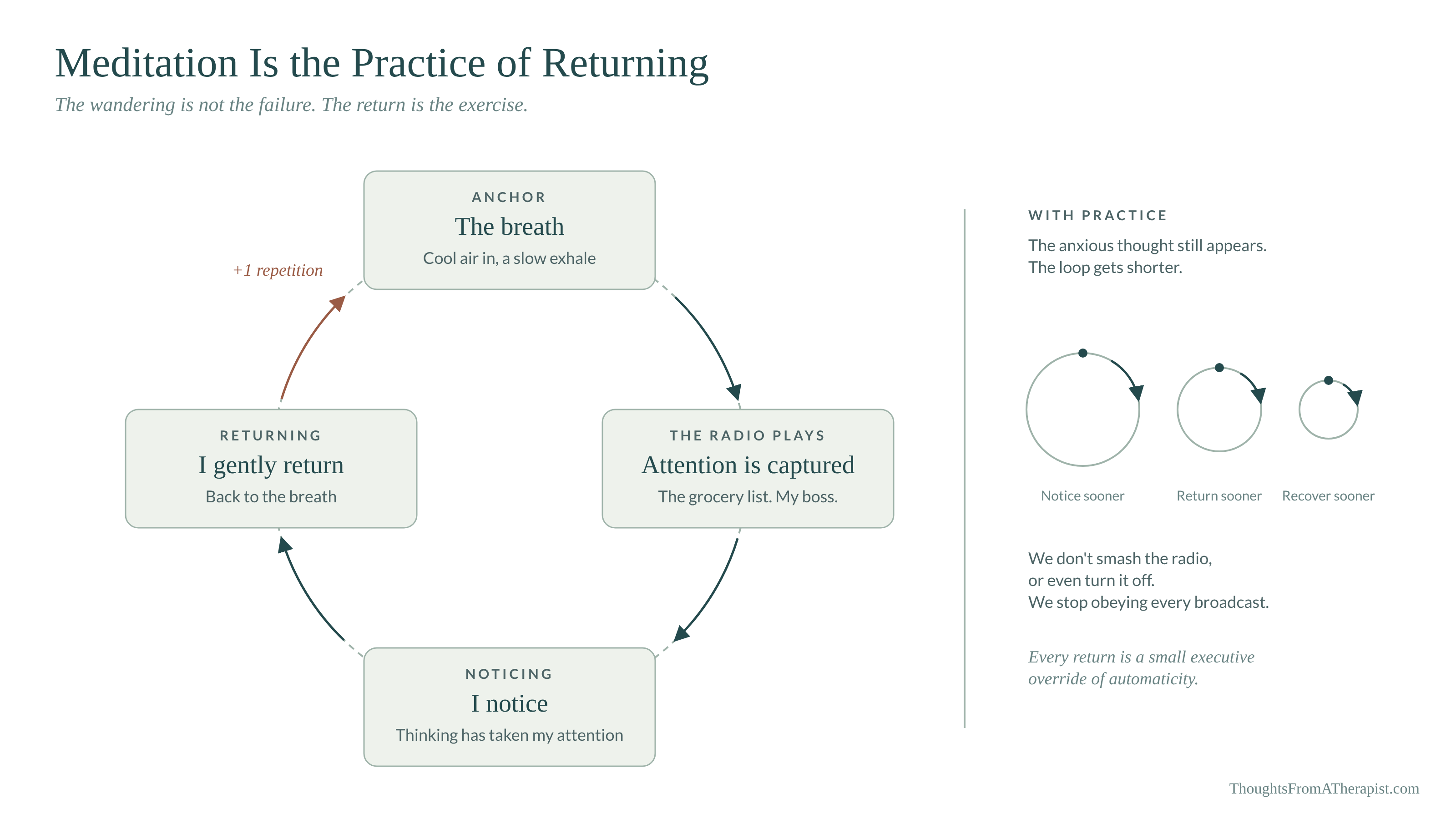
Breath, the radio plays, we notice, we return. The return is the exercise.
Analysis vs Observation
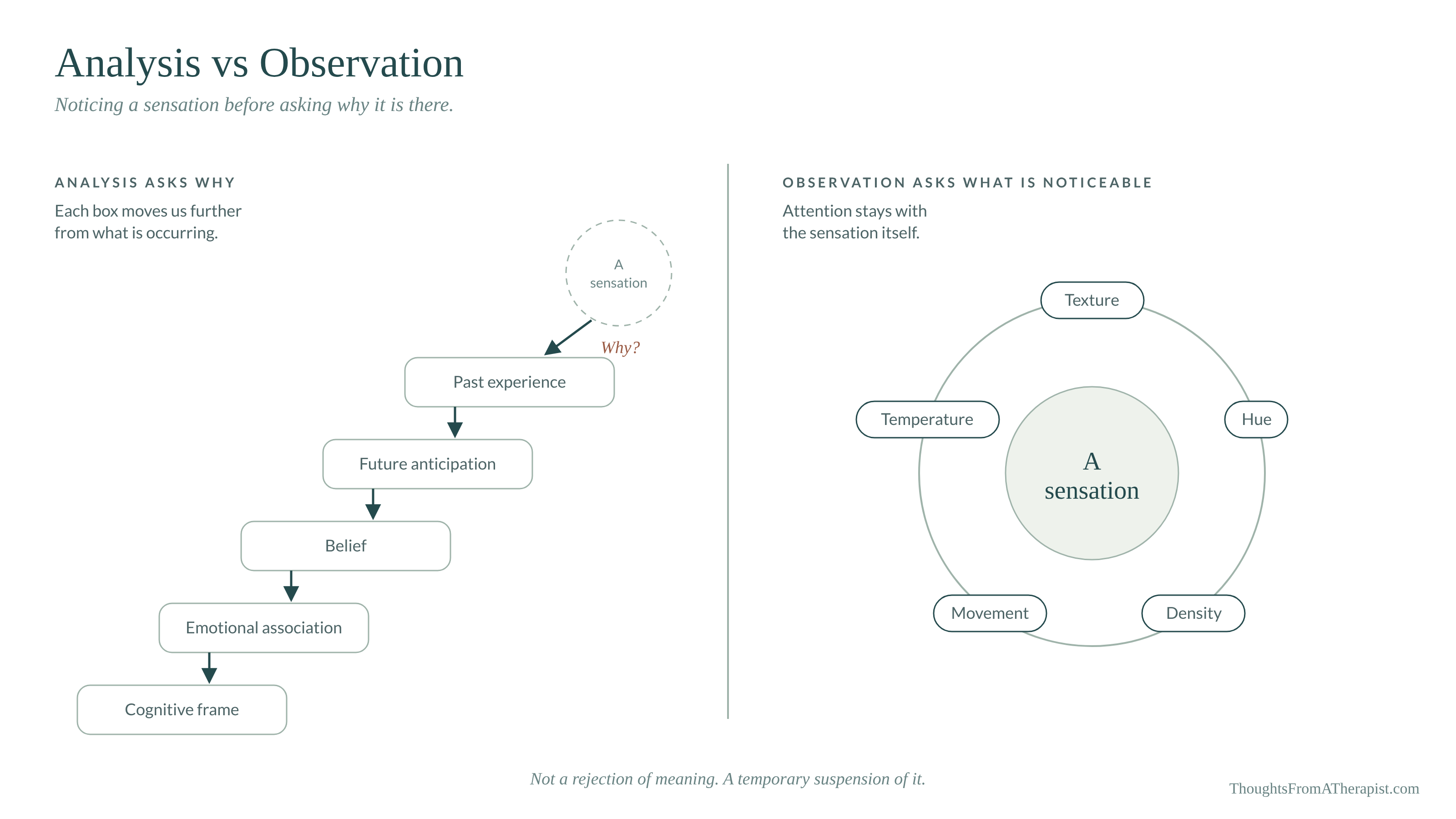
Noticing a sensation before asking why it is there.
Work with William
In therapy there is room for spiritual experience that stays connected to the body, the people we love, and responsibility, and for wonder and play to come back.