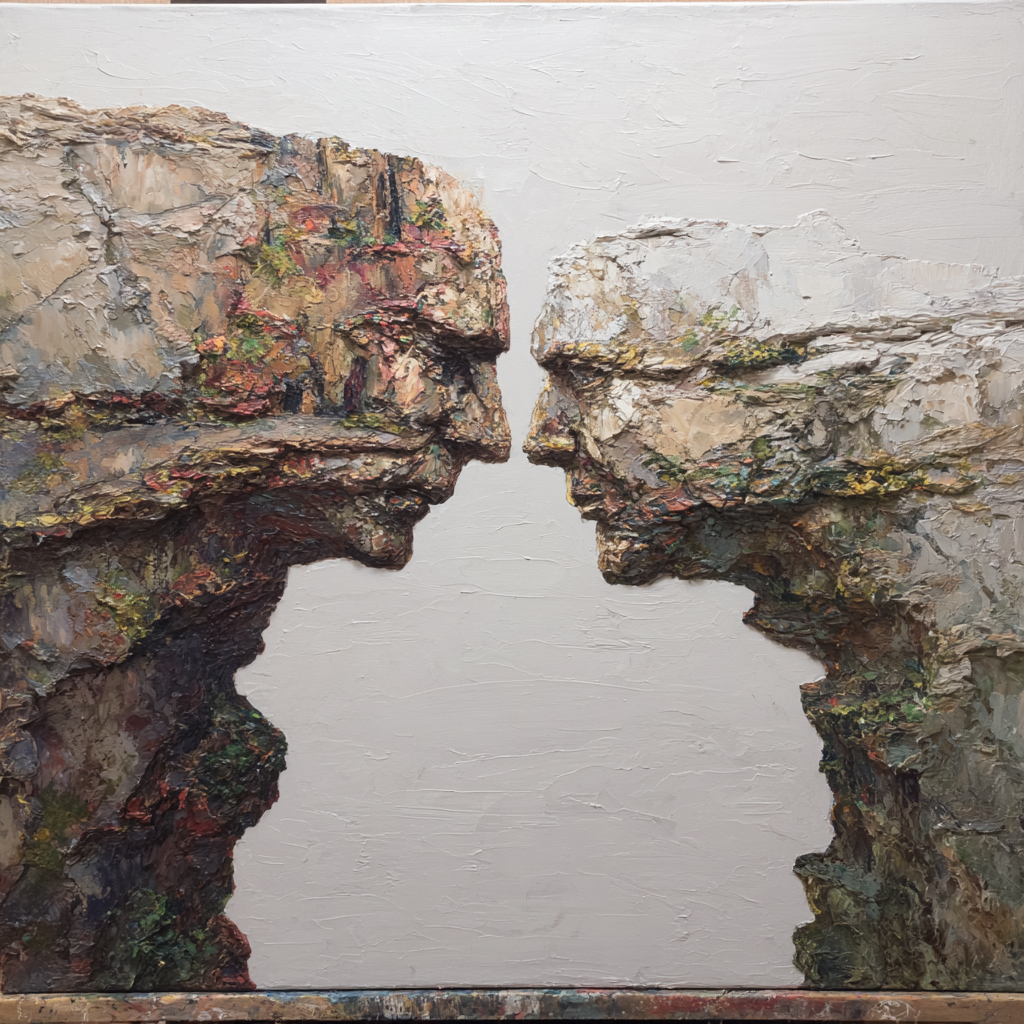
There’s a pattern that shows up all the time.
People don’t just have beliefs. They organize around them. And once that organization becomes rigid, the belief is no longer something they’re holding. It’s something that’s holding them.
What I start to see clinically is not someone struggling with a problem. I’m watching someone defend an identity. And the identity is doing something specific. It’s protecting them from the work.
The forms it takes
The pattern shows up in consistent ways.
There’s the victim, who holds tightly to the idea that they have no agency. The nihilist, who holds tightly to the idea that any process of seeking fulfillment or meaning is itself meaningless — so they can always return to that loop. The perfectionist, who holds onto the idea that everyone else is less competent, and therefore must overwork and carry the system. The spiritual bypasser, who uses spirituality — often Buddhism, sometimes other contemplative or wisdom traditions — as a mechanism for avoiding the vulnerability required to depend on, to trust, to connect, to attach.
There are other versions. Earlier in my work, doing more intensive clinical intervention, I encountered more extreme forms — including psychosis, where someone holds tightly to the idea that their perception is correct and everyone else is behind. That’s a different order of severity, but structurally it follows the same pattern.
An identity organizes reality in a way that protects the person from something they cannot yet metabolize.
The recursive loop
What makes these identities so durable is that they are self-sealing. They can always return to themselves.
The victim returns to: I don’t have agency. The nihilist returns to: none of this matters. The perfectionist returns to: if I don’t do it, it won’t be done right. The spiritual bypasser returns to: attachment is the problem, or, I’ve already moved beyond this.
There’s always a way back. And because there’s always a way back, there’s always a way to avoid the next step.
The perfectionist dialectic
The perfectionist is one to handle carefully, because much of what gets offered as intervention is actually inaccurate.
We’ll say things like: other people are just as competent as you are. You don’t need to do everything perfectly.
But that isn’t always true. A lot of perfectionists I’ve worked with — they’re not wrong, from a competency perspective. Many of them actually are more competent than the people around them. That’s part of why the identity holds. And pretending otherwise doesn’t land. It flattens the dialectic instead of holding it.
The work is closer to this: you may be more competent, and you are still deserving of rest. What you delegate will be acceptable. Over-functioning carries a cost — to your body, to the people around you, to the relationships that need a version of you that isn’t always carrying.
We don’t shrink reality to create flexibility. We let reality stay complex and find movement inside it.
Spiritual bypassing and moral identity
A big one to name directly: the spiritual bypasser.
People will use something like Buddhism — and I’ll say up front, Buddhism is part of my own orientation, clinically and personally, so I’m not speaking from outside it — specifically as a mechanism for avoiding the vulnerability necessary to depend on, to trust, to connect, to attach. They’ll arrive in therapy asking for help doing exactly that. How do I detach more. How do I stop needing people. How do I stay above this.
Underneath the request is fear. Fear of dependence. Fear of being impacted. Fear of vulnerability inside relationship. The spirituality becomes a structure that allows distance to feel like growth.
This same pattern shows up across other systems. It’s especially visible in more rigid forms of Judeo-Christian fundamentalism, where the bypass doesn’t organize around detachment. It organizes around moral certainty.
What gets avoided is the dialectics of ethics. Complex moral questions get reduced to fixed positions. Internal dissonance gets managed by reinforcing belief rather than exploring it. When behavior falls outside the person’s stated values, the behavior is reframed, or the belief is applied selectively to preserve identity. When the belief system doesn’t provide an answer to a moral dilemma, the question itself often gets shut down.
This protects the person from the experience of moral dissonance. It allows them to maintain coherence without sitting in the discomfort of not knowing what is right. The shame of being out of integrity with one’s stated values is hard to metabolize. Rigid identity offers a way around it. The cost is that integration never happens. Only protection.
The bypass of mortality and the unknown
There’s a deeper layer that cuts across both of these systems. It’s the bypass of uncertainty itself.
Questions like: what happens after we die. What existed before time. Whether consciousness emerges from matter or matter from consciousness. Where God comes from, or what precedes existence itself, or how something arises from nothing.
These are not only intellectual questions. They are emotional experiences. They confront us with uncertainty, with the limits of control, with the limits of understanding.
In many cases, people are given answers to these questions early in life. Answers that resolve the uncertainty cleanly. But often without permission to sit in the emotional experience of not knowing. So the identity forms around certainty. And that certainty protects against something specific — the discomfort of being inside a reality that cannot be fully resolved.
This is different from faith. Faith can hold the unknown. Certainty cannot.
At the collective level
We see this collectively too. Most clearly in how we organize politically.
We call ourselves Republican. Democrat. Even though those definitions shift constantly. What it means to be either changes across elections, across context, across decades, until at some point the definition becomes so fluid it loses precision. But the identity stays rigid.
Once the identity is fixed, we stop evaluating. It no longer matters what the representative actually does. They receive support because they belong to the identity. We stop checking their character. Their proposals. Their consistency. Their moral fallibility. We lose the ability to see dissonance.
That creates a particular vulnerability — to manipulation. When identity is rigid, behavior can be influenced without engaging substance. Attention gets pulled toward what is emotionally activating. Toward what reinforces tribal belonging. Toward issues that intensify identity.
You see massive amounts of time, energy, and money spent on issues that activate people emotionally even when those issues affect a relatively small portion of the population. Meanwhile, the things we all need remain under-addressed. Clean drinking water. Wildfire mitigation. Sustainable resource management. Roads. Education that prepares people to participate in a democracy.
These are shared needs. They require collective coordination. And collective coordination requires flexibility. Rigid identity makes that difficult, because we are no longer voting for solutions. We are voting for identity.
The feeling in the room
There’s a relational quality that comes with rigid identity that’s hard to describe until you’ve felt it. The person can feel not fully there.
In family work, it often feels like you’re not getting something vulnerable, and you’re not getting something spontaneous. You’re getting something pre-formed. Like a shell. Or more precisely — like a prompt. You say something, and what comes back is already written. It’s coherent. It fits. But it isn’t alive.
The room starts to feel flat. Distant. Lonely.
That’s often the signal that identity has replaced participation.
What the identity is protecting
Across all of these, the underlying pattern is consistent.
The identity is protecting against something that would require vulnerable acceptance. Grief. Acknowledgment of shame. Connection. A shift in belief. Or tolerance for uncertainty.
What is needed is contact with something that hasn’t yet been allowed. But instead of moving toward that contact, the system doubles down on identity. Because identity protects from the work.
Why it holds so firmly
From the outside, this looks like resistance. From the inside, it feels like truth.
Especially in more rigid structures, the person doesn’t experience themselves as avoiding anything. They experience themselves as correct. Which means insight doesn’t land. Logic doesn’t land. Confrontation doesn’t land. There’s no internal signal that anything is off.
Closing
The work is not to argue with the identity. That tightens it.
The work is to create conditions where the person can, at times, step outside of it. That can include introducing dialectics that expand reality. Creating enough safety for vulnerability to emerge. Allowing space for grief, shame, and uncertainty to surface without being managed away.
This is slow work. It requires precision. Because if the system feels pushed, it organizes more tightly.
Rigid identity is not a failure. It’s the system’s way of protecting itself. Over time, though, that protection becomes limiting. It narrows experience. It reduces flexibility. It makes connection harder.
The work becomes loosening the structure just enough that other things — relationship, grief, doubt, acceptance — can begin to enter again.
Not a different identity. A wider tolerance for what identity has been keeping out.