
Sometimes we fail someone and feel nothing, because our own values registered no infraction. When that happens the usual apology has nothing to draw on. The error is invisible from the inside, which means accountability cannot be a solo act. We need the person who felt it to tell us.
A story was shared with me recently that holds all of this. It is old and short and it concerns a bird who failed at an errand. It has been useful for thinking about humility, about values and where they differ, about what we assume is shared meaning, and about how quickly we recognize in another person a failure we cannot see in ourselves.
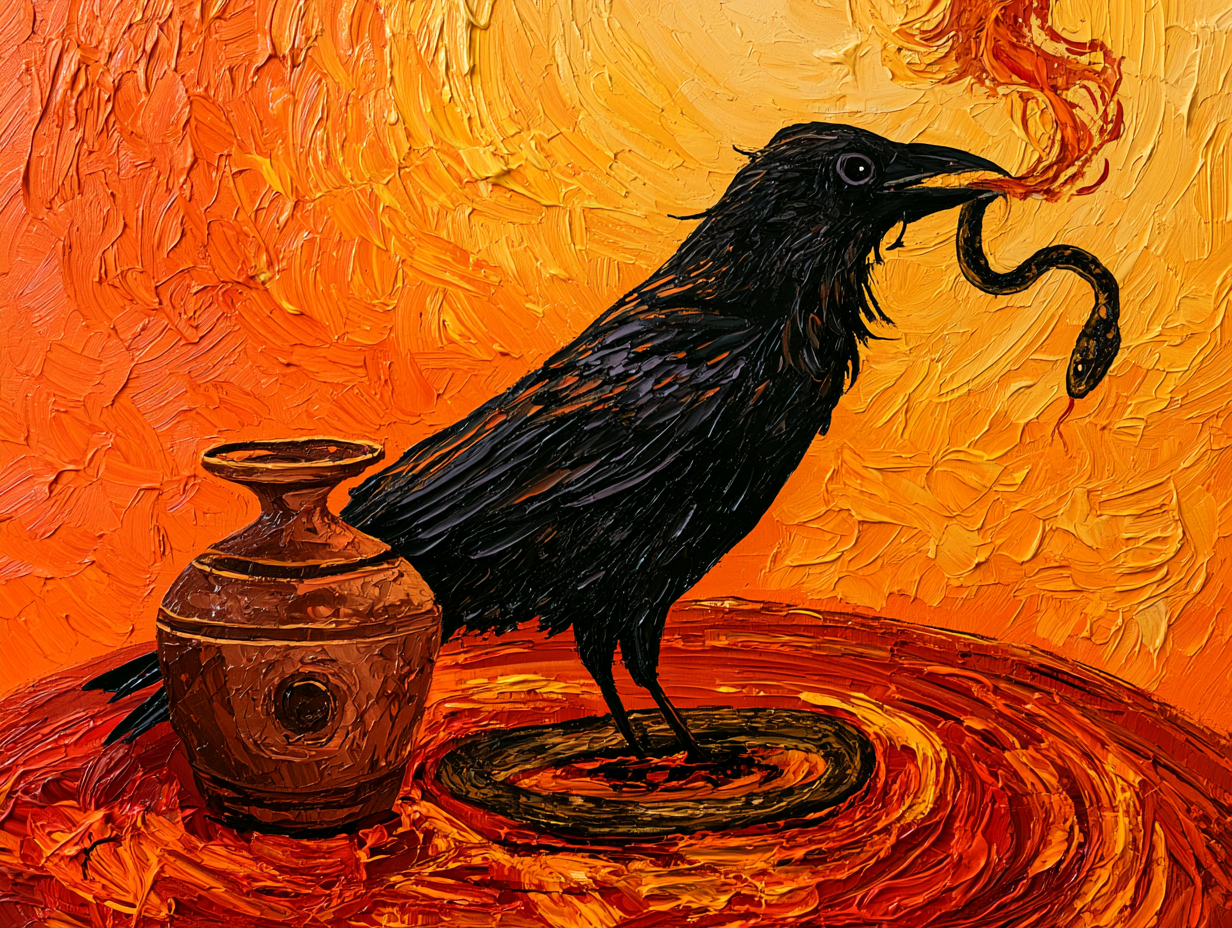
In Book II of Fasti, Ovid tells it quickly. Apollo sends a crow with a vessel to fetch water for a rite. The crow finds a fig tree, waits for the fruit to ripen, eats, and returns late with a water snake and a story about the snake blocking the spring. Apollo is not fooled. He fixes the crow, the snake, and the vessel in the sky, where they remain.
Read plainly, the story tells us to leave the fig tree and carry the water. Keep our commitments. Choose responsibility over appetite. When we fail, resist the urge to find a snake to blame.
That moral holds, and it stops early.
Everyone Is the Crow
There is an irony sitting inside the fable, and the irony is what makes it a Rorschach test. A story about the refusal to take responsibility invites us, immediately, to hand it to someone else. Most of us find the crow in a second. It is our partner, our boss, our friend, the politician we despise. We recognize the person who abandons responsibility for personal gratification and then constructs an explanation that protects them from accountability.
The more difficult reading is that this is all of us. This is all of us.
Imagine that I hold a value, or more honestly an aspiration, of being a healthy person. A waiter asks whether I want a side salad or French fries with my sandwich. The crow is waiting right there.
I order the fries. Before the plate arrives, my mind begins building the defense.
Inner speech
I took a long run today.
I ate well yesterday.
I deserve them.
That is the snake. I may never say any of it aloud, and it does not need to be offered to another person in order to work. It can remain entirely internal, protecting my image of myself from the incongruence of my own behavior.
The more honest sentence is less comfortable. I was unable to act in congruence with my stated value system in this moment because the fig was too tempting, so I ordered the French fries.
Oh, fuck. The crow is always there.
When Stealing the Fig Costs Someone Else
The same structure operates at larger scales. We want money, a lover, status, power. Sometimes the way to get it, the way to steal the fig, runs through someone else. The systemic gets sacrificed to the individual desire. The fig is no longer a side of French fries. It is a pleasure purchased through another person’s deprivation.
This is where the capacity to pause matters. Most of us do not have a well-established value system, whether or not we would say so. Those of us who do still lack the self-discipline, humility, differentiation, or grace to act from it while another desire is present. Either way, we remain organized around the immediate appetite. The ability to want something does not include the capacity to consider the system within which the wanting occurs. In this way we remain, effectively, a child forever.
The Fig Is Not the Problem
We could call that immaturity. The dialectic in the story corrects it. The morality of the fable carries its own immaturity if we read it too literally, because it sets pleasure against responsibility. The child eats the fig. The adult carries the water. Virtue becomes the repeated refusal of pleasure.
The fig is not the problem.
There are circumstances in which we can eat the fig and deliver the water. I can eat a fig without hurting anyone. We can satisfy the individual without exploiting the collective. We can experience pleasure in ways that remain congruent with our values and conscientious of the systems around us.
As we move into adulthood we come to hold both the value of pleasure and the value of ecological conscientiousness. That reframes the question. Instead of asking whether we must choose pleasure or responsibility, we can ask how pleasure might occur without requiring another person or system to pay for it. Beyond that is a more interesting question. How might serving the individual also serve the collective?
That asks for more than the avoidance of exploitation. It asks us to take the surrounding system so far into account that the feedback loops become visible. A few companies have worked this out, Patagonia among them, and probably a great many small businesses that none of us will ever hear about.
Analogy
Consider an apple tree. I give it water, nutrients, attention, and care. The tree grows and produces apples. I receive nourishment from the same system I am helping to sustain.
My pleasure and the tree’s health are not neutral in relation to one another. They form a positive feedback loop. In a sense, we are both eating our figs.
Not every conflict between appetite and responsibility can be designed away. There are times when the water must be carried and the fig left behind. Dialectical maturity does not mean that every tension dissolves once we arrange things cleverly enough. It means telling the difference between a pleasure that participates in a living system and one that extracts from it, and then acting on what we find.
Responsibility First, Honesty Second
The value underneath carrying the water is responsibility. Apollo gave the crow a task. The crow gave its word by accepting it. Something larger than its immediate appetite depended upon its return.
The honesty comes second. Once the crow abandoned the task, it faced another choice. It could acknowledge what happened, or it could protect itself by revising the story. The snake appeared because the crow could not tolerate the dissonance between what it had agreed to do and what it chose.
Our snakes get more serious as the stakes rise. The long run that justified the French fries was a small one. The difficult partner, the unreasonable boss, the unfair system, the childhood wound are larger, and they are more convincing because they may contain real context; accountability does not require us to deny context. It requires that context not absorb all responsibility.
Adulthood includes sitting within that dissonance long enough to say it plainly.
I am sorry. In this instance, I was the crow.
Shame takes the behavior and makes it an identity. Accountability holds enough space between who we are and what we did that repair remains possible. We can understand the conditions that shaped our behavior while still acknowledging that the behavior belonged to us.
When Our Values Register No Infraction
There is a harder version of this. Sometimes we do not feel the dissonance at all. We chose the fig and nothing in us objected, because the water never weighed much to us in the first place.
Said directly, our value operating system registered no infraction.
Definition
A value operating system is the set of commitments and weightings we actually run on, as opposed to the ones we would list if someone asked. It is what reports an infraction, or fails to.
The failure happened, and we cannot see it from where we stand, because the instrument that would detect it is the same system that permitted it.
In those moments the usual apology has nothing to draw on. We cannot confess a betrayal of our own values, because our values held. Someone else weighted that obligation heavily, and they absorbed the cost of a choice that cost us nothing.
This is where most repair fails. We search ourselves for the guilt we are supposed to feel, find very little, and offer an apology assembled out of compliance. The other person hears it and knows it is hollow, because it is. They are waiting for something else: the recognition that our indifference was itself the injury.
I did not feel the weight of that. You did. The difference between us is mine to answer for.
An Argument About Elephants
Here is an instance from life rather than from a fable. I once spent a couple of weeks in a group with two people who got into an argument about elephants.
One of them told a story about their father traveling to Africa to hunt an elephant and bringing the tusks home to hang on a wall. They told it with no sense of infraction at all. The other person was an environmentalist and heard something close to an atrocity. Why would Americans travel to someone else’s country to disturb the wildlife. The elephant population is already struggling. None of it had anything to do with sustenance. We have an obligation to look at the state of other species and act accordingly.
They were not arguing about elephants. They were comparing value systems, and the elephant was the object that happened to be available.
These two had no relationship before and would not have one afterward, so the argument stayed an argument. Had they been married, the elephant would have been the smaller problem. The larger one is the question sitting underneath it.
What does it mean to be in a relationship with someone who feels no objection to something I find morally intolerable?
When Is It Okay to Shoot the Elephant?
Very few people actually hold the position of no objection. Most of us hold a threshold, and what we disagree about is where it sits.
Life keeps handing us double binds. We consult our value system and our reward system at the same time and make a decision that is contextual and relative to the moment. Suppose an opportunity arrives that would pay for my children’s schooling and our vacations, and the cost of it falls on the garter snake population in a square mile of backwoods somewhere in Texas. That is ecologically negative in one direction and positive in another, and the direction it is positive in happens to be mine.
I run a smaller version of this constantly. I eat meat. I drive a car. I am aware that both carry a cost to the ecology I am part of, and the pleasure is large enough that I choose it anyway, at a cost something else absorbs.
Which means the argument about the elephant was never about whether. It was about when.
Consider the same question with the weights moved. Suppose someone offers a billion dollars for that one elephant, and the money opens children’s hospitals. Then take the hospitals out and let it be a billion dollars for nothing but me. Somewhere in there, most value systems capitulate and take the money.
A few people pursue purity and hold the line wherever it happens to fall. That is not most of us. What we have instead is a weighting, and the weighting moves with context.
Never
You never shoot the elephant
No circumstance makes it acceptable. The animal’s life is not available for trade.
Almost never
You almost never shoot the elephant
There is a threshold. Most offers fall below it, and the argument is about where it sits.
Why not
Why wouldn’t you shoot the elephant
The weighting runs the other way, and the cost registers as small or as someone else’s.
None of those three holds a different value in kind from the others. They hold different weightings of the same two values. That is why the conversation so rarely resolves by stating positions, and why it tends to turn into an argument about character instead.
Empathy in Both Directions
What makes this harder than the fable is that the empathy has to run both ways.
Pride
What the telling carried
Facing a genuine fear. Hunting a large and dominant animal. A justification that was not empty, which is that the meat went to a nearby village where people did not have much food.
Horror
What the listening carried
Terror, sadness, helplessness, and disgust at our own species, held while someone describes the same act as an accomplishment.
So empathy here means sitting long enough to feel that someone is proud of the thing that horrifies us, and long enough to feel what it costs the person across from them to hear it. Both are difficult to hold. Neither is available to us while we are assembling our own defense.
Once we are humble enough to admit that we are all the crow, we can lean on our bonds rather than on the fantasy that self-discipline will be enough. A marriage, a family, a community does more than restrain appetite. It notices what we cannot notice from inside our own valuation, and says so.
There is a version of this where we hunt discrepancies, catalogue them, and try to close each one as it appears. That never ends, and it turns a relationship into an inspection. The other version happens earlier and out loud. We say what we each weigh heavily, what we believe we owe one another, and where one person’s fig is likely to be paid for by the other. Much of what gets discovered late as betrayal is a difference in weighting that was never spoken.
Discernment Rather Than a Rule
Then we are left with what to do about a difference in threshold. Do we change, and take on a value system that makes us more compatible with the person we love? Or is the discrepancy small enough that we can move toward acceptance? There is no universal answer, which is why this takes discernment rather than a rule. Some differences turn out to be ordinary. Others reveal that two people do not share an existential pathway toward meaning, and that shows up fast in practical terms. What we do with money. What we do with our free time. What we consider play. Both findings are information. Only one of them is comfortable.
We Read Each Other Through Stories
There is something in both of these stories that people miss. We are constantly deducing one another’s value operating systems through stories and metaphors rather than through direct inquiry. The fable is one of those. The elephant is one of those. These days politics and religion are the primary ones. We think we are talking about a politician or a church, and much of the time we are running a test on the person in front of us, because it is safer to argue about a public figure than to ask a partner outright what they believe they owe other people. From those deductions we decide that we are on the same path, or that we are not.
The disagreement was never about elephants, and it was never about figs.
When we read the fable and see only our partner, our boss, our friend, it becomes a moral weapon. Its more difficult function is a mirror. Its hardest function is a second set of eyes. The order matters. Until we can find the crow in ourselves, the rest stays out of reach, including the admission that we need one another to carry the water.
We are all the crow. What varies is whether anyone is close enough to tell us the water never arrived, and whether we can bear to hear it from the person who felt its absence more than we did.


