Spirituality is where I go to immerse fully in the interconnectedness of everything. Spiritual contemplation is where I go for fun. It gives me the humility to follow a question past the point where an answer is available, and to stay there. For me, spirituality begins where certainty runs out, and it comes back, eventually, to one particular life.
This orientation formed outside any single tradition. It grew out of childhood questions that would not close, a period of terror about death, Buddhist and yogic teachings that later gave me language, long stretches in wild places, years of sitting with grief as a therapist, and a handful of psilocybin experiences. Each moved me further from certainty and closer to a felt sense that we are one and separate at the same time. The spirituality I trust makes us more available to ordinary life: the body, the people we love, grief, pleasure, and responsibility.
Where does spirituality begin when certainty runs out?
A Memory From Before I Had Language for It
When I was about five, I was standing near a fig tree and said something out loud. I no longer remember the words. I remember the sense that they traveled outward and kept going, infinitely.
At the same moment, something arrived that people might call déjà vu, although the word is too small for it. It was less the feeling that this moment had happened before and more an awareness of infinite experiences of having been there. My consciousness sat in it, knowing this was not the first round.
I cannot say what that was. Memory, imagination, a developmental event, or contact with something I still lack language for. What I know is that the experience was complete before I had any framework to put it in. The felt recognition came first. The interpretation came much later.
There Is No Final Why
In a science class, we learned why the sky looks blue. Sunlight scatters as it passes through the atmosphere, shorter wavelengths scatter more, and a wavelength corresponds to a color. Then came the next question, and the one after that.
The endless why
Why is the sky blue? Because sunlight scatters, and the shorter wavelengths scatter most.
Why does that wavelength look blue? Because the eye and the occipital lobe translate it into color.
Why does any of that produce the experience of blue? We can describe the brain constructing color with growing precision, and each description leaves another why standing behind it.
I realized then, as a kid, that there was no end to the question. Every answer becomes the material for another why.
Scientific explanation tells us, with growing precision, what happens and how processes relate, and I love it for that. It also arrives, every time, at the edge of what our instruments, language, and cognition can hold. That continuation past the edge is where spirituality starts for me.
The question keeps going after the answer stops.
Is Empty Space Empty?
Around fifteen, in chemistry class, we were taught that electrons move through empty space. Nothingness. It did not fit. If something travels through it, and we can describe the path, in what sense is it nothing? Maybe we lack the terminology or the measurement tool.
A missing measurement is still different from a missing existence.
I held that position firmly enough that it became the one place I got dinged on a psychological evaluation around that time. I was not being oppositional. The explanation was incomplete, and I could feel where.
We already accept plenty that has no weight or location. Consciousness cannot be set on a table. Irony has no mass. A relationship exists, and it cannot be lifted out of the two people in it and displayed on its own.
From there came the next contemplation. Does infinity go both ways? From any point we can imagine moving outward forever. Can we also move inward forever, every apparent unit turning out to be another field at a smaller scale? These questions break the capacity of our current cognition to arrive at an answer, and that is part of what I enjoy about them. They show the gap between what is and what a human mind can picture.
The Fear of Existing Forever
Not all of this was play. Around twelve, I went through a period of intense fear of death.
I was trying to make sense of mortality with the linear, dichotomous thinking I had been handed. This is good, this is bad. This happens because of that. Follow the right moral structure and arrive at the right destination.
The structure broke when I tried to extend it past humans. What is the morality of a squirrel? If a strict, legalistic ethic decides who goes to heaven, how does it rule on a lion, or a tree? I could not answer, and the inability frightened me.
Then the alternative frightened me more. I started contemplating time going on infinitely inside the consciousness of Will Bishop. Experiencing time as this human, the way this human experiences it, forever, began to feel torturous. I tried to rescue myself by imagining endless variations of my favorite movies, the Ninja Turtles included. It did not help. Infinite novelty still required this one consciousness to keep moving through linear time without end.
Much of my spiritual orientation started to bud right there, in the service of saving me from that terror. When relief came, years later, it came from somewhere other than making the individual self permanent: the sense that the self is real and is also not the final container of consciousness.
We Are One and Separate
Yogic and Buddhist teaching later gave me language for what I had already started to sense. What is the relationship between the observer and the observed? Is the separation between them ultimately real, or is it a useful distinction drawn inside something larger?
I am an I. I have a body, a history, a perspective, and a life nobody else can live for me. I am also everything, inseparable from the relationships, culture, ecology, and matter through which that I became possible. This holds from every standpoint, the observer’s and the observed’s. Physical science does not disprove this so much as stop short of it. It sits past the reach of quantification.
We are one and separate, and neither side cancels the other.
I read a lot of Thich Nhat Hanh and learned a great deal from him. He had a gift for making this tangible, and three of his teachings stayed with me.
The cloud
Was it ever there?
A cloud forms, falls as rain, and forms again somewhere else. The water continues and the form changes. He called this relationship interbeing, close to what he described as no birth and no death, only continuation.
Two matches
How many flames?
He strikes one match and lights a second from it. Pulled apart, there are two flames. Brought back together, there is one. What was divided, and what continued?
The broken leg
Good or bad?
A young man breaks his leg, which is bad. Soldiers come for every able-bodied young man and he is spared, which is good. Something bad follows from his staying home, and the judgment keeps flipping.
The consequences in that last story matter. What it shows is that our attachment to good and bad adds a conclusion before the story has finished, and since the story never finishes, every conclusion stays incomplete. I love these as tangible, everyday exercises in duality. A cloud, two matches, a broken leg.
Interconnectedness as Something We Feel
Interconnectedness can stay a concept. Time in wild places made it something I feel.
At first I went into nature for the awe, the rapture of it, and the awe is real. The longer I stayed out, the more something else happened. The body adjusts to altitude and cold. Attention changes. Weather stops being scenery and water stops being a convenience. We become a literal part of the ecology, and this is felt in the body, rawer than any human conceptualization of it. It is probably closer to what many shamanic traditions were able to feel.
In The Fractal Field of Mental Health, interconnectedness is one of the seven dimensions of mental health. Out there, it stopped being a dimension on a map and became where I was standing.
Mycelium
The mycelium of the psilocybin mushroom is the best image I have for it. The mushroom is the flower, the visible fruiting body, carrying the message of the mycelium beneath the soil. The mycelium is the more permanent part, a literal network of exchange, decomposition, and growth that makes a living ecology function. The individual form is real. The network is real too.
Beginnings and endings change meaning inside that picture. Birth and death still matter. Loss is still loss. The beginning or end of one form still leaves open the beginning or end of what it grew out of, and that meaning resists being held in any dogmatic way.
What the Therapist’s Chair Taught Me
Some of the most formative teaching came later, after I had finished graduate school and started sitting with clients. Much of the time a therapist has nothing to do except offer space, especially when grief is intense. We live inside a field of emotional cacophony, and our role is to be the regulator and the witness.
There is a spiritual nature to empathy, and it took me at least ten years to learn how to work with it. Early on I had less control over my empathy, and I went through cyclical periods of burnout.
Empathy works like hearing
We can heighten our hearing and become more intent and focused. We can also let the background fall away, so that every noise in a restaurant stops being available at once and we can hear the person in front of us. Empathy can be tuned the same way. I can turn toward the full field of another person’s experience, and I can choose how much of it to take in at once.
The theorists from my training were great. The teachers who changed me most came from outside school.
Alan Watts, who called himself a philosophical entertainer, would giggle at himself in the middle of saying something spiritual, funny, and dualistic all at once. I loved that interplay. Mortality, grief, purpose, and coexistence could be talked about seriously, and they could also be funny.
Joseph Campbell looked at everything symbolically and mythically, which fit the sense I already had that these are all stories, told from different depths. In one interview he said something along the lines of: it is fairly easy for a young man to survive when all he has to do is depend on his own survival.
I heard two things in that line. The first is that survival as our only existential responsibility is, in a way, a blessing. Sometimes we can almost envy the other animals, and we are animals too. The second is a kind of reassurance. We might suffer. We might eat out of a trash can. It too will pass, and we will most likely get through it.
That line gave me a self-confidence I have carried since. I can make it. If I do not, I die. Most likely I will make it, and one day I will look back on whatever suffering I encountered with the same dialectical complexity as the parable of the broken leg, where good and bad keep trading places.
Spiritual but Not Religious: Why Certainty Got in the Way
I have enjoyed reading about many religions, and I found them helpful until they were not. They offered stories, practices, and language for experiences that ordinary explanation cannot reach.
I do not hold a religious identity, and certainty is a large part of why. I watched religious identity work, often, as a tool for reducing cognitive flexibility. A tradition that opened a question could later announce the question answered, and belonging could start to depend on agreeing. Ironically, that certainty was detrimental to my own spiritual development and to how I participated in culture and life, because things are relative and contextual. I did not want something fixed. I did not want something that encouraged me to bypass the joy and fulfillment I get from my own contemplations.
There is a second bypass worth naming. When suffering gets explained away as illusion, karma, or a plan, a spiritual explanation can become a defense against grief and responsibility. Detachment can look like wisdom while working as avoidance. This is spiritual bypassing, one of the rigid identities I wrote about in The Realities of Rigid Identity.
Mystery gets smaller when we convert it into certainty.
Psilocybin and the Ego Becoming Part of the Scenery
Some of my most visceral experiences of interconnectedness have come during psilocybin experiences, in many contexts, from lying down with a pillow over my head and binaural beats to sitting out in the woods. Nature, grief, music, and love have opened the same door at other times.
I hold these as experiences, not proof. An intense internal experience does not establish the structure of the universe. It does change what can be felt and contemplated afterward.
There is usually a fight first. I have quite a thinker on board, and my ego fights hard to keep the ordinary boundaries through which I recognize myself. Once it surrenders, the ego dissipates and becomes part of the scenery. What remains feels closer to the singularity, the source. We are separate consciousnesses and one consciousness at once, and in that state it is felt rather than reasoned. Infinity and infinitely fractaled interconnectedness stop being concepts.
That leads to a contemplation I like to keep open. If consciousness is that pervasive, does everything carry some form of it, even a rock, participating evenly and predictably with gravity and the other laws of physics? I cannot establish that. The value is in letting the question stay open without needing belief or dismissal.
These experiences also reached back to the twelve-year-old who was terrified of existing forever. Will turned out to be one temporary organization inside something much larger, and the self still mattered without having to be permanent.
How Could There Be a Hero Without a Villain?
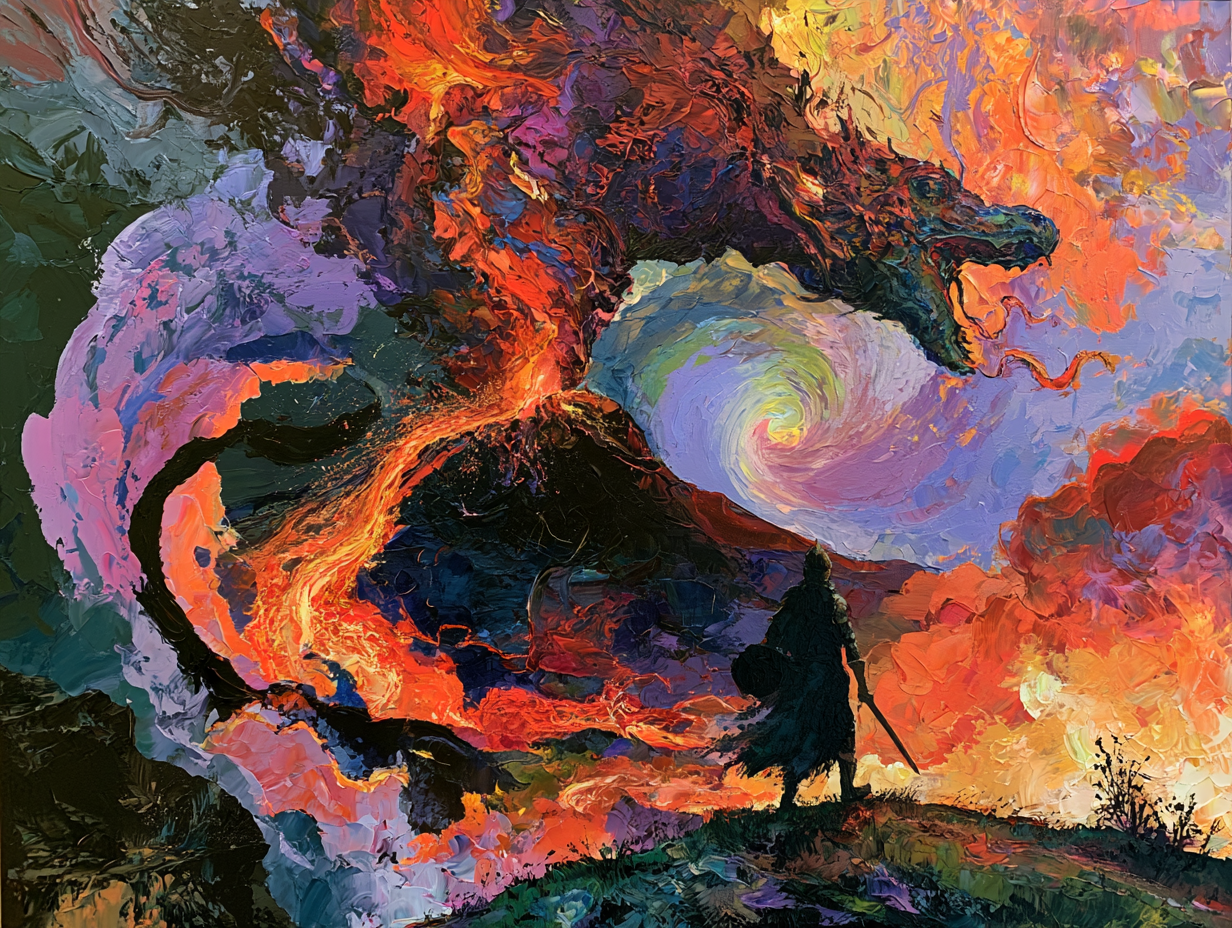
One image from those experiences belongs to my book, so I will only state it briefly here. A creature that was part volcano, part dragon, part dinosaur, bright as a supernova. A knight walking toward it, carrying the existential intention of finding fulfillment through heroism. The image was pre-verbal, and it said one thing clearly.
How could there be a hero without a villain?
For anything to exist, its counterpoint has to exist. Every frequency has a corresponding frequency. No up without down, no dark without light, no beginning without end. And the opposites are, at the same time, the same thing, the way the observer and the observed are.
That is where spirituality and dialectics meet for me. I want purpose. I want to engage the world through my values, the things I call good. I can also be grateful for what I would call bad or suffering, because it is the counterpoint that lets the other exist at all, and it is part of all of us. Gratitude for the counterpoint leaves our responsibility intact. We still answer for what we create, tolerate, and repair.
The growth of complexity looks to me like fractaled interconnectedness growing harmonically. Every note exists. We can still move toward an order of greater complexity and harmony, where more differences sound together without the structure collapsing.
There is comfort in this, although it asks us to move past the impermanence of the ego, of the self I call Will. There is release and relief in knowing it is much bigger than we could ever know, and that all things can and do exist at the same time.
Common Questions About Spirituality
Can we be spiritual without being religious?
Yes. For many of us, spirituality is a relationship with interconnectedness and mystery rather than membership in a tradition. Religions can offer language and practice for that relationship, and they can also close the questions spirituality depends on keeping open.
What is spiritual bypassing?
Spiritual bypassing is using spiritual ideas to step around grief, need, or responsibility. Suffering gets explained as illusion, karma, or a plan, and detachment starts to look like wisdom while it works as avoidance. A grounded spirituality makes us more available to the body, our relationships, and accountability.
What does Thich Nhat Hanh mean by interbeing?
Interbeing is his word for the way nothing exists on its own. A cloud carries the ocean, the sun, and the wind that formed it, and when it falls as rain its water continues in another form. Each thing is made of what it is not.
Is a psilocybin experience a spiritual experience?
For some people it opens a felt sense of interconnectedness and ego dissolution. I hold my own experiences as experiences, not proof, and as one threshold among several, alongside nature, grief, music, and love. Psilocybin carries psychological and legal risks, and nothing here is a recommendation.
Purpose Returns to One Life
As a kid, when someone first explained the Big Bang to me, I pictured it strobing. It bangs, expands infinitely outward, then compresses infinitely inward until it reaches the singularity, and bangs again. Cosmologists still debate whether anything like that cycle happens. What I loved was the rhythm of it, one becoming many and many becoming one.
Purpose, though, eventually comes back from the universe to the life being lived.
On a trip through the upper Wind River Range with my close friend Brian, we were above tree line the entire time, and the mosquitoes were at a different level. The bites put me close to a shock response.
When I finally got into my tent, I felt an overwhelming gratitude for my wife, Franziska. Our relationship and our love have always been, explicitly, my main purpose. That is the story of Will and Franziska. In that tent it solidified into something like permission. That is allowed. That can be what this is for. That can be what this story is for.
What is the purpose of life? It is a story, and the purpose is to live it, to immerse in the experience. Calling it a story does not make it false. We build meaning through what we love, protect, and create, and meaning we take part in making is no less real.
This is where spirituality and existentialism overlap. In the spirit of Alan Watts, I think of it as a hologram coming into alignment. When we are the story we are meant to be, we feel the congruence and coherence of it. Meant to be, here, is closer to an infinitely fluctuating variable that always was than to a fixed fate. The story is determined and undeterminable at once, and the paradox can stay a paradox.
Being a father has taken this further. My love for Franziska and for our sons, Benjamin and Emmett, has become a complete surrender to their importance, and it has changed what I mean by self. I believe I would give my life for theirs. That is a heavy thing to hold. It is also a kind of death of egocentrism, valuing another more than myself, or as myself. When I serve their development, it feels naturally aligned and fulfilling, an unconditional interconnectedness that asks for no explanation.
It also brings something that matters more than happiness. Happiness can be a false map. The compass points better toward fulfillment, congruence, and coherence, and that is what I feel as a dad and as a husband. Some days it is happy and joyous, and many days it is something else: every diverse, dialectical emotional situation arriving into one story.
Spirituality gives me room to contemplate infinity. Love gives that contemplation somewhere particular to return. I do not know whether this answers what life is for, or only what this life is for, and the living goes on inside that question either way.


