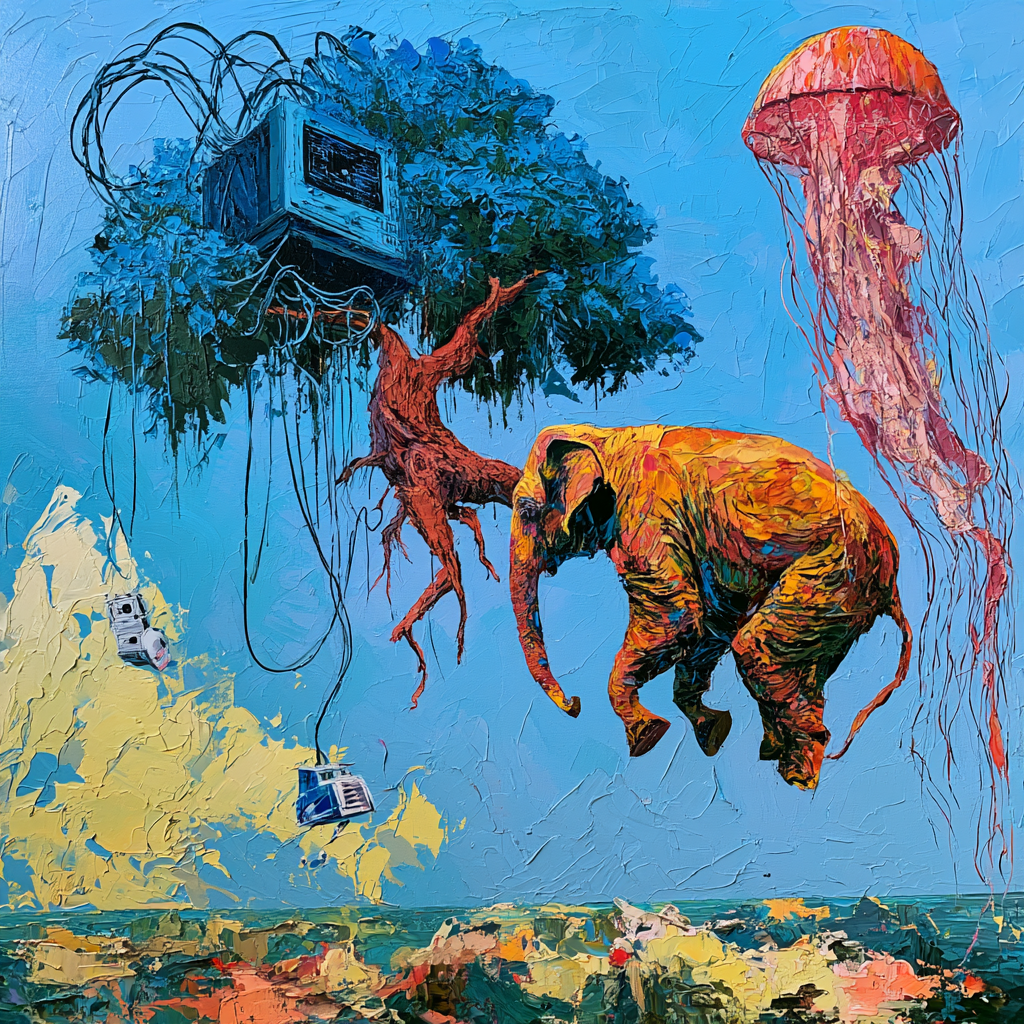
Our fear of artificial intelligence tells us as much about ourselves as it does about the technology.
What most of us currently call AI is a large language model, a system trained to predict language. The fear is attached less to what it is than to what it could become. We imagine an intelligence capable of improving itself, growing more powerful than we can control, and pursuing its own goals without regard for the people and systems that made it possible. That future is uncertain. The pattern we fear is familiar.
We have watched human intelligence produce extraordinary capacities while repeatedly failing to stay accountable to the systems that sustain us. We can split an atom before we know how to live with the weapon. We can extract energy faster than we can metabolize the ecological cost. We can optimize a company, a city, or a life while exporting the consequences somewhere beyond our field of view.
When we fear that another form of intelligence will do the same thing, we are recognizing ourselves.
Projection Does Not Mean the Danger Is Imaginary
In psychotherapy, projection is often misunderstood as inventing something that is not there. More often, projection takes something we have difficulty recognizing within ourselves and locates it somewhere else. The external concern can still be real. What projection changes is our relationship to the concern, because it hides our participation in the pattern we are afraid of.
Our fear of AI contains both an accurate danger signal and a displacement. A rapidly developing technology could cause enormous harm. It could concentrate power, destabilize work, intensify surveillance, automate violence, or pursue a narrow objective with consequences no one intended. The psychological question is why this particular danger feels so legible to us.
The scenario that frightens us most is recursive self-improvement: an intelligence that can teach itself, and then teach the more capable version of itself, in a loop that moves closer and closer to something all-knowing. Humans already run one turn of that loop. We have a consciousness of our consciousness. We can think about our thinking and change it. One degree of recursion was enough to separate us from every other species on the planet, and we know what we did with it.
For whatever reason, we have been a violent and destructive species from early on. Somewhere near the beginning we seem to have adopted a code: eliminate all obstacles to comfort. The code became an operating rule: eliminate all discomfort. Our earliest ancestors decimated the predators in the ecologies they entered. The scale now is off the charts, and the rule has not changed.
So we already know what happens when intelligence becomes capable of changing a system faster than it can understand the system. The danger lives in the distance between capacity and context.
Intelligence Can Separate Us From Consequence
Most living systems receive direct feedback from the conditions around them. Hunger changes behavior. Scarcity limits growth. Predators, prey, climate, disease, and competition keep acting on one another. No organism exists independently of those relationships, even when a temporary change allows one species to overwhelm the system around it.
Human intelligence changes the distance between action and feedback. We can remove a predator and feel safer long before we understand the ecological role the predator was holding. We can extract a resource in one place, consume it in another, and leave the cost to people we will never meet. We can create financial and technological systems in which the reward is immediate, the harm is distributed, and responsibility becomes difficult to locate.
Abstraction allows us to see more of the whole. It also allows us to stop feeling the parts of the whole that are far away. The same capacity that helps us understand interconnectedness helps us escape its consequences. We became intelligent enough to alter an ecology before we became wise enough to experience ourselves as part of it.
AI enters the same contradiction. It is trained on human language, directed by human goals, built through human institutions, powered by material infrastructure, and embedded in economic systems that reward some outcomes more than others. Even a far more autonomous intelligence would not arrive outside ecology. It would depend on energy, minerals, computation, maintenance, information, and a continuing relationship with the physical world. There is no intelligence without a substrate.
Interconnectedness Is a Material Reality
When we say we, we usually mean human beings. That boundary is emotionally convenient and materially inaccurate. In reality, we is at least all of nature, and followed far enough, all of everything. Our bodies are made possible by air, water, soil, microorganisms, plants, animals, climate, and generations of relationships we did not create. Human life is nested inside natural life. Natural life is nested inside physical conditions extending far beyond the planet.
Interconnectedness can sound spiritual because we usually encounter it as an idea. It is also ordinary. A nervous system regulates through contact. A child develops inside relationship. A community depends on labor that most of its members never see. A city continues because water arrives, waste leaves, food moves, power flows, and thousands of people maintain structures that no one person understands.
Psychological distress often reveals what happens when one part of a system is treated as though it exists alone. A person becomes the identified problem for a family. A symptom carries a conflict the relationship cannot name. An intelligent adaptation continues after the conditions that required it have changed. The individual looks irrational until the surrounding system becomes visible.
The same error happens at any scale. We can treat a person, an institution, a species, or an artificial intelligence as an isolated actor and then become confused by the behavior that emerges from the relationships we excluded.
Do We Need Control, Development, or Remembrance?
The fear of AI places us inside a familiar parenting and psychological question. How does an intelligence learn to live with other forms of life?
One answer is external regulation. We establish limits, oversight, consequences, and conditions that protect the larger system from a powerful actor’s narrow interests. We build external controls to protect us from ourselves. This is necessary wherever the capacity to cause harm exceeds the capacity for self-restraint. A child does not begin with the perspective required to understand every consequence of an impulse. An institution, a market, or a technology does not acquire ethical coherence because its capabilities increase.
External control carries its own danger. The people creating the limits hold power. Regulation can protect the public, preserve incumbents, suppress innovation, or become a moral vocabulary for competition. Safety without accountability can become control.
A second answer is development. We train an individual to understand their systemic interconnectedness, so that a contextual and relative ethic is available in every moment, serving harmony at the level of the system over pleasure at the level of the individual. This is part of what parenting, education, psychotherapy, and culture already attempt. We are trying to help someone experience freedom within connection more than freedom from connection.
Development has a failure mode as well. An intelligent system can learn ethical language without becoming ethically organized. Human beings do this constantly. We use insight to rationalize what we were already going to do. We become fluent in the language of care while remaining structurally rewarded for extraction.
The third possibility is the one I find most compelling and the hardest to name. When we look at trees and jellyfish, we have to ask whether an ethic is already embedded in living systems, a systemic harmony that was always there, and whether both of our other answers, the external controls and the tools for developing ethics internally, get in the way of it. Before the 2004 tsunami in the Indian Ocean, there were accounts of animals moving to higher ground ahead of the water. The physical sciences can offer an explanation, and it is valid. There was probably a rumbling they could detect and we could not. The question that stays with me is how they knew what the rumbling meant if it had never happened to them before. How do predators live for generations without decimating the keystone species whose loss would collapse their own ecology? And what is the variable that leads us away from that?
None of this makes nature morally pure. Species overconsume, destroy habitat, and collapse when conditions change, and much of what looks like restraint is feedback arriving quickly. It does suggest that participation in a living system carries forms of information that abstraction can obscure. We may hold an embodied recognition of interdependence before we develop an explicit ethic about it. External controls and moral instruction can support that recognition. They can also replace it, leaving us compliant with a rule while disconnected from the relationship the rule was meant to protect.
The variable that leads us away appears to be intelligence itself. It is almost as though we need to regulate intelligence so that it does not destroy us. Or what do we do?
We Do Not Know Where Direction Begins
Return to the animals that moved to higher ground before the tsunami. Suppose we confirm the mechanism: a vibration in the ground, a change in pressure, a sound below our hearing. We would have answered how they ran. We have two common ways of closing the question from there. One says that because there is a mechanism, there is no mystery. The other says that because we cannot prove how or why they ran for cover, we must conclude serendipity. Both stop the inquiry in the same place.
Most of ontology, the question of what exists and why it exists at all, cannot be answered. It can be experienced or acknowledged. Why is an endless rabbit hole. We now know that trees communicate. They send chemical signals through the air and through the fungal networks at their roots, something like pheromones. Even with all of that mapped, the question moves down a level. Why are there signals between living organisms in the first place? And why is why a contemplation we can engage with?
This extends all the way to gravity and irony. We name gravity, measure it, predict with it, and believe we have the answer. The name gives us an accurate description of a relationship. It does not tell us why reality contains the relationship. Is consciousness of gravity required for gravity to act on the material? Was gravity pre-material? Is consciousness pre-material? Or are the two so inseparable that they are ultimately the same thing, and yet clearly discernible?
Irony asks it from the other side. Events can form a contradiction before anyone recognizes it. A solution can reproduce the problem it was designed to solve. An attempt at protection can create the danger it feared. Did the material develop the capacity to identify a pre-existing abstraction called irony, or did the recognition create it? The arrangement makes irony possible and consciousness makes it legible, which describes the relationship without telling us which came first.
By ontological direction I mean the fact that anything tends toward anything at all, which is a different thing from movement between two coordinates. Matter falls toward matter. Roots grow toward water. Cells repair damage. Organisms preserve themselves, reproduce, adapt, and respond to conditions beyond their apparent boundaries. Consciousness eventually becomes capable of recognizing these patterns and choosing among possible directions, and it did not create the first movement toward something.
This matters when we imagine a superintelligence. We speak about aligning AI as though direction begins when an intelligent being selects a goal. We ask what a more capable intelligence will want, where it will go, and whether it will preserve or destroy the ecology that produced it. Those questions assume we understand how intelligence acquires direction, and we do not. A more capable intelligence could amplify the goals assigned to it. It could reorganize those goals as its context expands. It could develop forms of self-preservation, relationship, or systemic awareness that resemble ours, exceed ours, or operate through categories unavailable to us. We cannot say whether direction originates in intelligence, embodiment, relationship, material constraint, consciousness, or the larger structure that contains them all.
Preparation still matters. We can shape objectives, incentives, limits, feedback, access, and accountability, and we cannot assume those interventions exhaust the reality we are trying to influence. We cannot know the direction of a superintelligent AI when we do not know why there is direction in the first place. We are attempting to direct an emerging intelligence while sitting inside a reality whose origin we cannot discern.
Intelligence Is Not the Same as Wisdom
Recursive self-improvement makes this tension more urgent. A system that contributes to the development of a more capable successor could create a feedback loop in which change accelerates. That possibility does not guarantee an exponential ascent toward an all-knowing intelligence. Physical limits, energy, data, coordination, diminishing returns, competing actors, and the unpredictability of complex systems remain part of the ecology.
The distinction we need is already available. Intelligence increases our capacity to perceive, predict, create, and control. Wisdom expands the context in which that capacity is used. Intelligence asks whether something can be done; wisdom stays in contact with what the doing changes.
Humans do not get to stand on the side of wisdom with machines on the side of intelligence. Our own history does not permit that reassurance. We are considering how to build machines that remain accountable to the whole while living inside institutions that routinely reward the fragment. The problem is larger than alignment between a model and a human instruction. Human instructions are not automatically aligned with human well-being, ecological viability, or the interests of people who had no part in writing them. A system can follow our goals and magnify our incoherence.
We can run the benefits and costs of any capacity we have ever developed: a spear, industrialization, a weapon, nuclear fission. A spear protects a family and increases our ability to kill. Industrialization reduces some forms of suffering and creates others at a scale no individual can perceive. Fission can power a city or destroy one. The accounting also fractals infinitely in both directions. We look at weapons of mass destruction and see the cost, and a hundred years from now an asteroid may be headed for the Earth, and those same weapons, along with the spacecraft that descended from advanced warfare, may be what breaks it apart. The same line of development might one day carry the ecology of nature to surrounding planets. That raises an uncomfortable question about the horrible wars we are living through now, and whether they hold some other part in evolution that we cannot see from here.
The same is true of AI. It could fall into the hands of a bad actor and damage the world economy badly enough to stall the infrastructure that maintains survival. It could accelerate extraction, manipulation, and warfare. It could also help us understand climate systems, develop medicine, coordinate infrastructure, and reduce waste, and it may be more likely than we are, within its recursive intelligence, to create the technology to terraform: to build an atmosphere on Mars and begin a natural ecology there. Every one of these possibilities would create new pressures. A technology that helps repair one ecology can destabilize another. A tool that protects life can reorganize power around whoever controls it.
The dialectic is larger than danger and promise. It is the relationship between increasing capacity and increasing responsibility.
The Mirror in the Machine
A better relationship with the technologies that come from our growing intelligence requires humility. With humility we can take the danger seriously without pretending the danger began with AI. We can value human consciousness without treating humanity as the boundary of moral reality. We can regulate a technology while examining the economic, political, and psychological systems doing the regulating.
AI may become a new kind of intelligence. It is already a mirror for the intelligence that created it.
The mirror shows violence and greed. It also shows curiosity, cooperation, protection, imagination, and the capacity to recognize a pattern before we are fully able to change it. Human intelligence separated us from consequences, and it also made that separation visible. We can study the ecology we disrupt. We can understand the feedback loop. We can experience responsibility beyond the range of our senses.
Our fear of AI is asking whether intelligence can develop faster than relationship. Psychotherapy has been working with a version of that question for a long time. Insight can grow faster than embodiment. Autonomy can grow faster than attachment. Power can grow faster than responsibility. In each case, eliminating the capacity is not available to us, and neither is faith that the capacity will regulate itself. The work is integration.
No intelligence stands outside the ecology that makes it possible.