

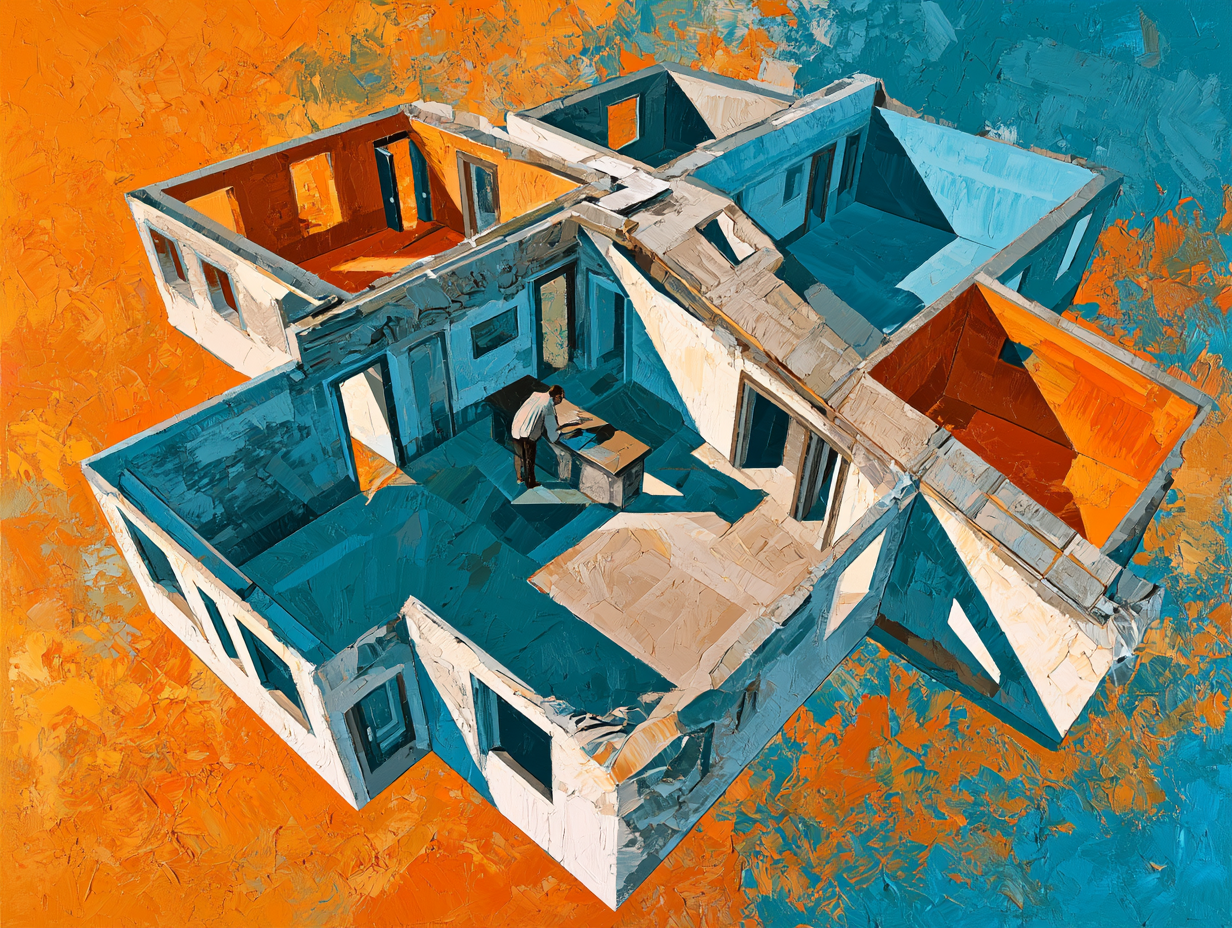
A teenager is skipping class and smoking pot. The question most of us ask is what is wrong with the teenager. The systemic question is what everything around him is doing to produce that behavior, including the parts of his life that never touch him directly: his father’s boss, the school’s curriculum, the way his parents were taught to handle emotion. Every symptom is connected to a near-infinite number of other variables.
The frame we usually draw around the identified patient, the one person whose symptom brought the problem to our attention, is too narrow for us to have a compelling impact. Below is the model in the form I use to teach it. It begins with the picture systems theory itself began with, a house with rooms at different temperatures, then puts a family in the house, then takes the same structure out into nature where it is easiest to see, and then makes the harder claim, that the culture we live inside is part of the structure too. Systemic thinking also runs in both directions. Whatever we add to one part of the system travels through the rest of it, and that is where the hope sits.
The identified patient is almost always too narrow a frame for us to have a compelling impact.
The Theory in Short
Feedback loops
A system holds a set point
Systems theory grew out of cybernetics, the study of how a system senses its distance from a set point and corrects toward it. A family does the same thing with its emotional climate, and the symptom is often the correction.
Adjacent systems
The nearest systems shape the symptom directly
The systems in direct contact with the identified patient, in a family the parents and the marriage between them, act on the symptom directly. They are crucial, and they are usually the ones we remember to look at.
Indirect systems
Influence that arrives through other systems
A system with no direct contact with the identified patient still reaches them through the systems it does touch. Dad’s boss, dad’s parents, the school’s curriculum, the culture’s definition of emotional intelligence. These are the ones most often overlooked, and they are often where a viable entry point is.
Both directions
Nutrients or poison
Whatever we add to one part of the system moves through the rest of it. We can feed the soil a tree depends on or poison it, and either way the whole tree is affected. The work is to trace the connections outward far enough to find the entry points where what we add will travel.
For readers who want to run the model on their own problem first, the worksheet does that in four pages.
Deconstructing a Symptom worksheet
A five-page fillable worksheet: name the presenting problem, ask all eleven variables what they are contributing, rate each one’s influence from 0 to 10, and then look for entry points only where the weight landed.
The map below puts the whole model on one page.

A House With Four Rooms
Picture a house that is a simple square divided into four rooms. We want one room to be 75 degrees. The room sharing one wall with it is 85. The room sharing the other wall is 65. The room in the far corner, the one that touches our room only at a point, is 32 degrees. How do we heat and cool our one room so that it holds 75?
We cannot do it from inside the room. Heat is moving through both shared walls the whole time, in from the 85 side and out toward the 65 side, and the 32-degree room is pulling heat out of both of its neighbors, which changes what each of them passes along to ours. A thermostat in our room will run the heater and the air conditioner against each other all day and the room will still drift. The temperature of the room is a property of the house.
This picture comes from cybernetics, the study of control and communication that Norbert Wiener named in 1948, and the thermostat is its oldest teaching example. A system has a set point, it senses its deviation from the set point, and it corrects. Gregory Bateson carried that idea into family therapy, and the phrase identified patient comes from that lineage: the family member whose symptom is doing the correcting for the whole system. What I add to the original model is the third room. The room that shares no wall with ours is the one everyone forgets, and it is reaching our room anyway through the two rooms it does touch.
The temperature of the room is a property of the house.
The Teenager Is the Room
Now put a family in the house. A child is the identified patient. He has responsibilities, goals, ambitions, and developmental tasks, and one of those tasks, for every human, is a degree of felt emotional regulation, enough that he can be congruent and keep the executive functioning resources he needs to stay differentiated and put his energy toward what he is trying to do. Differentiation here means being able to notice what we feel while still being able to think, consider another person, and act on our values.

One adjacent room is 85 degrees. That is dad. He is emotionally immature in the specific sense that he is constantly angry and does not know it. Something is felt, the feeling drives his behavior and his arousal level, his heat, and he is unaware of the whole chain. He is not differentiated from his emotions because he does not have the fundamental awareness that differentiation would require.
The other adjacent room is mom, and she is the counterexample. She is enmeshed with her emotions. She is aware of them, reflective about them, and overwhelmed by them. Between the two of them, the marital system has no mechanism for co-regulation. Neither one can bring the other back toward 75, so the marriage itself is doing a poor job of regulating emotion, and the child lives between those two walls.
A child in that house tends to go one of two cliched directions. One is depressive and hopeless: apathetic, not doing well in school, trying to please teachers and not getting the grades, because he lives inside a system that is constantly pulling at the resources he needs for tasks like school. The other is acting out. This child is the revolutionary on a micro level. He is saying the system is broken and we need to reorient it, and he says it by getting in trouble, experimenting with drugs, skipping school. Some of that can have other reasons, like a plain desire to flex his independence regardless of the system, and there is always a systemic component. Part of what the rebel is doing is trying to break the system so that it can be reconfigured.
A side note on the word emotional
A lot of people say someone is more emotional than someone else when what they mean is that the person emotes more. I would argue the reverse is often true. The people who are most controlled by their emotions are often the ones with no awareness of them, so they could not possibly differentiate from them. A feeling arrives, it runs their behavior and their arousal, and they never see it. Those are frequently the same people who chauvinistically call women the emotional ones, while sitting at the lower end of emotional maturity themselves. That paradox deserves its own post.
The Third Room
Dad’s room shares a wall with the teenager. Dad’s room also shares walls with rooms the teenager never enters: dad’s boss, dad’s parents, and, at the meta level, a culture that did not give dad the opportunity to grow in emotional intelligence because it misdefined emotional intelligence in the first place. Dad cannot articulate or name the diverse palette of his emotional experience, and he has been led to believe that this makes him the stoic one, the emotionally intelligent one, when the truth runs the other way.
Mom got the opposite inheritance. Dad got the 1950s explanation of emotions. Mom got whatever we told the millennials at the beginning: everything needs to be validated, and vulnerability means the embodiment and expression of one’s emotions. The pendulum in mental health and therapy swung hard in that direction, and we may have unintentionally encouraged people to over-focus on and over-identify with their emotional condition, which creates a feedback loop that can end in chronic anxiety and overwhelm. True stoicism, the older meaning rather than the way the word is used now, sits between the two inheritances. It honors that we are emotional and that we make our decisions emotionally. Therefore we must know our emotions, and we must know that not all emotions are facts.
Every room has eleven walls
The house with four rooms is a simplification. A real room in a real house has four walls. A person has more. Everyone in this family is surrounded by the same set of variables, the eleven that the worksheet later in this post walks through: near environment, recent change and loss, body and physiology, emotional state, triggers and trauma, constructs and beliefs, family of origin, the relationships around them, developmental fit, community and culture, resources and access. Each one is a wall on that person’s room, and heat moves through every one of them. So when I say the third room, I mean all of those walls at once: everything acting on mom and dad that never touches the teenager directly and reaches him through them anyway. Dad’s boss is one wall of dad’s room. Mom’s has walls of its own, and so does the teenager’s.

Mom’s rooms and the school’s rooms
Mom’s walls keep going. She values openness and communication and does not have it in her marriage. Maybe the family just moved. Maybe she changed jobs, and the new job pays for something while offering no fulfillment. The teenager has walls of his own. Maybe he is interested in the interplay between art and engineering, and no such curriculum exists in his school. His recall is low, his ability to sit and learn from seminar-based education is low, and the school is not providing the experiential, integrated education that would be most useful for his development. So he finds himself bored and underappreciated in what the school offers, and he is smoking pot and skipping class.
The two adjacent rooms are crucial for understanding this kid. And there are walls attached to mom and dad, and walls attached to those, and walls attached to those. This is where the fractal goes out almost infinitely, all the way to the constructs people argue about at the most meta level: capitalism, populism, monopolies. All of it can reach the room.
Dad’s relationship with his boss has something to do with why his kid is smoking pot and playing video games all day.
Turtles, Trees, and Prairie Dogs
That last sentence feels like a stretch to a lot of minds. That is why I keep reaching for examples from nature, where the same structure is easy to see, so that the harder claim about a family has something to stand on.
I was watching Planet Earth and they had a segment on sea turtles. Turtles are the kind of animal people want to help. So we protect a beach, the breeding habitat, and we feel that we have done something good. That is already a systemic move rather than an individual one. We are not handing the mother turtle a piece of lettuce, we are tending the system she depends on. And then the system keeps going. How are people using that beach? Suppose urban development pushed predators out of the hills. The coyotes that used to hunt up there now have a limited food supply, so they come down to the beach and find that it is easy to dig up turtle eggs. Now the third room. Hatchlings find the ocean by moving toward the moon, which sits low over the water. The city lights behind the beach are brighter than the moon, so the hatchlings walk inland toward the city and die. The lights of a city that shares no wall with the beach turn out to be one of the biggest culprits in the decline of the population.
A tree is the same. Why is the tree suffering? We look at the soil, and we look at whether something is happening to the bee population, and the answer may sit in the tree’s third room, a system that never touches the tree and reaches it through one that does.
Or the prairie dogs. Remove the eagles, the coyotes, and the rattlesnakes, and the rodent population goes wild, and all of suburbia loses the beautiful backyards it wanted.
None of these map one to one onto a family. The point is that they are all the same point. Nature examples are the simplest version of a structure that applies everywhere, and once the structure is legible in a turtle, it is easier to see in a household.
Energy Is Finite
Here is a second family, because the house looks different when fewer people live in it. The parents are divorced. Mom is providing for two kids by herself. The neighborhood is not particularly safe, and she does not feel particularly safe in it. She has no co-regulator because she has no partner. The finances are thin, and for a lot of families two incomes barely pay the bills, so one makes it nearly impossible.
Her daughter is being disruptive in school. We already know the social correlates here. Marginalization increases the risk of nearly all of the overt things we are trying to do better with as a society: domestic abuse, unwanted pregnancies, drug use, crime. All of them are correlated with an undernourished population. There is a myriad of social factors affecting this child directly. And there is a doubling effect, because every one of those marginalization variables is also acting on mom, which reduces mom’s ability to be the external regulator and guide, and drains the executive resources she would otherwise put toward helping her daughter.
I like to look at all of it together in terms of energy, because energy is finite. A car burns gasoline no matter which direction it drives. If a lot of our gasoline is going toward mitigating the fear of living in an unsafe neighborhood, or toward digesting food that is shitty because the food industry is under-regulated, that gasoline is gone. It cannot be diverted toward something more value-congruent.

Intervening Anywhere Travels
The good news is built into the same structure. Once we go from micro up to meta, every intervention trickles. If we help mom and dad’s marriage, what does that do to the resources available to the child? He is no longer burning gasoline trying to manage his own emotional temperature while doing homework with his parents screaming at each other in the next room. Or in the house where mom and dad do not talk, the son has noticed that mom is unhappy and has ended up playing some of the emotional support role, carrying some of the communication needs that belonged to the spouse. Nobody is saying children should have no role. It makes sense every once in a while for a child to help unload the groceries. There is a developmental line, and the parental role often crosses it, and repairing the marriage pulls it back.
Now go all the way out. Imagine every child who went to school had access to extracurriculars, to a diversified and expanded curriculum that could help them feel more existentially fulfilled, to the best food, to breakfast and lunch. Imagine what happens to the classroom. Then imagine what happens to the teacher. Almost every teacher will say they went into teaching thinking it was primarily about education, and because of all the social pressures arriving in the room, classroom management is where most of their gasoline goes. A healthier system frees that gasoline for the thing the teacher came to do.
As the system gets healthier, more resources can be developed toward other things, and the people in it are better resourced for however they would like to participate in and cooperate with our shared society and our shared ecology. It becomes an exponential feedback loop of solution-oriented positivity.

The inverse is what we are stuck in right now. At the top of the system, a survival code keeps running long after survival stopped being the question, and a survival code can only do one thing with resources, which is collect them: more cars for someone who does not care about cars, a few boats for someone who does not care about the ocean. For some people that is congruent, that is their existential code, and this does not apply to them. For many it is not, and the result is people with the most resources and the least fulfillment, chasing more of the thing that is not fulfilling them. With a little guidance, the same drive reoriented toward a different code, such as solving, could design the public transportation for a small town brilliantly instead of owning fifteen houses. And when we look at a lot of our politicians and a lot of the people in the news, there is also the modeling variable. What are they modeling in terms of emotional maturity and value congruence? And what are they telling us about our collective construct operating system?
The Construct Operating System
In the cybernetics example, the room next to mine affects my room through physics. Heat moves through the wall. There is also an abstract wall. The psychological reality is that my room is also affected by the constructs surrounding me, the shared ideas about how people are supposed to be, and those act on the house as directly as heat does.
Right now a lot of leadership is not displaying humility, not apologizing, not taking responsibility for being wrong. Many leaders have no clearly articulated value system that extends beyond the pleasure of the self. They get dysregulated the way a four- or five-year-old does and then behave in unconscious, enmeshed alignment with the dysregulation, text messaging contemptuous, dichotomous belief systems to the country. What is that doing to our young population?
What the culture teaches about relationships
Take a young man who feels lonely and would like to date. He gets on the internet, and there are emotionally immature men telling him that the way to get a date is to become a less considerate monkey. Meanwhile we wonder about the divorce rate, when a more plausible variable is that dating culture was bought by corporations and we built a system in which people are no longer people but commodities we swipe through. In every system, like the ants that live with certain fruit trees, something has to be set up that supports symbiosis. The construct being sold instead is strange: if we want something, we should not change, we should be ourselves and demand it more juvenilely. The counter to that construct is that all systems must change to meet the importances, goals, and objectives of the individuals inside them.
Boarding up the window
Put it back in the house. The 85-degree room says, I like being 85. The 75-degree room says, I cannot be 75 with you that hot. Then the hot room goes to 100. And what usually happens next is that someone finds the window between the two rooms and boards it up and adds insulation. That is the us-and-them intervention: close ourselves off from the other room. The alternative is the hot room saying, I do like it hot, and maybe I can be 80, and the cold room coming up to 65, and now 75 is achievable for both of them from a cybernetic perspective. Put a 60-degree room next to a 100-degree room and 75 is going to be difficult without either of them accepting a degree of change. How much of that wall should be window, and how much reciprocity and co-influence two rooms need before it can stay open, is its own question, taken up in When Should We Set a Boundary and When Should We Stay Open?.
Which arrives at the foundational argument. We cannot all have an individual orientation, because individual orientation is the antithesis of systemic thinking. In honoring myself, I must understand that I am part of this system. The shared constructs of that system will either deplete and waste the resources we need for executive functioning, or they will offer those resources. A system in which everybody feels safe, well fed, understood, and valued for their uniqueness does not happen on its own. It requires the understanding that if I steal people’s parking spots, if I cheat, if I do not play by the rules, that affects me too, and it affects everybody. Not as some ethereal element. As a direct systemic operant.
Where the Hope Is
None of this needs to be doom and gloom. With more of a systemic understanding we can drop some of the constructs of rugged individualism and move toward a more collectivist understanding, in which a lot of these problems get solved the more we resource people at all the different levels. The big problems, gun violence, abortion, the devastation of the natural environment, what we do about climate change, are addressed more naturally the more systemic our orientation becomes. There are fewer unwanted pregnancies when children are better cared for and fed. There is less violence when all of us collectively take responsibility for the regulation of our system. Energy looked at systemically is more than an environmental intervention: had we been more effectively diversified before the Iran war, the country would have stayed more affordable. The same holds for demonopolizing food, because the more of us who participate in the system, the easier time the healthy options have of working. This is the ground Dialectic and Deconstruction Solutions (DDS) was built on (more on my model for civic solutions at SolveSomething.com), and it is why the method insists on deconstructing a problem before trying to solve it: the fractal has to be visible before an entry point can be chosen.
Systemic Is Not a Brand
One last note, because it comes up constantly. Systemic thinking became an individualistic philosophy, as a lot of things do, and the mechanism is the rigid identity: a field decides what is systemic by whether the idea came from inside the field.
Well, is that systemic?
I get asked that as if an intervention that did not come out of marriage and family therapy cannot be systemic, which makes no sense. How does dad’s breathwork routine affect his internal physiology, his weight, his cortisol, his heart, his skin? That is systemic. If I stop eating sugar there is a large systemic effect inside one body. And then fractal it outward. If dad stops eating sugar, sleeps better, and does breath work, and the result is physiological health, then more of his resources go toward his values and his emotional stability, and that changes his ability to be a father. All systemics are on all levels.
Deconstructing a Symptom
The practical version of all of this is a set of questions. Take the presenting problem and ask what is maintaining it, one variable at a time. In a marriage the problem might arrive as “we aren’t communicating.” Then: what is impacting the fact that we are not communicating well? Stress at work, which is the near environment. Family of origin: the rules, modeling, and expectations each of us grew up with about how a couple talks. Constructs: the rules we hold about marriage, about responsibilities, about gender roles. An emotional variable: is one of us grieving? Triggers and trauma attached to the context: is the hard conversation about substance use or finances, and does that topic bring up significant emotion for one of us? Any time we deconstruct, there are at least seven obvious variables worth asking about. The worksheet below uses eleven, each with its own section and its own question, and the point of it is the looking rather than the fix. There is no symptom that all eleven variables do not touch, so the directions push the reader into every section, even the ones that seem far away, and then ask for a 0 to 10 rating of how much each variable is influencing the symptom right now. Moving schools might be a 10. Dad’s relationship with his own father might be a 3. The constructs behind the curriculum might be a 1. The ratings are a perception rather than a verdict, and the exercise is the deconstruction itself.
The eleven, with the question each one asks of a symptom:
| Variable | The question it asks |
|---|---|
| Near environment | The question it asksWhat is pressing on this from close by: work, school, the neighborhood, time, safety, money this month? |
| Recent change and loss | The question it asksWhat changed in the last year: a move, a separation, a death, a season, a team not made? |
| Body and physiology | The question it asksSleep, food, substances, illness, pain. What is the body spending before the day starts? |
| Emotional state | The question it asksWhat is being carried: grief, fear, loneliness, resentment, a loss not yet named? |
| Triggers and trauma | The question it asksWhat does this topic bring up for anyone involved, and what does the situation resemble? |
| Constructs and beliefs | The question it asksWhat rules are being applied to this, and by whom: about marriage, parenting, responsibility, gender, success? |
| Family of origin | The question it asksWhat did the people around this learn about it growing up: rules, modeling, expectations? |
| The relationships around it | The question it asksWho regulates whom, who is carrying what, how do the adults regulate each other? |
| Developmental fit | The question it asksWhat is being asked of this person, and does it fit how they learn, their stage, their strengths? |
| Community and culture | The question it asksPeers, what the community holds boundaries around, what leaders and media model. What is encouraged here? |
| Resources and access | The question it asksFinances, services, curriculum, support, time. What is available here, and what is missing? |
A post of its own takes three symptoms through all eleven, a teenager, a couple, and a clinic. Two shorter examples are below.

Franziska and I had to do this with Emmett’s schooling. He is a brilliantly eclectic, creative kid, and he was struggling in school. Why? Deconstruct it: how he learns against how he was being asked to learn, his peer relationships, how much the arts are encouraged, the degree to which the community holds effective boundaries around electronic devices. When we visited the Montessori, it was: oh, yes, that is exactly where Emmett should be. Emotionally available adults, a lot of freedom within structure, one of the more dialectic places we have seen. You do not have to just sit down. You have things you can work on for extended periods. Every one of those variables was visible once the symptom was deconstructed, and the entry point was a different school rather than a different child.

Only after all eleven are rated does the worksheet ask what can be done, and only for the variables that rated highest. Two questions per variable: how could we influence it, and how would that influence reach the symptom? If the variable is that dad’s boss is an asshole, dad could quit his job, and the symptom changes because dad has far more emotional resources to assist his kid and is no longer emanating that stress into the shared household. The high-rated variables we cannot change, like the boss’s character, get their own box, because those ask for a boundary or an acceptance rather than a repair.
Deconstructing a Symptom worksheet
A five-page fillable worksheet: name the presenting problem, ask all eleven variables what they are contributing, rate each one’s influence from 0 to 10, and then look for entry points only where the weight landed.
Many of the people reading this site are therapists in training, so there is also a one-page clinician version for case conceptualization, built to be done in session with the client holding the pen: the same eleven variables rated 0 to 10, with the client’s numbers and ours side by side, and the gap between the two sets of numbers is often where the session goes.
Systemic case conceptualization on one page
For clinicians: the eleven variables rated 0 to 10 with a client, where the weight landed, and entry points to explore.
The eleven variables, stated in general terms so they can be applied to any symptom:

Both Directions
The practical conclusion is to look at all the systemic variables and to deconstruct the fractal far enough to find viable entry points. The adjacent rooms are the obvious ones. The third room is where the overlooked ones are. And the entry point works in both directions, because everything we add to a system travels. We can offer nutrients to the soil a tree depends on, or we can offer poison, and in either case the whole tree is going to show it.
The teenager in the first house is still skipping class. His behavior is the reading on the thermostat, the place where the temperature of the whole house becomes legible, and nothing in the house, including the parts of it that never touch him, is outside of what he is responding to.


